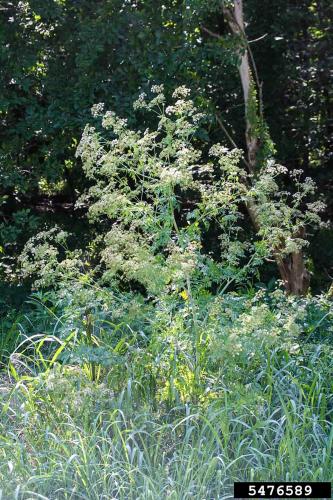








Fully grown, poison hemlock looks something like a gigantic Queen Anne’s lace, but with multiply compound, fernlike leaves. It’s common, nonnative, and highly poisonous. It is native to Europe, Asia, and the Mediterranean region.
Poison hemlock is a robust biennial plant: it takes two years to mature and bloom, spending its first year low to the ground, growing a rosette of leaves, then overwintering, then “bolting” the next growing season, sending up a tall stalk that produces flowers and seed, then dying.
Poison hemlock’s stalks can grow more than 9 feet tall. They are smooth, often covered with a white waxy coating that can be rubbed off, and are spotted or mottled with purple.
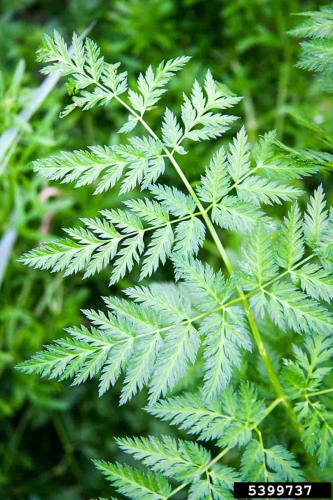
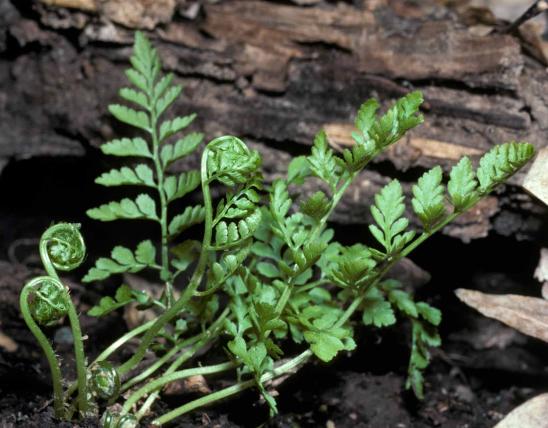
The leaves are fernlike. There are basal leaves (whorled) and stem leaves (alternate). All the leaves are compound and taper to a point; the leaves become progressively smaller up the stem. The lowest stem leaves can be up to 2 feet long, are generally oval or triangular in outline, and are three or four times pinnately compound, with long leaf stems that sheath the stalk at their bases. The highest stem leaves are nearly stalkless, only about 1 inch long, and only two or three times compound. The foliage has an unpleasant musty smell.
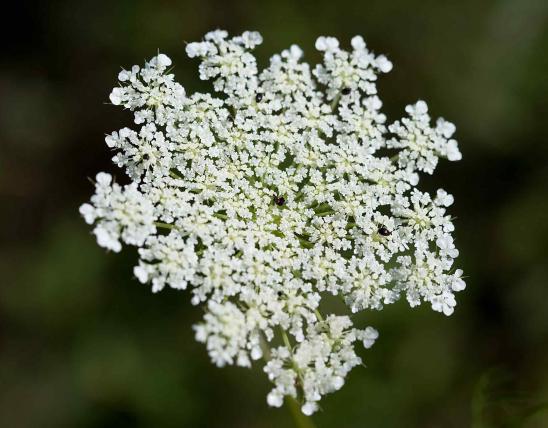
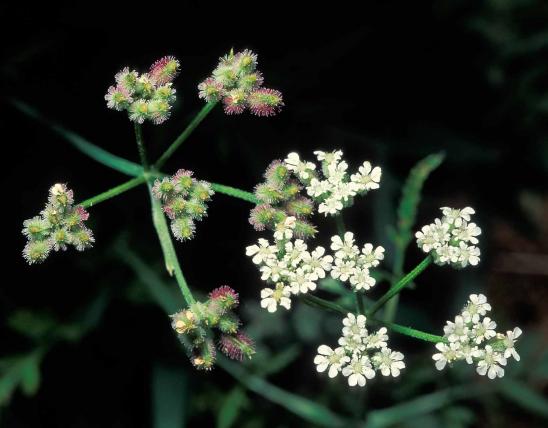
The flower clusters are typical of members of the carrot family: compound umbels, like an umbrella with a smaller umbrella attached to each spoke. The florets are minute, with white petals. The overall appearance is very similar to Queen Anne’s lace, except that Queen Anne’s lace has a purple floret at the center of each flower cluster, and poison hemlock’s florets are all white.
Blooms May–August.
- Because this plant is extremely toxic, while several close relatives are considered edible, correct identification is critical for anyone wishing to eat “wild edibles.” If you are inexperienced with plant identification, it is best to consider all wild members of the carrot family as potentially fatally toxic.
Similar species: There are several lookalikes in Missouri, some deadly toxic and some edible.
- Queen Anne’s lace (Daucus carota) is very common and grows in similar habitats. But its stems are hairy and lack purple markings, it rarely grows more than about 2 feet tall, and the leaflets of its compound leaves are mostly linear (narrow, like grass) (not fernlike). There is a purple floret in the center of each flower cluster. Also, each compound-umbel flower cluster has forked bracts at the base. The crushed leaves smell sweet, like carrot.
- Common water hemlock (Cicuta maculata) is closely related and is probably the most toxic plant in North America. It is common and native to Missouri. It doesn’t get quite as tall (reaching 6 feet) and is mostly associated with wet or moist habitats such as stream banks, edges of lakes and ponds, wetlands, ditches, and roadsides. Its compound leaves are quite different, especially with their rather large, lanceolate, toothed leaflets.
Height: 20 inches to nearly 10 feet.
Scattered to common nearly statewide.
Habitat and Conservation
Occurs along roadsides, railroads, ditches, pastures, fencerows, and other open, disturbed areas; in natural habitats, it can occur on banks of streams, rivers, and spring branches. It prefers damp or moist soils but can thrive in dry sites as well.
Poison hemlock starts to become conspicuous in late winter and early spring, when its big green rosettes of fernlike leaves start to “green up” on the ground. By May and June, these plants have bolted to 6 or even 10 feet tall. They often form thickets of tall, lacy-leaved, white-flowering plants, like gigantic specimens of Queen Anne’s lace.
Status
Nonnative, invasive plant; native to Eurasia and the Mediterranean region. Considered a weed; if ingested, it is fatally toxic to people and livestock. The sap can cause blistering and welts in contact with skin.
Human Connections
People who consume any part of this plant can be fatally poisoned, and when it comes in contact with the skin, the sap from this plant can cause blisters and welts. Be sure to use gloves, long sleeves, and eye protection when handling poison hemlock. Avoid inhaling the pollen of the plant.
Poison hemlock is a bane to livestock and crop farmers.
- All parts of the plant are poisonous if ingested, and cattle and horses are especially affected. Among other symptoms, respiratory paralysis, suffocation, and death can occur quickly — within only a few hours of ingestion. Horses may show symptoms within just 30 minutes.
- When pregnant cattle, sheep, goats, and pigs eat poison hemlock, they may give birth to offspring with deformed limbs.
- The first-year basal rosettes are apparently most palatable to livestock, while the mature plants with stalks seem less palatable. But poison hemlock can be accidentally included in hay mixtures.
- Each individual plant can produce up to 38,000 seeds. Consult University of Missouri Extension for recommendations for managing this weed. In general, farmers combat it with weeding, mowing, tilling, and herbicides.
- The best time to apply herbicides is during the first year of the biennial life cycle and early in the second growing season, when the plants are still only rosettes. Once the plants have bolted and are flowering and setting seed (in May and June), mowing and spot-spraying may be the best options. Mowing seed-bearing plants, however, disperses the seeds.
Now found nearly worldwide, poison hemlock was originally introduced to the United States in the early 1800s as — get this! — an ornamental garden plant touted as “winter fern.” Today, colonies of this highly toxic, nonnative plant are appropriately termed infestations. Poison hemlock is considered invasive in many states and provinces.
In ancient Greece, this species was used as a method for executing prisoners. The famous philosopher Socrates (470–399 BC), tried and convicted on political and religious grounds, was executed by being made to drink a poison hemlock potion. Socrates and his students (including Plato) were major founders of Western philosophy, and their influence resounds to this day. Upon his sentencing, Socrates reportedly said, “The unexamined life is not worth living”; this famous phrase endures as a reminder of the value of honest introspection and critical thinking.
Ecosystem Connections
As a nonnative plant, this species does little or nothing to help native plant and animal communities. Everywhere it grows, it takes the place where a native plant could have lived. Our native plants often have specialized relationships with their unique native pollinators, and with the insects specialized to chew their leaves. Our native birds are adapted to eat the native insects. All these components work together in functional ecosystems. Nonnative plants do not help, and often hurt, native ecosystems.
This toxic plant is apparently unpalatable to herbivorous mammals such as deer and rabbits, but ingesting just a small amount can prove fatal.
Several insects visit the flowers for nectar.
The caterpillars of black swallowtail butterflies are adapted to eat plants in the carrot-parsley family, including toxic ones such as native water hemlock. They can also eat the leaves of nonnative poison hemlock and transfer the toxicity to their own bodies; predators learn not to eat them, or any butterflies that look like them.
The toxic chemicals in poison hemlock are different from the ones that are in water hemlock.