










This 655-acre native prairie was purchased from Vaughn Lumpee in 1987. Mr. Lumpee ran a cattle operation on this area and he had a great fondness for the cowboy lifestyle.
Media

Safety Concerns
Name
Skin irritating
Scientific Name
Achillea millefolium
Family
Asteraceae (daisies, sunflowers)
Description
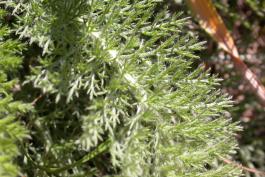
Common yarrow is an aromatic perennial with fine, hairy, fernlike leaves and flat-topped clusters of little white daisy-like flowers. Native to North America, Europe, and Asia, it has been used for medicine and magic for millennia.
Yarrow is an aromatic perennial, growing from a rhizome, with a simple or branching stem.
The composite flowerheads are minute, arranged in dense, flat-topped, terminal clusters; each small flowerhead is miniature sunflower or daisy-like arrangement, with tiny white (sometimes pink) ray florets surrounding tiny, light yellow or whitish disk florets. There are usually about 5 ray florets and 10–20 disk florets.
Blooms May–November.
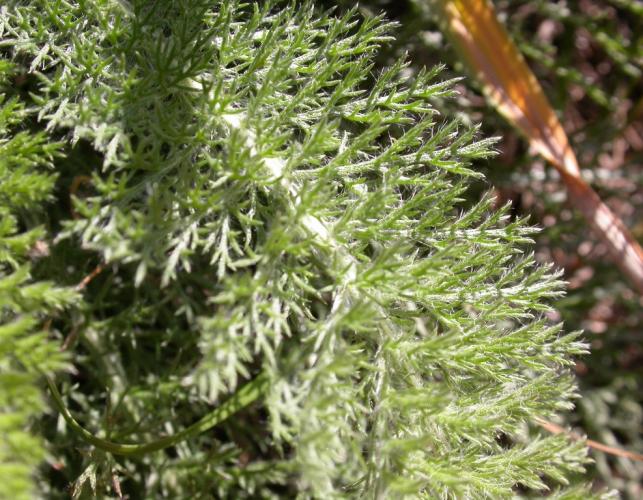
The leaves are alternate, finely dissected, fernlike, to 10 inches long, narrow-oblong. The odor is distinctively sweet and rather soapy, akin to the smell of chrysanthemums.
Several cultivars have been developed for the gardener, with a variety of flower colors.
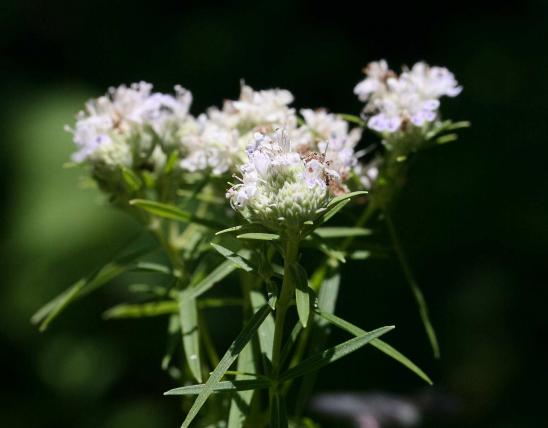
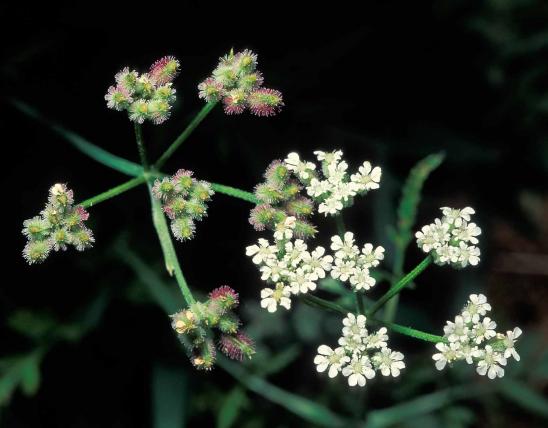
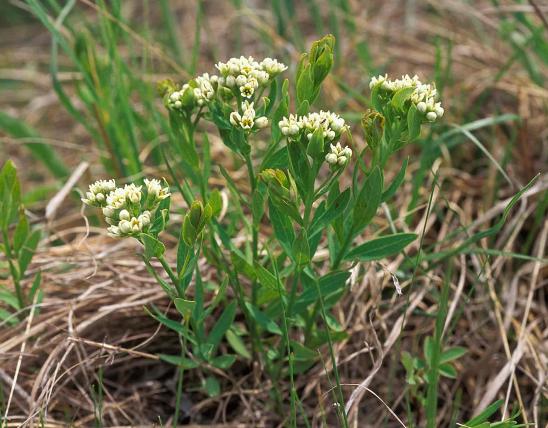
Similar species: Yarrow is an easy plant to identify, with its flattish clusters of tiny daisy-like flowers and finely dissected, unique-smelling foliage.
Size
Height: to 2½ feet.
Where To Find

Scattered nearly statewide.
Habitat and Conservation
Occurs in upland prairies, glades, openings of moist to dry upland woodlands; also in pastures, old fields, railroads, roadsides, and open, disturbed areas.
Some populations in Missouri may have been introduced.
Status
Wildflower native to North America and Eurasia. It has a long history as a medicinal herb. Today it is a popular ornamental plant, with numerous cultivated varieties.
Human Connections
With its strong odor and host of potent chemicals, yarrow has had many spiritual and medicinal uses in human cultures across the world, including China, Europe, and North America.
- In China, dried yarrow stalks were used for fortune-telling in the I Ching.
- Europeans long ago used it in magical amulets, love charms, healing spells, and clairvoyance.
- Ancient Greek soldiers used yarrow to stanch bleeding from battle wounds; such use continued up to the U.S. Civil War, where it was called "soldier's woundwort."
- Yarrow was found at a Neanderthal burial site in northern Iraq.
Yarrow can cause skin rashes in some people. Yarrow is thought to be toxic to pets and livestock (should they eat it).
Yarrow is a common garden perennial and is also a component of some wildflower seed mixes. It often becomes an aggressive plant that is difficult to control.
- Although yarrow's wild forms can be weedy in the home garden, many horticultural varieties have been developed that are easier to manage.
- Cultivated forms and hybrids offer attractive variations, such as yellow, pink, or red flowers.
- Yarrow is a good choice for native-plant gardening, naturalizing, and prairie plantings. It tolerates dry, sunny conditions and is a good wildflower for attracting butterflies.
With all its medicinal and magical uses, yarrow has a slew of nicknames, in various languages, going all the way back to Saxon, Classical Greek and Roman, and medieval times, and throughout Europe and North America.
- The common name "yarrow" is from the Old English word for the plant, gearwe, pronounced very similarly.
- The genus name, Achillea, refers to the mythical Greek hero Achilles, who supposedly used this herb to treat his soldiers' wounds.
- The species name, millefolium, is Latin for "thousand leaves," referring to the finely dissected, featherlike leaves. The common name "milfoil" is from this same source.
See Ecosystem Connections for ethnobotany information about the subfamily that contains yarrow and its closer relatives.
Ecosystem Connections
Researchers have found that some cavity-nesting birds, including starlings, line their nests with yarrow, whose aromatic chemicals may inhibit parasites.
Many insects visit the flowers for nectar and pollen, and others eat the leaves.
As with other plants that have big clusters of flowers, spiders and other small predators often lurk among the flowers, ready to capture insects drawn to the pollen and nectar.
Relatives: The sunflower, daisy, and aster family, the Asteraceae (aster-AY-cee-ee), is a huge family globally. Sometimes called the Compositae for the composite structure of its flowerheads, it comprises more than 32,000 species in more than 1,900 genera worldwide. Missouri has about 330 species in 104 genera.
Because it's such a large family, botanists divide the Asteraceae into subfamilies, or "tribes":
- Yarrow is in tribe Anthemideae. Others in this tribe include chamomile and wild chamomiles, wormwoods and mugworts (including absinthe), ox-eye daisy, and tansy. Chrysanthemums are in this tribe, too.
- Many plants in this tribe are aromatic (often unpleasantly), with leaves often lobed.
- Many have a long history of medicinal or culinary use: as healing herbs, herbal teas, and potherbs, in cosmetics and shampoos, and as a source of insecticides.
Title
Media Gallery
Image

Caption
Common yarrow is an aromatic perennial with fine, hairy, fernlike leaves and flat-topped clusters of little white flowers. Native to North America, Europe, and Asia, it has been used for medicine and magic for millennia.
Credit
MDC Staff
Right to Use
Photo by MDC Staff, courtesy Missouri Department of Conservation
Image

Caption
Yarrow is a perennial herb with finely dissected, fernlike leaves. It has an aromatic, spicy scent, distinctively sweet and rather soapy, akin to the smell of chrysanthemums.
Credit
Julianna Schroeder
Right to Use
Use of this image is restricted to MDC only
Image
Caption
The leaves of yarrow are distinctively scented. This plant occurs in fields, pastures, prairies, roadsides, waste places, and disturbed sites. Yarrow has a long history as a medicinal plant in China, Europe, and North America.
Credit
Julianna Schroeder
Right to Use
Use of this image is restricted to MDC only
Image

Caption
A yellow female flower crab spider (Mecaphesa sp.) eats a tiny insect on a blooming yarrow flower cluster, Tucker Prairie, May 23, 2021.
Credit
Julianna Schroeder
Right to Use
Use of this image is restricted to MDC only
Image

Image

Image
Image

Title
Similar Species
Similar Species
Media

Media

Media
Media

Media

Media
Media

Media
Media
Media

Media

Media
Media
Where to See Species
About Wildflowers, Grasses and Other Nonwoody Plants in Missouri
A very simple way of thinking about the green world is to divide the vascular plants into two groups: woody and nonwoody (or herbaceous). But this is an artificial division; many plant families include some species that are woody and some that are not. The diversity of nonwoody vascular plants is staggering! Think of all the ferns, grasses, sedges, lilies, peas, sunflowers, nightshades, milkweeds, mustards, mints, and mallows — weeds and wildflowers — and many more!