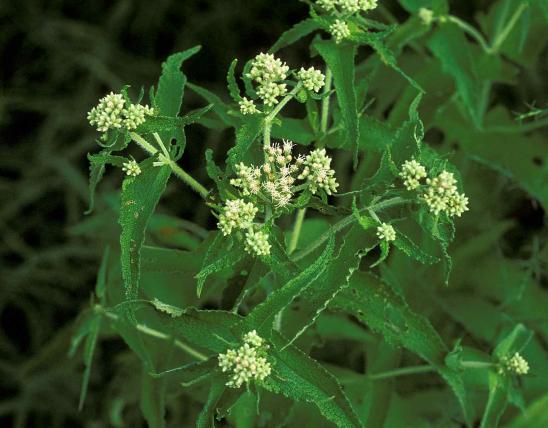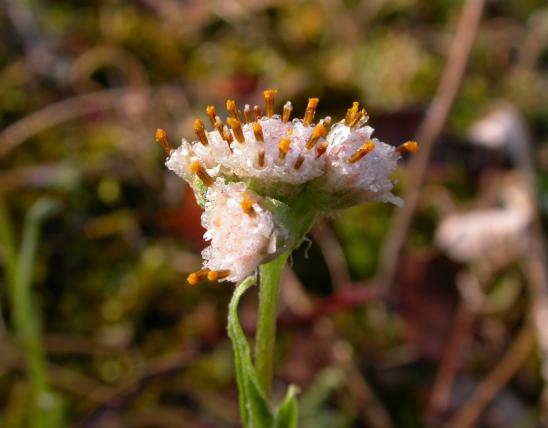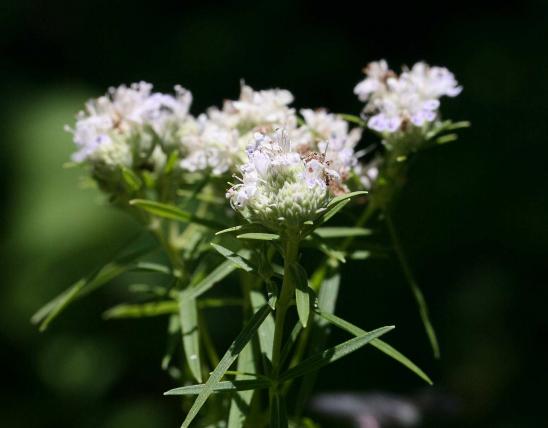








Nine white-flowering species of thoroughworts, or bonesets, have been recorded for Missouri. They are in genus Eupatorium (yoo-puh-TOR-ee-um). This page introduces them as a group.
The plants are upright, single-stemmed or few-stemmed perennials with fibrous, sometimes fleshy roots. When they branch, it’s usually at the top of the plant.
The flowers are white or grayish and occur in flat-topped or domed clusters. The small flowerheads contain disk florets but no petal-like ray florets. The thin, threadlike styles usually protrude, giving the flowers a furry appearance from a distance.
- Bloom time helps identify thoroughworts as a group: Most start blooming in August and continue into October or November.
When the flowers are mature, the fruits (achenes) are topped with numerous thin hairlike bristles, making the flowerheads look furry or fuzzy (they are similar to those of dandelions, but without a thin stalk separating the “seed” from the “parachute”).
The leaves are mostly opposite (the ones at the top of the stalk may be alternate), usually with toothed margins, usually with 3 main veins.
- Leaf shape, leaf stalks, and configuration of the leaf veins can be useful for identification.
Missouri has nine species in genus Eupatorium, interchangeably called thoroughworts or bonesets. Only four species are fairly common.
The following list has our more common or widespread species at the top, with the rarer or less widespread ones at the bottom. See Ecosystem Connections for summaries of these species.
- Tall thoroughwort (E. altissimum)
- Late boneset (E. serotinum)
- American boneset (or common boneset, or American thoroughwort, E. perfoliatum)
- Upland boneset (E. sessilifolium)
- Hyssop-leaved thoroughwort (E. hyssopifolium var. calcaratum)
- Smallflower thoroughwort (E. semiserratum)
- Round-leaved boneset (E. rotundifolium var. scabridum)
- Dog fennel (E. capillifolium)
- White thoroughwort (E. album)
Similar species: The daisy/sunflower family is so large that botanists have divided it into several subgroups called tribes. Thoroughworts are the banner members of tribe Eupatorieae. None of them have petal-like ray florets, so their flowers look fuzzy. You may already know some of them, but others are worth learning about. See Ecosystem Connections to get introduced to this tribe.
Height: Tall boneset and late boneset, our tallest native thoroughworts, can reach 6½ feet, but usually only are about 3 or 4 feet tall.
Most of the our other species reach only about 4 feet, maximum.
Statewide. Different species have different distributions within the state.
Habitat and Conservation
Each species has its own preferred habitats, but most live in open, sunny situations such as prairies, glades, open woodlands, old fields, pastures, roadsides, and places with disturbed soils. Many species also prefer moist soils, such as bottomland forests, stream banks and river banks, ditches, and so on.
As you might expect, the most common and widespread species — tall thoroughwort, American boneset, late boneset, and upland boneset — are generally the least finicky about habitat. Some are considered garden weeds.
Status
Eight of our nine species are native Missouri wildflowers.
- Dog fennel (E. capillifolium), which has been found growing in rail yards in the St. Louis area, is not native to Missouri. It is native to the eastern United States, where it's often considered a weed.
Three of our thoroughworts are Missouri species of conservation concern:
- Smallflower thoroughwort (E. semiserratum), imperiled to critically imperiled
- Round-leaved thoroughwort (E. rotundifolium), probably critically imperiled
- White thoroughwort (E. album), recently discovered in our state, is unranked, requiring more information. See Ecosystem Connections below for theories to explain the presence of this and other species with small populations in our state.
Our more common thoroughworts are generally considered undesirable in pastures, as livestock do not eat them due to their bitter flavor.
- The related and similar-looking white snakeroot (Ageratina altissima), once considered a member of this genus, is definitely unwelcome, as it is toxic enough to cause livestock and even human death.
- The visual similarity of thoroughworts to white snakeroot casts an unfavorable light on all of them.
Gardeners may consider thoroughworts weeds, or they may cultivate them as showy, easily cultivated native wildflowers that are pollinator-friendly.
Human Connections
Some species of thoroughworts can be grown in rain gardens, borders, native plant or woodland gardens, or other naturalized settings, and as cut or dried flowers.
- In the landscape, they offer showy flower clusters late in the season and attract butterflies and other pollinators.
- Deer don’t like to eat them.
- They tend to self-seed.
- Some suggested species include American boneset (E. perfoliatum) and tall thoroughwort (E. altissimum).
- Some cultivars have been developed especially for landscape plantings.
Thoroughworts, as a group, usually have been used historically for a variety of medicinal purposes wherever they occur.
- The name “boneset” apparently refers to some of these uses; some people say it comes from a belief that the plants could be used as a so-called bone strengthener.
- Another theory for the name is that at least one species had been used to treat dengue fever (also called breakbone fever), which causes severe joint pain.
- Like many other plants with historical medicinal uses, eupatoriums contain compounds that are toxic to people, livestock, and most other animals that eat them.
Because of their varying levels of toxicity and their bitter taste, livestock usually avoid eating thoroughworts, so these plants tend to increase in heavily grazed pastures as the animals prefer to eat other plants.
Why the name “thoroughwort”? Apparently, it comes from the species American boneset, E. perfoliatum, with its perfoliate leaves. With each pair of leaves joined at the bases, the stem appears to go through the “leaf.”
- In the past, the words “through” and “thorough” were not so sharply different in meaning. (Think of the word “thoroughfare,” for example.)
The genus name, Eupatorium, was created by Linneaus in reference to Mithradates VI Eupator (135–63 BC), an Anatolian ruler. Eupator was famous for supposedly making himself immune to poisons by gradually and regularly ingesting small amounts of various toxins.
Ecosystem Connections
Like goldenrods, ironweeds, native asters, and many other composites that produce big clusters of flowers late in the season, thoroughworts attract a wide array of pollinators — butterflies, bees, wasps, flies, beetles, and more.
- The presence of these insects makes them a hunting ground for many kinds of spiders, assassin bugs, robber flies, and other predators.
- Insect-eating birds also visit the flower clusters for food.
In addition to being a meeting place for insect diners, thoroughworts and other wildflowers that offer big clusters of flowers are also a place for insect courtship and mating.
Many kinds of insects — beetles, flies, true bugs, butterflies, moths, grasshoppers, and more — eat the leaves, stems, roots, or sap of thoroughworts.
- Some insects prefer to eat the flowerheads.
- Other tiny insects mine the leaves, eating their way through the juicy inner layers, leaving pale, squiggly tunnels visible from above and below.
- Some insects bore into the roots.
- Some lay eggs in the stems, and their developing larvae cause swellings (galls) on the stems.
- In some cases, certain species of insects are restricted to a single species of thoroughwort.
White thoroughwort (E. album) has recently been discovered growing in Missouri. How did it get here?
- Like hyssop-leaved thoroughwort and round-leaved boneset, it might be appearing in our state as part of a natural northward expansion of its range due to changing climate patterns and increased opportunities for dispersal (such as movement along highways).
- An alternative explanation is that these plants might be relicts that continue to survive as small populations from the past. White thoroughwort may be a survivor of the open pineland habitat that used to be common in the eastern Ozarks.
If you've read this far, you might want brief descriptions of all nine of Missouri's thoroughworts:
- Tall thoroughwort (E. altissimum). Stems and leaves with short white hairs. Leaves are lance shaped or narrowly oval, often sessile, to about 5 inches long and 1 inch wide, usually with teeth along the outer half. Three noticeable main veins extend the length of the leaf, starting from the base of the leaf blade. Flowerheads contain 5 florets. Blooms August–October. Most likely to be confused with late boneset (statewide) and smallflower thoroughwort (occurs in the Bootheel). Scattered statewide.
- Late boneset (E. serotinum). Stems and leaves usually with short hairs. Leaves are lance shaped or ovate, often angled at the base, with definite leaf stalks, tapered to a sharply pointed tip, with sharp, often coarse teeth along the margins. Main veins 3 (sometimes 5), branching from the middle vein at the base of the leaf blade. Flowerheads contain 9–15 florets. Blooms August–October. Most likely to be confused with tall thoroughwort or white snakeroot (Ageratina altissima). Scattered statewide.
- American boneset (or common boneset, or American thoroughwort, E. perfoliatum). Easily identified by its perfoliate leaves: opposite, stalkless leaves that are fused together across the stem, making them look like a single leaf that has been pierced by the stem. Leaves are roughened or felty to the touch and may be up to 8 inches long and 2 inches wide; there is only 1 main vein. Also note its greener color (it’s not as grayish as tall thoroughwort and late boneset); the plant usually has fine, short hairs. Flowerheads contain 9–23 florets. Blooms July–October. Scattered statewide.
- Upland boneset (E. sessilifolium) has the stems (below the flower clusters) and leaves hairless (glabrous). Leaves are stalkless (sessile), lance-shaped to narrowly ovate, tapering to a sharply pointed tip, the margins sharply toothed. Blades to 7 inches long, 2½ inches wide. Leaf bases typically rounded; in pairs of opposite leaves, the bases often overlap slightly. There is only 1 main vein (the midvein). Flowerheads contain 5 (sometimes to 7) florets. Blooms July–September. Scattered in the Ozarks, Ozark border, and the eastern half of northern Missouri.
- Hyssop-leaved thoroughwort (E. hyssopifolium var. calcaratum) has stems dark purple or brown. Leaves are mostly stalkless, mostly whorled in fours (not in pairs), linear to narrowly oblong, to about 2 inches long and ¼ inch wide. Flowerheads contain 5 florets. Blooms August–November. Uncommon in our state, mostly in the eastern Ozarks.
- Smallflower thoroughwort (E. semiserratum) has leaves much like tall thoroughwort, having the teeth mostly above the midpoint. However, the 2 side veins branch from the midvein well above the base of the leaf blade. Flowerheads contain 5 florets. Blooms August–October. Uncommon in our state, occurring mostly in the Bootheel lowlands.
- Round-leaved boneset (E. rotundifolium var. scabridum) has stalks purplish brown and short-hairy. Leaves are stalkless or with only short leaf stalks; blades are ovate to broadly ovate to nearly circular, to about 2 inches long and 1¼ inches wide, the margins sharply toothed, and with 3 main veins: the 2 side veins branch away from the midvein slightly away from the base of the blade. Flowerheads contain 5 florets. Blooms August–November. Uncommon in our state, having been found in Butler, Carter, and Ripley counties (southeast Missouri).
- Dog fennel (E. capillifolium) has white, greenish-white, or cream-colored flowers in clusters along the upper stems (not in flat-topped or dome-shaped clusters) and has distinctive leaves, very unlike our other thoroughworts: they are threadlike, like the leaves of fennel or dill. It can possibly reach 8 feet tall, but in Missouri it is rarely encountered in natural settings. Blooms August–October. This species is native to coastal states to our east and south; in those places, it’s a problem weed in pastures, and it is toxic to livestock if eaten. As an introduced species in our state, it’s been collected only from the St. Louis area, in rail yards.
- White thoroughwort (E. album) has recently been discovered in a restored pine forest area in Missouri’s southeastern Ozarks (Carter County). It is similar to smallflower thoroughwort but has long, thin, narrow-pointed bracts at the base of the flowerheads (while smallflower thoroughwort has bracts that are oval to narrowly oblong and rounded or bluntly pointed on the tips). On both, the margins of the bracts are thin and pale.
Relatives: The daisy/sunflower family is so large that botanists have divided it into several subgroups called tribes. Thoroughworts are the banner members of tribe Eupatorieae (yoo-puh-TOR-ee-ee). In Missouri, this tribe includes:
- White snakeroot (Ageratina altissima), which looks very similar to the thoroughworts but has triangular leaf blades that are more broadly angled or rounded at the base (not as narrow/lanceolate as in thoroughworts). White snakeroot is common statewide and used to be called Eupatorium rugosum. It’s a toxic plant if eaten, so it’s good to be able to identify it.
- Brickell bushes (Brickellia spp.), which have cream-colored to greenish-yellow flowers. Missouri has two species.
- False boneset (B. eupatorioides) has cream-colored flowers in flowerheads with narrowly cylindrical bases; the leaves are narrow, alternate, and have only one obvious vein and only a few, coarse teeth. Scattered nearly statewide, mostly in prairies, pastures, and other open habitats. Could be confused with tall thoroughwort.
- Tassel flower (B. grandiflora) has mostly opposite, triangular or heart-shaped leaves. Its bell-shaped flowerheads nod (droop) distinctively, making it look something like a thoroughwort that needs water. Scattered mostly in the Ozarks, occurring on glades, bluff edges, especially on limestone and dolomite substrates.
- Climbing hempweed (Mikania scandens) resembles thoroughworts with its opposite, toothed leaves and clusters of fuzzy-looking white flowers, but it is a nonwoody vine with twining stems. It is scattered in the Bootheel lowlands, occurring in swamps, bottomland forests, banks of ponds and streams, ditches, and other moist places.
- Joe-Pye weeds (Eutrochium spp.), until about 2000, were considered part of genus Eupatorium, but now they have their own genus. They have pinkish or purplish-tinged flowers (not white), and their leaves are usually in whorls on the stem (not opposite). Missouri has 3 species.
- Pink thoroughwort (Fleischmannia incarnata) occurs mostly in the Bootheel lowlands, where it’s uncommon in swamps, ditches, and other moist places. It often reclines on nearby vegetation and has purple or lavender-blue flowers.
- Blazing stars (or gayfeathers, Liatris spp.) are in this tribe, too, with 9 species in Missouri. They are upright, unbranching plants with vivid magenta flowerheads sessile and clustered along the tops of the unbranching stalks.
- Mist flower (blue boneset or wild ageratum, Conoclinum coelastinum), a perennial with fluffy-looking pale purple flowers, is scattered mostly in the southern half of Missouri.