








The Southern Plains bumblebee is one of several species of bumblebees that occur in Missouri. It is a species of conservation concern, closely tied to native prairie habitats.
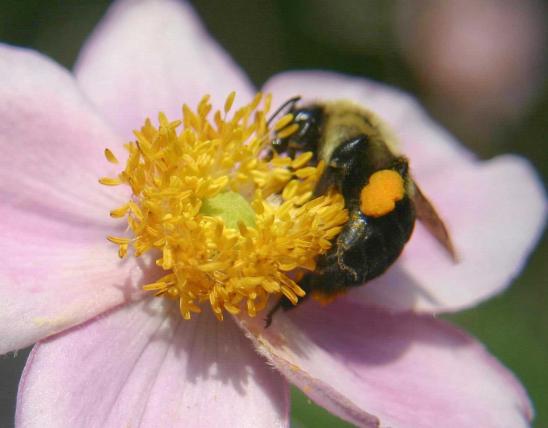
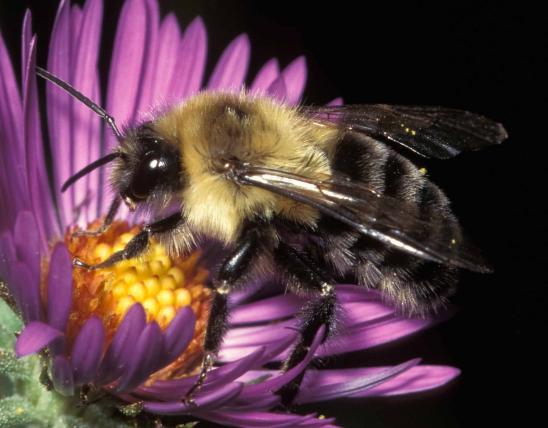
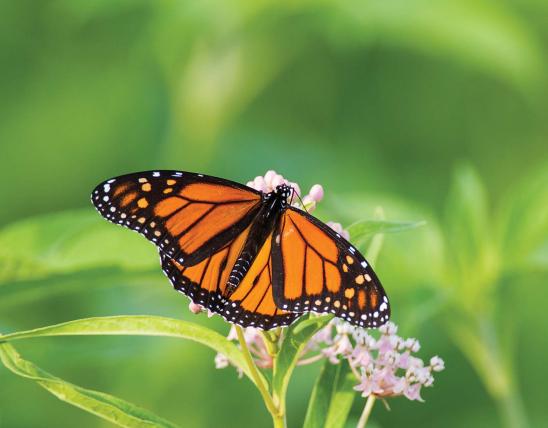
Like other species of bumblebees, they are large fuzzy or hairy bees. Bumblebees (genus Bombus) always have some fuzz on the abdomen. Females have pollen baskets on the last pair of legs.
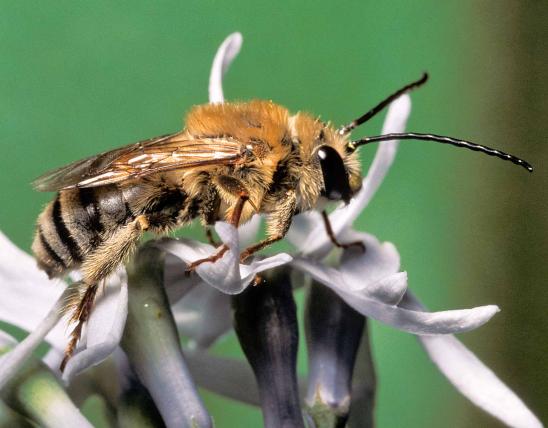
As with other bumblebee species, the (female) workers, queens, and males can look different. Because the queens and males aren’t seen as frequently as the workers, identifications usually focus on the workers.
- The fastest way to determine the species of Missouri’s bumblebees is to look at the color patterns of the hairs on the head, the thorax, and the abdominal segments (the abdomen is the third, obviously segmented, part of the body, behind the head and thorax; the abdominal segments are called tergites). The first abdominal segment, closest to the thorax, is called “T1” for “tergite 1.” The second segment is “T2,” etc. Female bumblebees (workers and queens) have six tergites; males have seven.
To distinguish worker Southern Plains bumblebees from other Missouri bumblebees, view the insect from above, and look at the hairs on the abdomen: note that T1 and T2 are both covered with yellow hairs that are appressed (lay flat against the body) and do not appear fluffy. The rest of the abdomen segments are black.
Also note that the bare dark area that develops on the thorax (between the wing bases) is a broad black line stretching from wing base to wing base (not a circle).
Learn more about bumblebees (genus Bombus) on their group page.
Learn more about bumblebees and other apid bees (family Apidae) on their family page.
Body length (not counting appendages): ½ to ¾ inch (workers); ⅞ to 1 inch (queens); ¾ inch (males).
Statewide, in appropriate habitats.
Habitat and Conservation
Named after the Southern Great Plains, this bee is noted for its preference for native prairies and other open habitats with plenty of wildflowers. In Missouri, it is usually only found in native prairie habitats.
Historically, this species had a wide distribution across the eastern United States and into northeastern Mexico, but its numbers have been declining and its range contracting. Loss of habitat is one reason for the decline: nearly all of our continent’s native prairie habitats have been converted into agriculture. The decline has been ongoing since the early 20th century.
Food
This bumblebee has a relatively short tongue, compared to other bumblebee species. It has a more limited range of preferred nectar plants — ones especially found in prairies — meaning it is restricted to native prairies. Favorite flowers include milkweeds, coneflowers, ironweeds, blazing stars, goldenrods, native peas, and clovers.
Status
Native Missouri bee. A Missouri species of conservation concern. Has been proposed as a federally endangered species.
Human Connections
Some plants can only be pollinated by bumblebees. This species, in particular, is tied closely to native prairie habitats, which can feature hundreds of plant species even within a few square yards.
The Missouri Bumble Bee Atlas is a statewide community science project aimed at tracking and conserving Missouri's native bumblebees. Learn how you can participate in this program, and download a free training packet, including a quick identification guide to Missouri's bumblebees, on its website. MDC is one of the sponsors of this citizen-science initiative.
Considering that many bumblebees are declining, if you find a bumblebee nest on your property, leave it alone and consider yourself lucky. Watch the bumblebees over the course of the season; take pictures!
Bumblebees are capable of stinging, if molested or if their nest is endangered. Although they are social insects and will defend their nest if they sense it is endangered, they are not aggressive.
Ecosystem Connections
In addition to the plants they pollinate, bumblebees have many interrelationships with organisms that most of us are scarcely aware of — their predators, their parasites, and the many non-stinging insects that can survive, in part, because they mimic bumblebees. All of these have their own roles in the chain of life.
Holes in the ground are easy to overlook, but they are an important home for many animals, often a succession of them. A hole may begin as the system of rotted taproots from a large tree that has died. In addition to bumblebees, rodents, shrews, gartersnakes, yellowjackets, and many other animals take advantage of these ready-made basement apartments.