











The American bumblebee used to be common across most of the eastern United States, but its numbers have declined drastically, and it is now a species of conservation concern.
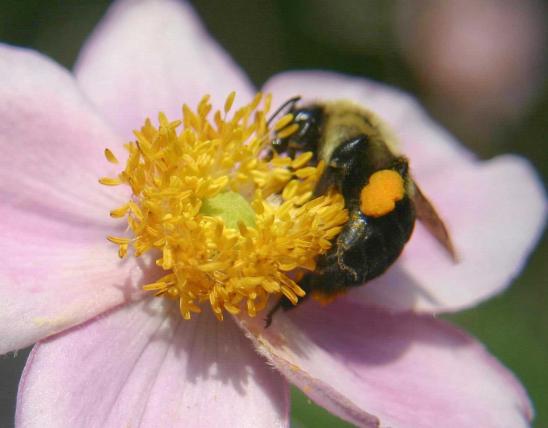
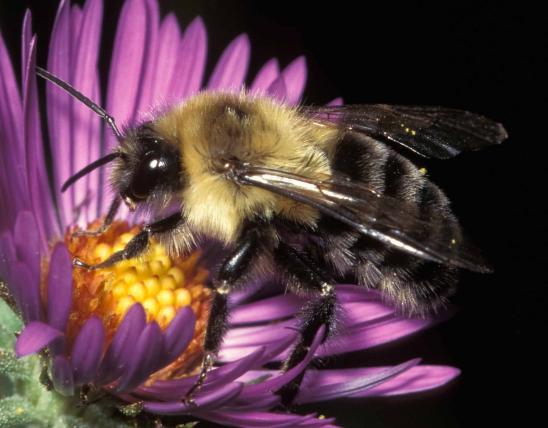
Like other species of bumblebees, they are large fuzzy or hairy bees. Bumblebees (genus Bombus) always have some fuzz on the abdomen. Females have pollen baskets on the last pair of legs.
As with other bumblebee species, the (female) workers, queens, and males can look different. Because the queens and males aren’t seen as frequently as the workers, identifications usually focus on the workers.
- The fastest way to determine the species of Missouri’s bumblebees is to look at the color patterns of the hairs on the head, the thorax, and the abdominal segments. The abdomen is the third, obviously segmented, part of the body, behind the head and thorax; the abdominal segments are called tergites. The first abdominal segment, closest to the thorax, is called “T1” for “tergite 1.” The second segment is “T2,” etc. Female bumblebees (workers and queens) have six tergites; males have seven.
To distinguish worker American bumblebees from other Missouri bumblebees, view the insect from above, and look at the hairs on the abdomen: note that T1 often has the front half of that segment with black hairs, and the hind half with yellow hairs. The next two abdominal segments (T2 and T3) are yellow, and the end of the abdomen is black.
Also note that the hairs on the top of the head are black (not yellow).
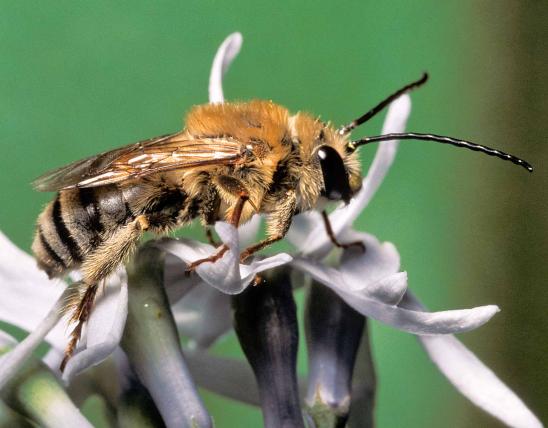
Males are often seen; they are relatively slender and long, with almost all yellow hairs except for a black bar on the thorax stretching between the wing bases, and dark, hairless lines visible between the abdominal segments. Sometimes the final abdominal segment (T7) is orange instead of yellow.
Learn more about bumblebees (genus Bombus) on their group page.
Learn more about bumblebees and other apid bees (family Apidae) on their family page.
Similar species:
- The black and gold bumblebee (Bombus auricomus) is similar, but its T1 abdominal segment is usually all black (though it may have yellow on the sides); also, the hairs on the top of its head are yellow (not black). The black and gold bumblebee is relatively common in Missouri.
- Male yellow bumblebees (Bombus fervidus) resemble male American bumblebees, but the hair colors on the thorax and T7 can be used for distinguishing them. Yellow bumblebees are critically imperiled in Missouri.
Body length (not counting appendages): ⅝ to ¾ inch (workers); ¾ to 1 inch (queens); ⅝ to ⅞ inch (males).
Statewide.
Habitat and Conservation
As with most other bumblebees, this species is associated with grasslands, pastures, and other wide, sunny areas with plenty of wildflowers.
The American bumblebee used to be one of the most common and widespread bumblebees in the eastern and southeastern United States, but its range has contracted rapidly and drastically in the northern portions. See Human Connections for some of the presumed causes for the decline.
Food
This bumblebee is long-tongued, which means it can reach into long-throated flowers for nectar. It also means this species is important for pollinating these flowers, which shorter-tongued bees cannot access. Examples include both native wildflowers and agricultural crops, particularly in the bean and sunflower families.
Other flowers that American bumblebees pollinate include members of the mint family, squash/cucumber family, iris family, rose/apple family, hibiscus/cotton family, morning glory family, potato/tomato family, and evening primrose family.
Foraging American bumblebees may venture as much as one and a half miles away from the nest, which is relatively far for bumblebees.
Status
Native Missouri bee. A Missouri species of conservation concern. Has been proposed to be listed as a federally endangered species. The North American population declined nearly 90 percent between 2000 and 2020.
Life Cycle
This bumblebee may build its nests in a variety of locations, typically in grasslands but also in burrows, including old rodent burrows, underground. It may also nest in hay bales, old bird nests and bird houses, and barns.
Freshly hatched queens mate with males in summer, hibernate through winter, and emerge in early spring. The rest of the colony dies at the onset of winter.
In early spring, the queen becomes active, locates an acceptable nest site, gathers pollen and nectar, and begins laying eggs. The first eggs to hatch will all develop into female workers. Upon hatching, the young are grublike larvae. They eat the pollen and nectar, then pupate; they emerge as winged adult worker bees that perform most of the tasks for the colony: caring for the young, foraging, maintaining the nest, defending the colony, and so on. With workers to take care of those activities, the queen can focus on laying eggs. By late summer, a hive of this species can have 200 workers.
In midsummer, the queen begins to lay eggs that will become reproductive females (queens) and males. In July or August, males mate with freshly hatched queens, which will hibernate through the winter until spring.
Human Connections
This species’ numbers declined nearly 90 percent in North America between 2000 and 2020. The dramatic decline is strongly related to human activities:
- Historical and ongoing conversion of native grasslands into crop fields and low-diversity pastures.
- Current agricultural trends that eliminate thickets, hedgerows, and the diverse wildflowers they contain, in favor of vast unbroken tracts of “clean” crop fields. (This farming change has affected a wide range of other pollinators, such as monarch butterflies.)
- Commercial and residential development that replaces native or rural habitats.
- Pesticides, intended for crop pests, harm bees and other nontarget species.
- Neonicotinoids (“neonics”) are a type of pesticide that is drawn into a plant’s tissues, making the plant itself toxic. The idea is that insects that chew the leaves or suck the plant’s juices will die. However, the toxin also enters the nectar and pollen that bees and butterflies eat, and these nontarget pollinators are gradually poisoned. These systemic pesticides were introduced in our country in the 1990s and are commonly used on ornamental garden flowers such as bedding plants and in hanging baskets. Check labels before you buy.
- Commercial greenhouses often utilize domestically reared bumblebees for pollination; these greenhouse bees can carry diseases, escape, then transmit the disease to populations of wild bees.
The Missouri Bumble Bee Atlas is a statewide community science project aimed at tracking and conserving Missouri's native bumblebees. Learn how you can participate in this program, and download a free training packet, including a quick identification guide to Missouri's bumblebees, on its website. MDC is one of the sponsors of this citizen-science initiative.
Considering that many bumblebees are declining, if you find a bumblebee nest on your property, leave the nest alone and consider yourself lucky. Watch the bumblebees over the course of the season; take pictures!
Bumblebees are capable of stinging, if molested or if their nest is endangered. Although they are social insects and will defend their nest if they sense it is in danger, they are not aggressive.
Ecosystem Connections
Long-tongued bees play important roles in pollinating many kinds of flowers that have evolved to rely on them to transfer pollen from one plant to another. Flowers and pollinators both benefit from their mutual specialization; each has exclusive access to a food source or service. Bees have special access to pollen and nectar that other insects can’t reach, and the flowers have a special insect that focuses only on them.
In addition to the plants they pollinate, bumblebees have many interrelationships with organisms that most of us are scarcely aware of — their predators, their parasites, and the many non-stinging insects that can survive, in part, because they mimic them. All of these have their own roles in the chain of life.
- Skunks, raccoons, and birds are some of the vertebrate predators that eat bumblebees. Camouflaged crab spiders and ambush bugs lie in wait on flowerheads, ready to snatch bees as they alight to gather pollen and nectar.
- Bees and wasps developed the same palette of colors that communicate their ability to sting. Once stung, a predator will hesitate before attacking anything that looks like whatever produced the sting. Also, many harmless, nonvenomous insects such as flies, beetles, and moths, have evolved colors, shapes, and hair patterns to resemble bees and wasps, because that appearance allows them to survive and reproduce.
- Robber flies zoom at bees like hawks, grasping and biting them and sucking their juices. One species, called the Florida bee killer (or Florida beebandit, Mallophora bomboides), preys on bees but also looks specifically like the American bumblebee. It has been suggested that this bee-mimic fly may be both a Batesian mimic (defensively protected from predation) and an aggressive mimic, like a wolf in sheep’s clothing, as it hunts the species it mimics.
Holes in the ground are easy to overlook, but they are an important home for many animals, often a succession of them. A hole may begin as the system of rotted taproots from a large tree that has died. In addition to bumblebees, rodents, shrews, gartersnakes, yellowjackets, and many other animals take advantage of these ready-made basement apartments.