










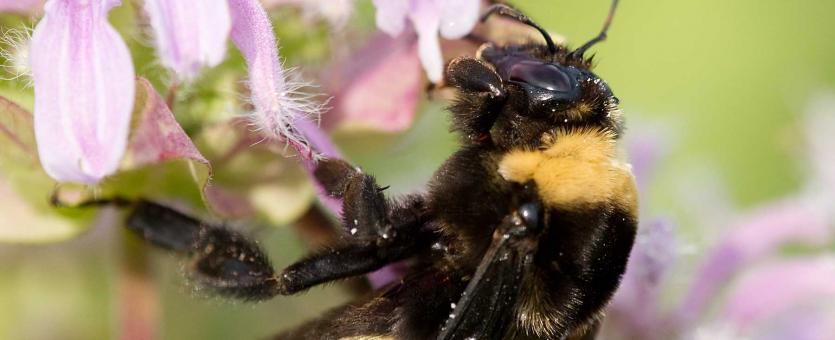
The black and gold bumblebee is associated with prairies and other grasslands. Its color pattern is distinctive. A colony usually only comprises a queen and about 35 workers.
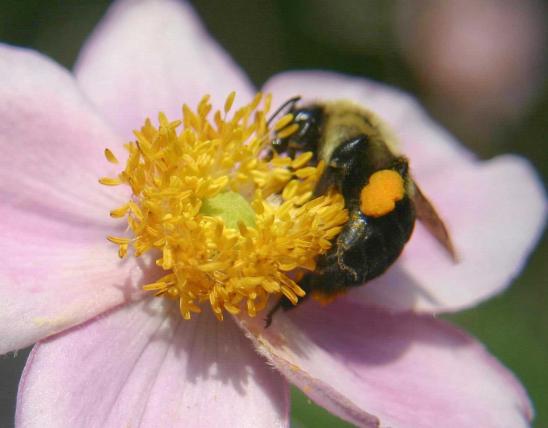
Like other species of bumblebees, they are large fuzzy or hairy bees. Bumblebees (genus Bombus) always have some fuzz on the abdomen. Females have pollen baskets on the last pair of legs.
As with other bumblebee species, the (female) workers, queens, and males can look different. Because the queens and males aren’t seen as frequently as the workers, identifications usually focus on the workers.
- The fastest way to determine the species of Missouri’s bumblebees is to look at the color patterns of the hairs on the head, the thorax, and the abdominal segments (the abdomen is the third, obviously segmented, part of the body, behind the head and thorax; the abdominal segments are called tergites). The first abdominal segment, closest to the thorax, is called “T1” for “tergite 1.” The second segment is “T2,” etc. Female bumblebees (workers and queens) have six tergites; males have seven.
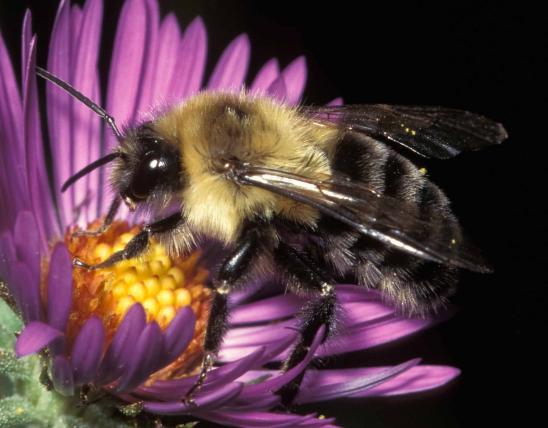
To distinguish worker black and gold bumblebees from other Missouri bumblebees, view the insect from above, and look at the hairs on the abdomen: note that T1 is covered with black hairs (although it can have yellow on the sides of that segment). Then, note that T2 and T3 are yellow, and the end of the abdomen black. Also, the top of the head has yellow hairs (not black). The thorax is mostly black, except for yellow at the forward portion, as seen from above.
Learn more about bumblebees (genus Bombus) on their group page.
Learn more about bumblebees and other apid bees (family Apidae) on their family page.
Similar species: The American bumblebee (Bombus pensylvanicus) is a species of conservation concern and looks quite similar. Its T1 segment often has the front half with black hairs and the hind half with yellow hairs (instead of all black, as viewed from above). Also, the hairs on the top of its head are black (not yellow).
Body length (not counting appendages): ¾ to ⅞ inch (workers); ⅞ to 1 inch (queens); ¾ to ⅞ inch (males).
Statewide.
Habitat and Conservation
Like most other bumblebees, this species is usually found in native prairies and other grasslands, as well as pastures, roadsides, flower gardens, and other open areas with plenty of various flowers, especially native wildflowers. They are not generally found in wooded areas.
Status
Native Missouri bumblebee.
Human Connections
The Missouri Bumble Bee Atlas is a statewide community science project aimed at tracking and conserving Missouri's native bumblebees. Learn how you can participate in this program, and download a free training packet, including a quick identification guide to Missouri's bumblebees, on its website. MDC is one of the sponsors of this citizen-science initiative.
Considering that many bumblebees are declining, if you find a bumblebee nest on your property, leave the nest alone and consider yourself lucky. Watch the bumblebees over the course of the season; take pictures!
Bumblebees are capable of stinging, if molested or if their nest is endangered. Although they are social insects and will defend their nest if they sense it is endangered, they are not aggressive.
Ecosystem Connections
Native bees play important roles in pollinating many kinds of flowers that have evolved to rely on them to transfer pollen from one plant to another. Flowers and pollinators both benefit from their mutual specialization; each has exclusive access to a food source or service. Bees have special access to pollen and nectar that other insects can’t reach, and the flowers have a special insect that focuses only on them.
In addition to the plants they pollinate, bumblebees have many interrelationships with organisms that most of us are scarcely aware of — their predators, their parasites, and the many non-stinging insects that can survive, in part, because they mimic them. All of these have their own roles in the chain of life.