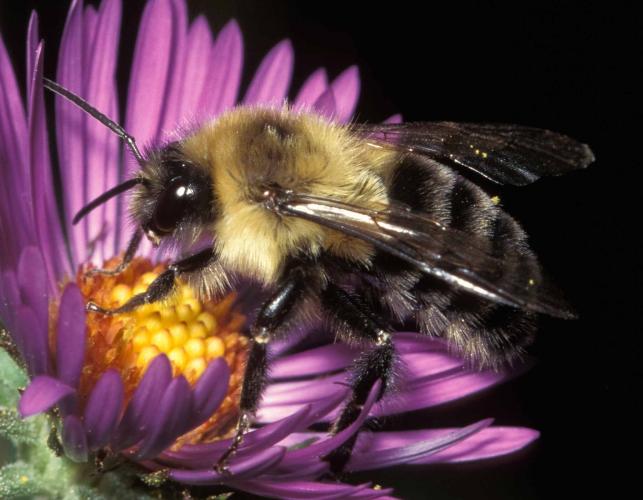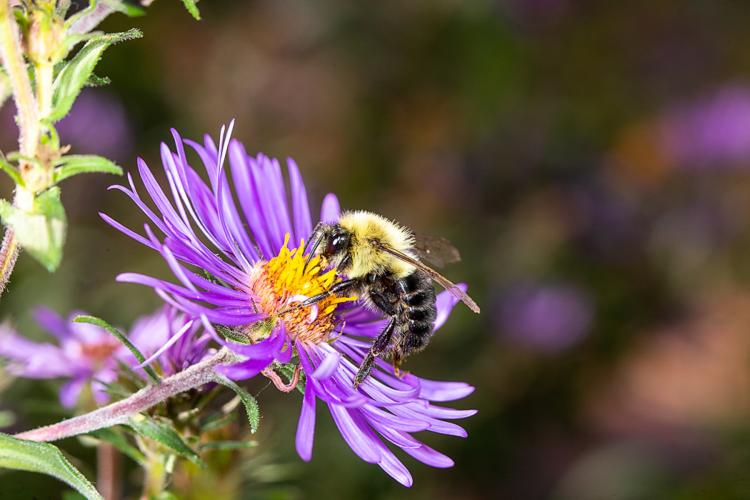













The common eastern bumblebee is widespread in the eastern United States. It is widely used in greenhouses as a pollinator and has unusually large colonies (for a bumblebee species). Look for them visiting goldenrods and asters in late summer.
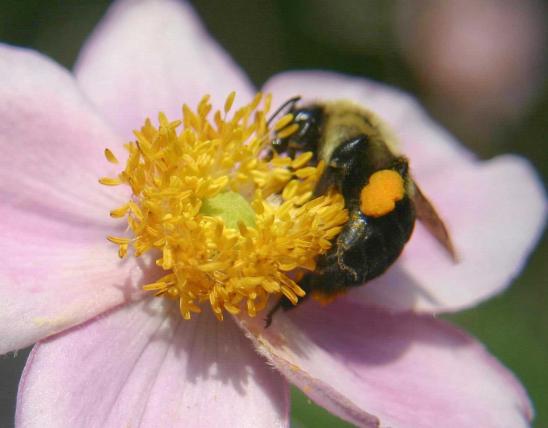
Like other species of bumblebees, they are large fuzzy or hairy bees. Bumblebees (genus Bombus) always have some fuzz on the abdomen. Females have pollen baskets on the last pair of legs.
As with other bumblebee species, the (female) workers, queens, and males can look different. Because the queens and males aren’t seen as frequently as the workers, identifications usually focus on the workers.
- The fastest way to determine the species of Missouri’s bumblebees is to look at the color patterns of the hairs on the head, the thorax, and the abdominal segments (the abdomen is the third, obviously segmented, part of the body, behind the head and thorax; the abdominal segments are called tergites). The first abdominal segment, closest to the thorax, is called “T1” for “tergite 1.” The second segment is “T2,” etc. Female bumblebees (workers and queens) have six tergites; males have seven.
To distinguish worker common eastern bumblebees from other Missouri bumblebees, view the insect from above, and look at the hairs on the abdomen: note that T1 is covered with yellow hairs. The rest of the abdomen is black. Then note that the bare black spot that develops on the thorax (between the wing bases) is teardrop-shaped, with a slight point pointed toward the rear. The yellow hairs are rather gray or silvery compared to other bumblebees.
Learn more about bumblebees (genus Bombus) on their group page.
Learn more about bumblebees and other apid bees (family Apidae) on their family page.
Body length (not counting appendages): ¼ to ¾ inch (workers); ¾ to ⅞ inch (queens); ½ to ¾ inch (males).
Statewide.
Status
Native Missouri bumblebee.
Ecosystem Connections
This is one of the bumblebees that can be parasitized by thick-headed flies (or conopid plies, family Conopidae). These flies ambush bumblebees and deposit their eggs into their bodies. The larval conopid develops gradually inside the living bumblebee but ultimately kills it. In some bumblebee species, the presence of a nearly grown larva of canopid species Physocephala tibialis induces the soon-to-die bee to burrow into the ground, digging its own grave. Being underground protects the canopid larva as it polishes off the bee and pupates through winter. About 70 percent of common eastern bumblebees parasitized by this species succumb to this “grave-digging mind control.”