











The brown-belted bumblebee is one of several species of bumblebees that occur in Missouri. It has a wide distribution across the northern and southeastern United States and is relatively common in our state.
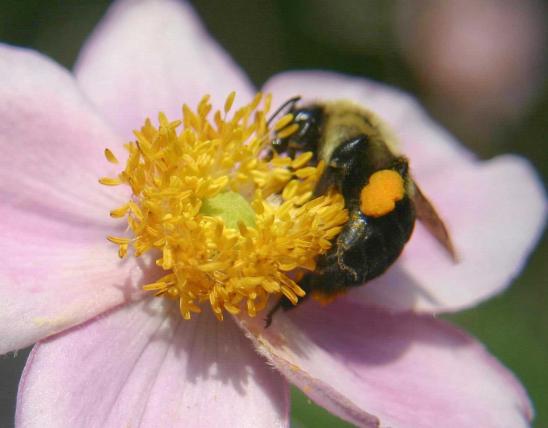
Like other species of bumblebees, they are large fuzzy or hairy bees. Bumblebees (genus Bombus) always have some fuzz on the abdomen. Females have pollen baskets on the last pair of legs.
As with other bumblebee species, the (female) workers, queens, and males can look different. Because the queens and males aren’t seen as frequently as the workers, identifications usually focus on the workers.
- The fastest way to determine the species of Missouri’s bumblebees is to look at the color patterns of the hairs on the head, the thorax, and the abdominal segments (the abdomen is the third, obviously segmented, part of the body, behind the head and thorax; the abdominal segments are called tergites). The first abdominal segment, closest to the thorax, is called “T1” for “tergite 1.” The second segment is “T2,” etc. Female bumblebees (workers and queens) have six tergites; males have seven.
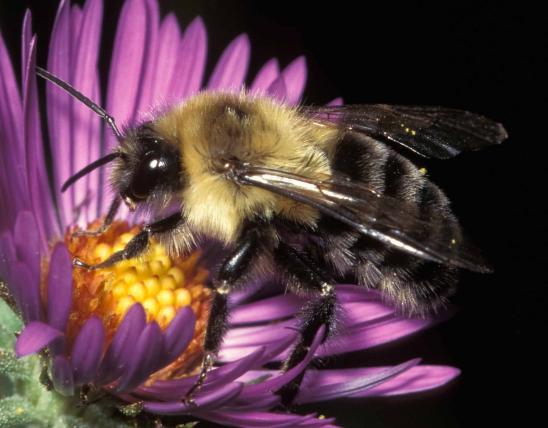
To distinguish worker brown-belted bumblebees from other Missouri bumblebees, view the insect from above, and look at the hairs on the abdomen: note that T1 is covered with yellow hairs. Then, note that T2 has brownish-yellowish, or rusty hairs in the front half of that segment, in a wide crescent or very wide U shape; the crescent extends relatively far toward the sides, looking more like a band than a patch on the otherwise blackish T2 segment. The rest of the abdomen is black.
Other key identifiers:
- The face has a noticeable patch of dense yellow hairs.
- The hair on top of the head is black.
- The bare black spot that develops on the thorax (between the wing bases) is generally circular.
Learn more about bumblebees (genus Bombus) on their group page.
Learn more about bumblebees and other apid bees (family Apidae) on their family page.
Similar species:
The two-spotted bumblebee (Bombus bimaculatus) is similar; T2 has black hairs except for a yellow shallow-W shape, which looks something like two yellow spots. The two yellow spots do not extend much toward the sides (not resembling a band), but they do extend fairly far hindward, almost to the front edge of T3.
The rusty patched bumblebee (Bombus affinis), rare in Missouri and federally endangered, also has brownish hairs on the first half of T2, but the rest of that segment is yellow (not black). On the thorax, the bare black spot has a stripe of rear-pointing black hairs (while the black spot on brown-belted bumblebees is more or less round). Also, the rusty patched bumblebee has smaller eyes than the brown-belted bumblebee.
Body length (not counting appendages): ⅜ to ⅝ inch (workers); ⅝ to ⅞ inch (queens); ⅝ inch (males).
Statewide.
Habitat and Conservation
This species is widespread in North America and lives in a variety of habitats. As with many other bees, brown-belted bumblebees prefer open habitats with plenty of wildflowers: prairies and other grasslands, sunny wetlands, pastures, areas along roadsides and railroads. They can also be found in urban and suburban areas where flowers grow.
Food
This bumblebee visits many kinds of wildflowers, including members of the sunflower, milkweed, pea, and mint families. Some examples include coneflowers, black-eyed Susans, and goldenrods; milkweeds; clovers, bush clovers, and vetches; and beebalm, wild bergamot, and horsemint.
Status
Native Missouri bee.
Life Cycle
This bumblebee usually constructs its nests underground. Queens mate in the fall, hibernate through winter, and emerge in early spring. They locate an acceptable nest site, gather pollen and nectar to store in the nest, and lay eggs.
The first eggs to hatch will all develop into female workers, which do not reproduce. Upon hatching, the young are grublike larvae. They eat the pollen and nectar, then pupate; they emerge as winged adult worker bees that perform most of the tasks for the colony: caring for the young, foraging, maintaining the nest, defending the colony, and so on. With workers to take care of those activities, the queen can focus on laying eggs. Colonies of this species usually comprise fewer than 50 individuals.
As the season continues, the queen lays eggs that will become males, which, when mature, leave the nest to find queens with which to mate. In addition to creating males, the queens also lay eggs that will hatch into queens, and these also leave the nest to forage and mate. The queens feed heavily, to have energy to survive winter as well as to develop eggs for the next spring’s brood.
Except for the new young queens, which will hibernate until spring, all the bees of the colony die as winter begins.
Human Connections
Bumblebees are important pollinators, which is significant for humans agriculturally, horticulturally, and environmentally. Some plants can only be pollinated by bumblebees. Red clover, an important fodder and traditional medicinal plant, is rarely pollinated by other bees.
The Missouri Bumble Bee Atlas is a statewide community science project aimed at tracking and conserving Missouri's native bumblebees. Learn how you can participate in this program, and download a free training packet, including a quick identification guide to Missouri's bumblebees, on its website. MDC is one of the sponsors of this citizen-science initiative.
Bumblebees are capable of stinging, if molested or if their nest is endangered. Although they are social insects and will defend their nest if they sense it is in danger, they are not aggressive.
Considering that many bumblebees are declining, if you find a bumblebee nest on your property, leave it alone and consider yourself lucky. Watch the bumblebees over the course of the season; take pictures!
Ecosystem Connections
Holes in the ground are easy to overlook, but they are an important home for many animals, often a succession of them. A hole may begin as the system of rotted taproots from a large tree that has died. In addition to bumblebees, rodents, shrews, gartersnakes, bumblebees, yellowjackets, and many other animals take advantage of these ready-made basement apartments.
In addition to the plants they pollinate, bumblebees have many interrelationships with organisms that most of us are scarcely aware of — their predators, their parasites, and the many non-stinging insects that can survive, in part, because they mimic them. All of these have their own roles in the chain of life.
This is one of the bumblebees that can be parasitized by thick-headed flies (or conopid plies, family Conopidae). These flies ambush bumblebees and deposit their eggs into their bodies. The larval conopid develops gradually inside the living bumblebee but ultimately kills it. In some bumblebee species, the presence of a nearly grown larva of canopid species Physocephala tibialis induces the soon-to-die bee to burrow into the ground, digging its own grave. Being underground protects the canopid larva as it polishes off the bee and pupates through winter. Compared to some other bumblebees attacked by this species of canopid fly, the brown-belted bumblebee seems relatively immune — at least to its “grave-digging mind control.”