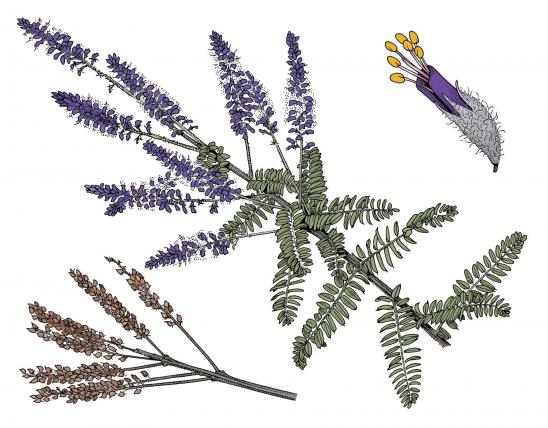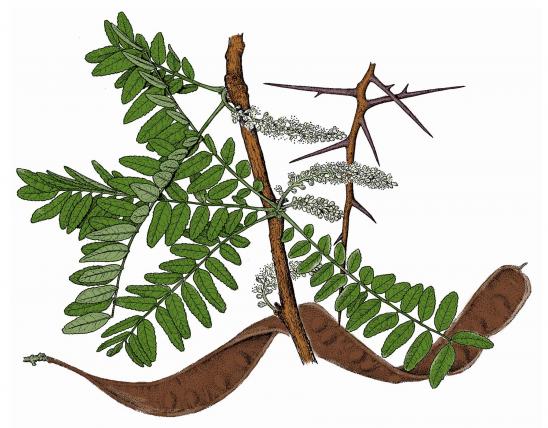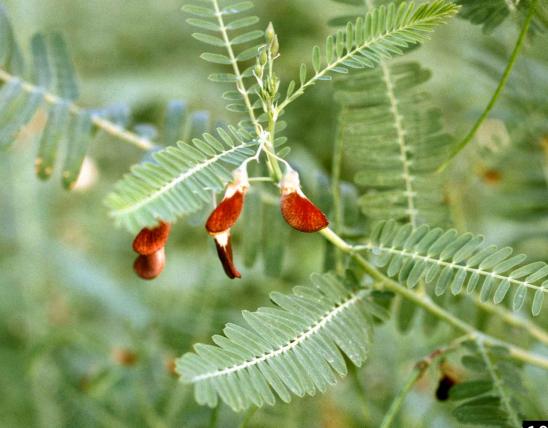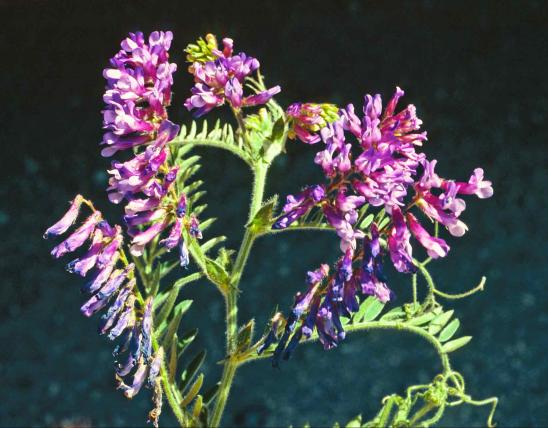













False indigo is a perennial, woody, branching shrub growing to 12 feet high, often in clumps. It bears elongated clusters of small purple flowers with protruding, yellow-orange anthers. The leaves are feather-compound with oval leaflets. It grows in moist ground.
Flowers May–June, the flower clusters dense, spike-shaped racemes, sometimes with side branches below the ones at the stem tips, 1½–6 inches long on a hairy stalk; each flower is tube-shaped, about ¼ inch long, with a single purplish-blue petal and 10 protruding stamens that have bright yellow-orange anthers.
The leaves are alternate, pinnately compound, to 10 inches long, with 9–27 oval leaflets ¾–1½ inches long, the surface dull green and smooth.
Fruits mature August–September; an elongated cluster of many small pods about ½ inch long, the surface smooth but with resinous dots (resembling little raised bumps or warts), each pod with only 1 or 2 seeds.
Similar species: In Missouri, the most commonly encountered relative is lead plant (Amorpha canescens), a small shrub that reaches only about 3 feet tall. It is a densely hairy plant, becomes woody with age, and has much smaller leaves and leaflets: the leaves to 4 inches long, and with up to 5 leaflets each to about ¾ inch long and ½ inch wide. Also, it grows in sunny native prairie habitats, not in streamside thickets.
Another close relative is shining false indigo (also called smooth wild indigo or dark indigo-bush, Amorpha nitens). It is a species of conservation concern in Missouri, classified as critically imperiled. Long thought to be extirpated from our state, it has recently been reported from southeastern Missouri. It is very similar to A. fruticosa. Botanists distinguish between the two this way: A. nitens has the leaflet undersides distinctly shiny, and the foliage and calyx (sepals) turn blackish when dry. (Meanwhile, A. fruticosa’s leaflet undersides are not shiny, and the foliage and calyx do not turn blackish when dry.) Another clue: the leaflet tips of A. nitens tend to be more rounded, while those of A. fruticosa tend to have a small point.
Height: Usually 3 to 6 feet; occasionally as tall as 13 feet.
Scattered nearly statewide.
Habitat and Conservation
False indigo is found in moist ground, near water, in thickets. It grows on the banks of streams and rivers, margins of ponds, lakes, and sloughs, bottomland prairies, bases and ledges of bluffs, and openings of swamps and bottomland forests. It also grows along ditches, railroads, and roadsides, and in various moist, disturbed areas.
False indigo does well in gardens and is available at wildflower nurseries.
Status
Native Missouri perennial shrub.
Throughout its wide range, false indigo varies in several characteristics, including the number and size of leaflets, shape and size of fruits, the plant’s hairiness, and more. In the past, these were considered different botanical varieties and were given official names. Botanists today view these as natural variation within the species.
Human Connections
It’s hard to think of a better shrub for native landscaping. False indigo is hardy and tolerates poor soils. It has showy, fragrant flowers and interesting foliage. It’s pollinator-friendly, attracts butterflies, and improves soils by adding nitrogen. It is useful for windbreaks, screens, and erosion control. Plants that feed insects, by extension, also feed birds and other animals that eat insects. When you plant false indigo, you’re helping nature.
From this species, researchers have isolated anti-microbial compounds, and compounds that fight tumors and inflammation. Because the glands on the fruits of false indigo can poison a variety of insects, including mosquito larvae and several crop pests, this species has also been explored as a potential source for insecticides and insect repellant.
Indigenous people of the Great Plains used false indigo in many ways, including food for horses, bedding for people, and arrow shafts.
The genus name, Amorpha, means “without form” or “deformed.” It refers to the flowers in this genus, which have unusual forms, considering they’re in the bean or pea family. Instead of having the typical pea-shaped flowers, with 1 banner, 2 wing, and 2 keel petals, false indigo and other members of its genus have only a single petal: the banner.
Globally, there are about 15 species in genus Amorpha, all native to North America. Missouri has only three of them. Some of their closest relatives are in genus Dalea, the prairie clovers (for example, purple prairie clover).
The species name, fruticosa, means “shrubby.” Interestingly, the same adjective, “fruticose,” describes one of the three main forms that lichens take: shrubby lichens are described as “fruticose lichens.” Some neat examples of this growth form are beard lichens, reindeer lichen, and gold-eye lichen.
Ecosystem Connections
False indigo, like many other plants in the bean or pea family, transforms atmospheric nitrogen (in the air) into a form that plants can use as fertilizer. This process, called nitrogen fixing, occurs underground in root nodules. Inside the nodules are bacteria capable of performing the nitrogen conversion. These plants are able to survive in remarkably poor soils, and they enrich the soils they grow in.
Northern bobwhite eat the seeds. Red-winged blackbirds frequently nest in false indigo. Countless birds and other animals use the thickets for cover.
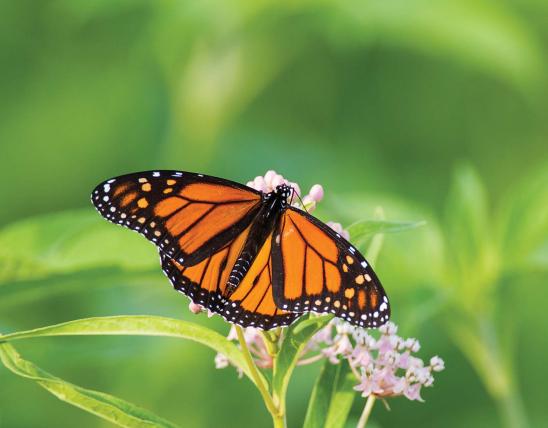
A variety of butterflies and moths use false indigo as caterpillar food plants. These include the clouded sulphur, southern dogface, gray hairstreak, marine blue, silver-spotted skipper, hoary edge, and Io moth. Many more species of butterflies, as adults, visit the flowers for nectar.
The leadplant flower moth, also called the false indigo flower moth (Schinia lucens), is especially connected to plants in genus Amorpha: its caterpillars can only feed on plants in this genus. Like most flower moths, the caterpillars and adults are beautifully camouflaged with the colors and patterns of the flowers they eat. In this case, they are richly mottled with reddish purple. This moth is a Missouri species of conservation concern, listed as critically imperiled. The loss of native prairie habitat, where its false indigo foodplants grow, explains its decline in our state.
A wide variety of pollinators visit false indigo, including many different types of bees. One andrenid bee, called the eastern scaly miner bee (Andrena quintilis), is narrowly specialized for pollinating plants in genus Amorpha; in Missouri, that means it’s pretty much limited to false indigo and lead plant.
Although false indigo is native to a large part of the United States, it is not native to New England and the Pacific Northwest, where it is spreads invasively. In the northeastern United States, it has escaped cultivation and is a pest in sensitive riparian (streamside) habitats. Broken-off stems and roots are distributed during floods and become new plants. Also, the seeds can survive for a long time before germinating, making the species difficult to control. This species has also been introduced and has escaped cultivation in Europe, Asia, and other parts of the world, sometimes invasively.