










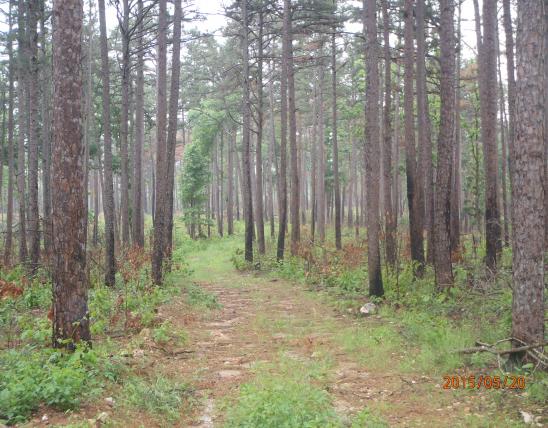
This is a forest area that has an archery and firearms range. This area has unimproved roads that are open to public vehicles. These roads may not be shown on area maps or posted with signs.
Media

Safety Concerns
Name
Edible
Scientific Name
Tradescantia ohiensis
Family
Commelinaceae (spiderworts)
Description
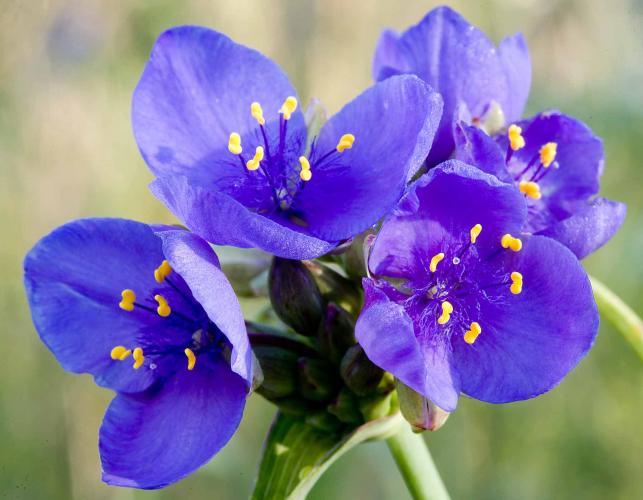
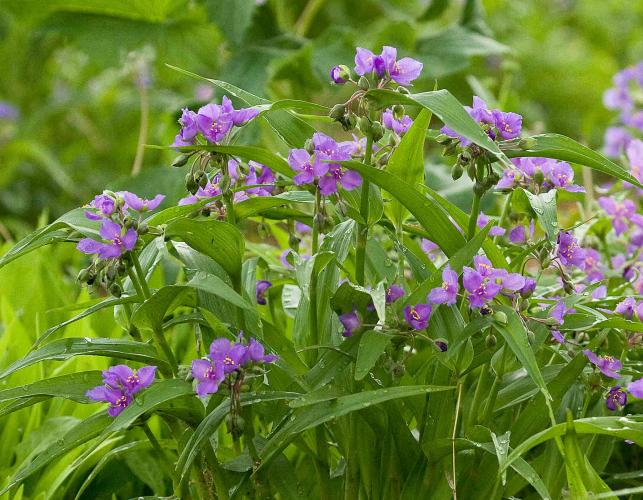
Smooth spiderwort is the most common and widely distributed of Missouri's spiderworts. It has smooth, slender, straight or zigzag stems. The long, narrow leaves are folded lengthwise and attach to the stem in a thick node. The 3 petals of the triangular flower can be blue to purple or reddish pink, or rarely white.
Smooth spiderwort is an herbaceous perennial with a straight or sometimes zigzag stem, lacking hairs or with very few hairs.
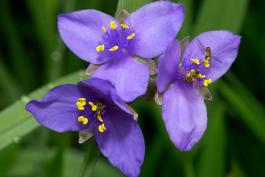
The flower clusters are subtended by 1 or 2 leaves similar to the rest of the leaves. The petals are 3; blue, rose, purple, lavender, or rarely white; the size of the petals varies; the flowers are triangular, about ¾–1½ inches across. The stamens are bearded and fluffy. Each flower is open for just one day; often, the flowers open only in the morning and close by midday, with only the buds and curving flower stems visible in the flower clusters.
Blooms May–July.
The leaves are about 12 inches long; narrow, folded lengthwise; bluish green, clasping the stems in a thick node.
Similar species: There are 8 species of spiderworts in the Missouri flora, plus several documented, naturally occurring hybrids that display characteristics of more than one species. Smooth spiderwort hybridizes with nearly all of them, and it is the commonest and most widely distributed of Missouri's spiderworts.
The spiderworts sold in garden centers are usually hybrids.
Other Common Names
Ohio Spiderwort
Blue Jacket
Size
Height: 7 inches to 3 feet.
Where To Find

Statewide.
Habitat and Conservation
Occurs in glades, prairies, and openings in moist to dry upland forests; along railroads and roadsides; also in old fields and pastures.
This spiderwort grows throughout the eastern United States and is commonly cultivated as an ornamental.
Status
Native Missouri wildflower.
Human Connections
This is a beautiful perennial flower for gardening. Get plants from an ethical native wildflower nursery. Plants for sale at most garden centers are usually hybrids.
In addition to their place in flower gardening, and the pleasure they bring to hikers, spiderworts have proven useful for assessing an area's exposure to radiation, as the stamen hairs mutate and change color once exposed. This sensitivity to radiation and chemical mutagens is a property being explored for numerous applications.
Ecosystem Connections
Bumblebees and other insects pollinate this plant, and a number of herbivorous mammals, including deer, rabbit, and livestock, eat the foliage.
Spiderworts are in the same genus as several common houseplants, including the ones called inch plant, "wandering Jew," or (increasingly) "wandering dude" (Tradescantia zebrina, whose leaves are striped with purple and silver) and purple heart or purple queen (T. pallida, whose leaves are completely purple). The familiar blue-flowering garden weed called common dayflower (Commelina communis) is in the same family.
The spiderwort or dayflower family is called the Commelinaceae (kah-muh-lih-NAY-see-ee); it is a monocot family usually with branched, somewhat succulent stems and swollen nodes, with alternate leaves whose bases connect to the stems with sheaths. Each flower usually opens for only a day. There are more than 700 species in this family; most are tropical or subtropical.
Title
Media Gallery
Image

Caption
Each spiderwort flower is open for just one day. Many insects, like the beelike syrphid flies shown here, pollinate spiderwort. Since each flower is open for just one day, and usually closes before noon, the pollinators have to work quickly.
Credit
MDC Staff
Right to Use
Photo by MDC Staff, courtesy Missouri Department of Conservation
Image

Caption
Smooth spiderwort is named for the smoothness of its foliage; it typically lacks hairs on the vegetative parts. Each flower is open for a day. When it closes, it droops down, making room in the flower cluster for new buds to bloom the following day.
Credit
David Stonner
Right to Use
Photo by David Stonner, courtesy Missouri Department of Conservation
Image
Caption
Smooth spiderwort has 3 petals, which are blue, rose, purple, lavender, or (rarely) white; the overall shape of the flower is triangular, about ¾–1½ inches across.
Credit
Noppadol Paothong
Right to Use
Photo by Noppadol Paothong, courtesy Missouri Department of Conservation
Image
Caption
There are 8 species of spiderworts in Missouri, plus several documented hybrids that display characteristics of more than one species. Smooth spiderwort (Tradescantia ohiensis) hybridizes with nearly all of them, and it is the commonest and most widely distributed of Missouri’s spiderworts.
Credit
David Stonner
Right to Use
Photo by David Stonner, courtesy Missouri Department of Conservation
Image

Caption
Spiderwort blooms May–July. It grows throughout the eastern United States and is commonly cultivated as an ornamental.
Credit
Noppadol Paothong
Right to Use
Photo by Noppadol Paothong, courtesy Missouri Department of Conservation
Image

Caption
Spiderwort occurs in glades, prairies, and openings in moist to dry upland forests; along railroads and roadsides; also in old fields and pastures.
Credit
David Stonner
Right to Use
Photo by David Stonner, courtesy Missouri Department of Conservation
Image
Image

Image

Image

Image

Image

Title
Similar Species
Similar Species
Media

Media
Media

Media

Media
Media
Media

Media
Media

Media

Media
Media

Media

Where to See Species

Ben Branch Lake Conservation Area is in Osage County, ten miles north of Linn off Missouri Highway 89. The Conservation Department purchased most of this 512-acre area in 1978.

Fiery Fork Conservation Area is in Camden County, 15 miles northwest of Camdenton and seven miles east of Climax Springs, off Highway 7.

This 80-acre native prairie remnant is named after the Osage Indians' traditional name for the sun.
The Conservation Department acquired this prairie in 1987.
The Conservation Department acquired this prairie in 1987.
About Wildflowers, Grasses and Other Nonwoody Plants in Missouri
A very simple way of thinking about the green world is to divide the vascular plants into two groups: woody and nonwoody (or herbaceous). But this is an artificial division; many plant families include some species that are woody and some that are not. The diversity of nonwoody vascular plants is staggering! Think of all the ferns, grasses, sedges, lilies, peas, sunflowers, nightshades, milkweeds, mustards, mints, and mallows — weeds and wildflowers — and many more!