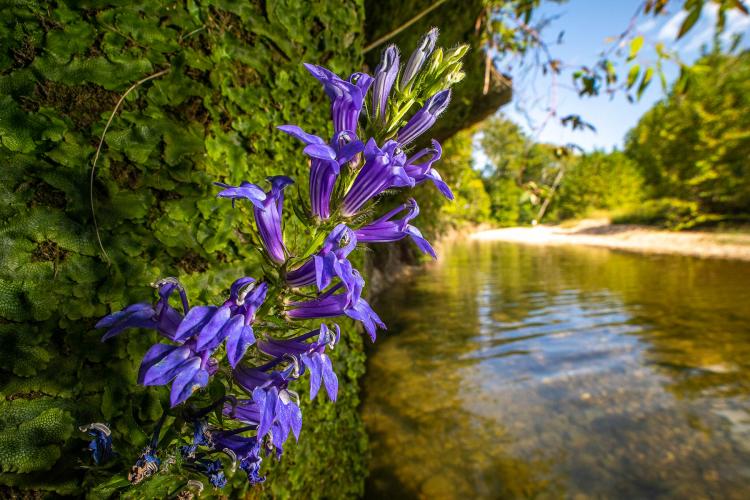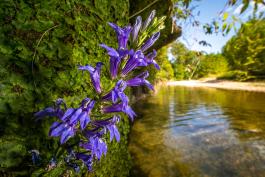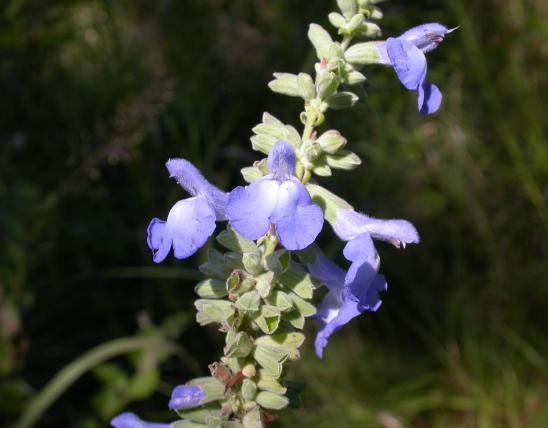









Blue cardinal flower, blue lobelia, or great blue lobelia, is a showy, late-blooming native wildflower that grows along streams, ditches, sloughs, and other wet places. It has blue or purple tubular flowers with 2 upper lips and 3 lower lips.
Blue cardinal flower, also called great blue lobelia, is a perennial wildflower whose stalks are either unbranched, or or branch toward the tip; the stalks are often slightly winged.
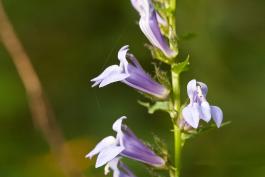
The flowers are in the leaf axils of the upper stem leaves and have the typical lobelia shape, with a 2-parted upper lip and a 3-divided lower lip; the flowers can be as much as 1 inch long; the petals are light or dark violet, light or dark blue, or lavender; rarely white.
Blooms August–October.
The leaves are alternate, light green, narrowly lance-shaped, 2–6 inches long, sometimes with a few irregularly spaced teeth.
Similar species: Missouri has 5 species of Lobelia, 4 of which are common:
- Cardinal flower (L. cardinalis) has bright red flowers.
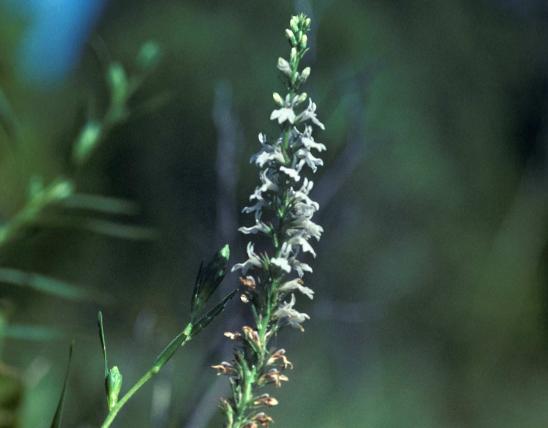
- Spiked lobelia (L. spicata) has pale blue or white flowers.
- Indian tobacco (L. inflata) is similar to spiked lobelia, but its stems usually branch above the midpoint, and its fruit capsules become greatly inflated as the seeds ripen. It's an aggressive, somewhat weedy plant often found in disturbed areas.
Height: to 3 feet

Statewide.
Habitat and Conservation
Found in wet places: banks of streams, rivers, and spring branches, margins of ponds and lakes, bottomland forests, moist depressions of upland prairies, sloughs, swamps, fens, and moist ledges of bluffs; also pastures, ditches, and roadsides.
This is a popular late-blooming native wildflower for home gardening; it requires moist locations.
Status
Native Missouri wildflower.
Human Connections
Blue cardinal flower is a favorite wildflower during autumn. It, mist flower, and our native asters contribute cool lavender and blue hues that contrast against the fiery oranges, reds, and yellows that trees and shrubs display in fall.
An alkaloid, lobeline, is extracted from several types of lobelias. It's similar to nicotine and has been used in anti-smoking medications. In large does, lobelia extracts can cause death.
In the 18th century, extracts of L. siphilitica were used to treat venereal disease, hence the species name.
Ecosystem Connections
Bumblebees are the primary pollinator.
Because of the toxic alkaloids in its foliage, this plant is rarely eaten by mammals.
Plants that grow along streams and in other wet places play in important role in preventing soil from washing away, whether during floods or heavy downpours.