







Clasping Venus' looking glass is a single-stemmed plant with purple or blue star-shaped flowers and bluntly toothed, alternate leaves that clasp the stem. It's scattered statewide in a variety of habitats.
Clasping Venus' looking glass is a single-stemmed winter annual; the stem is 5-angled and somewhat hairy. The sap is milky.
The flowers emerge from the leaf axils; the corolla is tubular with 5 spreading lobes, appearing star shaped, about ½ inch across, blue to purple, rarely white; the calyx is slender and 5-lobed.
Blooms May–June.
The leaves are alternate, round, light green, clasping the stem, palmately veined, the margins finely and bluntly to sharply toothed, the undersurface finely roughened or with soft, short hairs.
The fruits are fairly cylindrical capsules that stand upright against the plant stalk; there are 3 chambers; as the fruits mature and turn dry and tan, tiny seeds are released from (usually) 3 oval pores that open on the sides of the fruit, just below the midpoint of the fruit.
- The flowers on the lower parts of the stem are cleistogamous (kly-STAH-guh-muss): They remain closed and are self-fertilizing, capable of setting seed without ever opening up. In this species, few of those seeds are viable, however. Meanwhile, the flowers at the top of the stem are chasmogamous: (kaz-MAH-guh-muss): They open up and expose their pistils and stamens to the air, inviting the possibility of cross-pollination.
Similar species: Five species of Triodanis occur in Missouri, all called Venus' looking glass. In addition to the "pure" species, they sometimes produce hybrids that complicate their identification. Here are the the other four species:
- Small Venus' looking glass (Triodanis biflora), scattered mostly in southern Missouri. Very similar to clasping VLG, but with longer, less clasping leaves and flowers mostly cleistogamous, with only one or two open flowers at the top of the stem.
- Holzinger's Venus' looking glass (Triodanis holzingeri), uncommon, mostly in chert glades and sandy river banks; recorded from Jackson, Newton, and Osage counties. Very similar to clasping VLG, but the fruits have narrow, slitlike pores positioned midway on the capsule (not oval pores positioned below the midpoint of the fruit).
- Slimpod Venus' looking glass (Triodanis lamprosperma), uncommon in the unglaciated plains of western Missouri and eastward to St. Francois County. Very similar to clasping VLG, but has round, very flattened, very shiny seeds.
- Prairie, or slender leaved Venus' looking glass (Triodanis leptocarpa), scattered, mostly in the unglaciated plains of western Missouri. Has narrow leaves and 1-chambered capsules.
A cultivated plant in the same family, and also called Venus' looking glass (Legousia speculum), is sometimes grown in Missouri gardens. It is native to the Mediterranean region, and it differs from Triodanis species in its more-branched stems, flowers in terminal clusters, and lack of cleistogamous (non-opening, self-fertilizing) flowers.
Height: about 18 inches.
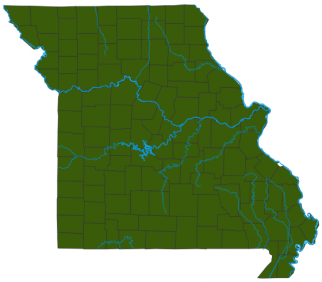
Scattered statewide.
Habitat and Conservation
Occurs in prairies, glades, blufftops, woodland openings, oxbows, marshes, edges of lakes, banks of streams and rivers, old and fallow fields, ditches, railroads, roadsides, and open, disturbed areas.
All Triodanis species are winter annuals: They germinate in the autumn, overwinter as a basal rosette of leaves, then flower the following spring.
Status
Native Missouri wildflower.
Human Connections
Native Americans used this plant and its relatives medicinally.
The species name, perfoliata, refers to the stemless, clasping leaves, which look as if the plant stem pierces through the leaf blade.
The common name for this genus of pretty flowers refers to the Roman goddess of love and beauty; Venus's Greek counterpart was Aphrodite.
Ecosystem Connections
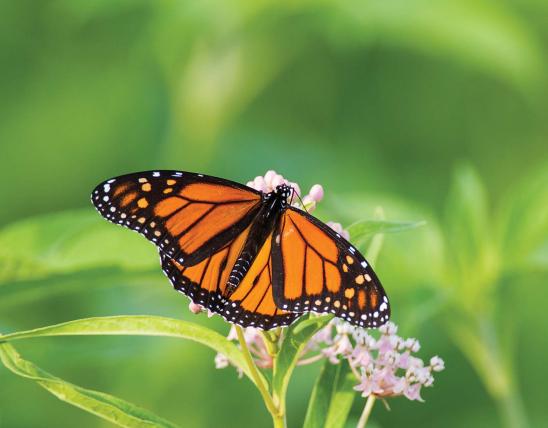
A variety of bees, flies, butterflies, and moths visit the flowers.
Plants, large and small, hold soil in place with their roots. As Americans learned in the first half of the 20th century, a landscape stripped of plants soon loses its precious topsoil. Even humble plants play a role.