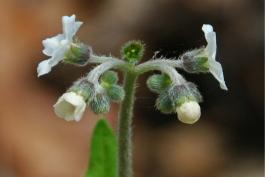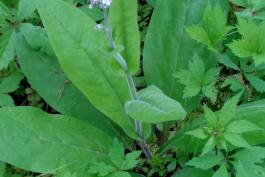










Wild comfrey has large basal leaves that are soft, hairy, and elliptical with long petioles — they look like hounds’ tongues! The upright flowering stalk has few leaves and looks like a wand.
Wild comfrey is an herbaceous perennial with large basal leaves and a hairy, upright flowering stalk. The flower stalks have a few clasping leaves, with no leafy bracts among the flower branches.
The flowers are like small forget-me-nots, washed-out sky blue to greenish white, small tubes ending in 5 rounded lobes, about ½ inch across.
Blooms April–June.
The leaves are mostly basal, elliptical with long petioles, very hairy, soft, to 1 foot long; the stem are leaves few, clasping the hairy stems.
Fruits are in a cluster of 4 round nutlets, hairy, depressed on the upper surface, with tiny Velcro-like hooks that help them cling to fabric and fur.
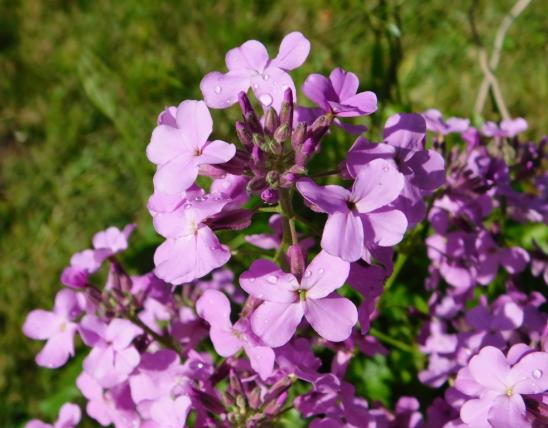
Similar species: Common hound’s tongue (Cynoglossum officinale) has purplish-red (not pale or light blue) flowers, leafy bracts at the branch points in the flowering stalks, and narrower leaves overall. It’s a native of Eurasia and occurs along watercourses, in pastures, along roadsides and railroads, and other open, disturbed areas.
Height: to 2½ feet.

Central and southeastern Missouri.
Habitat and Conservation
Occurs in bottomland forests, moist upland forests, pastures, and banks of streams and rivers.
Status
Native Missouri wildflower.
Human Connections
Our native species was used medicinally by Native Americans for a variety of ailments. Some modern herbalists have confused C. virginianum with European "true" comfrey (Symphytum officinale). Many borages contain toxic alkaloids and can potentially sicken a person.
Ecosystem Connections
Like several other plants that produce sticktights, beggar’s ticks, and stickseeds, wild comfrey produces nutlets with spiny, barbed tubercles that attach to fur (and clothing). This adaptation distributes the seeds away from the parent plant, and a localized disaster may not destroy all of them.
A nifty-looking, black-and-white grass miner moth called Ethmia trifurcella is documented for using this particular species as its larval food plant.