









Native to Ozark glades and prairies, tickseed coreopsis, or lanceleaf coreopsis, has long been appreciated as a hardy garden perennial. Because of its popularity, it has escaped from cultivation and now occurs statewide.
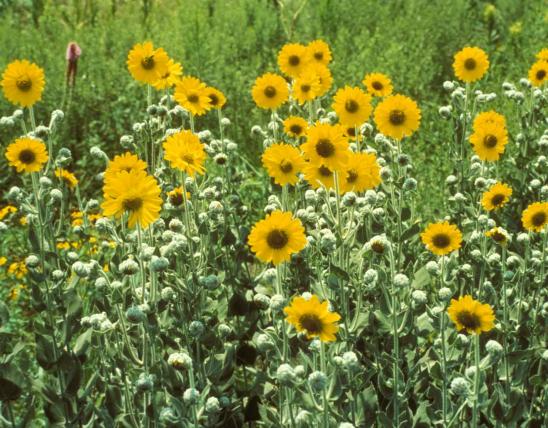
Tickseed coreopsis is a showy perennial wildflower that usually has several stems and grows from a short, horizontal rootstock. Stems and leaves hairless or with varying amounts of hairs.
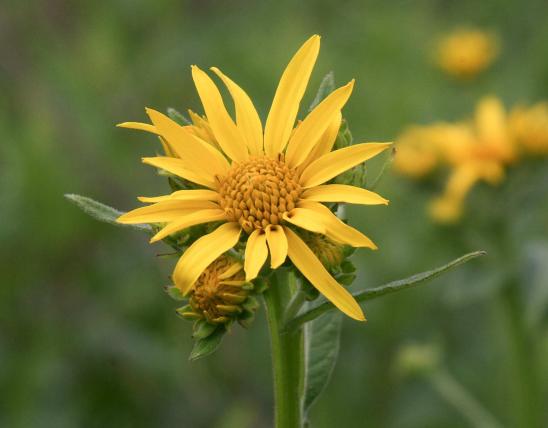
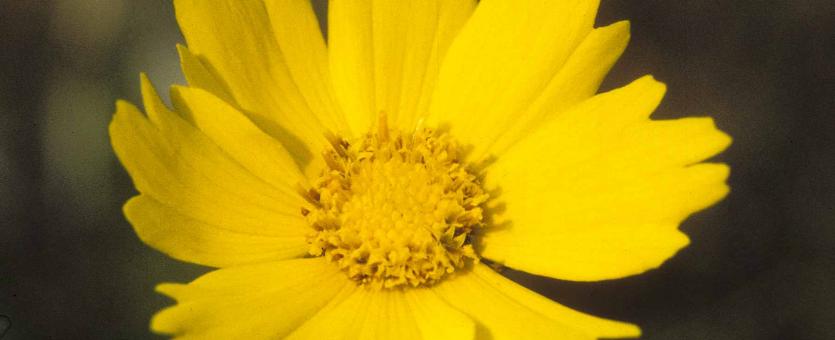
The flowerheads are solitary or few; large, about 2 inches across; the ray florets are usually 8, typically broad, uniformly yellow, the ends sharply, jaggedly toothed or lobed. The disc florets are yellow and numerous. The involucre (cup) at the base of the flowerhead has 2 series of bracts: the outer (basal) series with 8 spreading bracts that are narrowly triangular with a sharply pointed tip; the inner series, also with 8 bracts, encloses the flowerhead before it opens and again when flowering is done; its bracts are green at the base, yellowish to translucent at the tip.
Blooms April–June.
The leaves are opposite, simple, narrow, mostly unlobed, mostly positioned at the lower half of the stems and usually growing from only 1–3 nodes. The upper leaves are usually smaller and stalkless; the lower leaves are larger and with long stalks.
The fruits are achenes (structurally similar to sunflower seeds) that somewhat resemble ticks: they are dark brown or black, about ⅛ inch long, flattened, oval, with a wide, pale wing on each side, bent slightly inward, with a thickening at the inner base, inner tip, or both; 2 short teeth (awns) project from the outer tip.
Similar species: Several types of flowers are rather similar.
- Five more species of Coreopsis are recorded for Missouri. See Ecosystem Connections for a list of Missouri's other Coreopsis species.
- In cultivation, there are several hybrids and nonnative species of Coreopsis that are popular as ornamentals and as cut flowers.
- Missouri has 11 species in genus Bidens (beggar’s ticks), which are closely related and are easily confused with Coreopsis species.
- Cosmos (plants in genus Cosmos) are similar, too. Three species of these common garden flowers have been recorded growing out of cultivation in Missouri; none are native to our state. They usually have white, pink, or purple flowers.
Height: to 2 feet (cultivated forms may be taller).

Scattered mostly in the Ozarks and north to the Missouri River. Cultivated, and escapes from cultivation, statewide.
Habitat and Conservation
Grows natively in rocky prairies, glades, tops of bluffs, sandy open areas, and along roadsides and railroads.
This species is cultivated statewide and commonly escapes into natural habitats.
Status
Native perennial wildflower.
A longtime favorite for native wildflower gardening; attracts butterflies and other pollinators, naturalizes readily. Commonly used in highway plantings.
Human Connections
Tickseed coreopsis is frequently planted along roadsides for beautification.
Several species in this genus are cultivated as garden ornamentals and for use as cut flowers.
- "Doubled" cultivars with numerous ray florets have been developed.
- In gardens, this species demands excellent drainage and full sun but seems to prefer poor soil.
- It can self-seed abundantly and is good for naturalizing in wildflower gardens, rock gardens, meadows, and other places where a formal look isn't necessary.
- Deadheading the spent flowerheads can help prevent it from spreading, but it also reduces the seed available for goldfinches and other birds.
Coreopsis (pronounced cor-ee-OPP-sis) is one of many plants whose common name is the same as the genus name. Others include iris, forsythia, gladiolus, zinnia, chrysanthemum, petunia, and asparagus. There are many more examples!
The genus name, Coreopsis, is derived from Greek and means “resembling a bug.” It refers to the size, color, and shape of the achenes ("seeds").
A memorable chuckle in James Thurber's classic 1939 short story "The Secret Life of Walter Mitty" comes when the vague protagonist daydreams that he is a famous surgeon performing a critical and risky operation. After Mitty heroically repairs the hospital's "anaesthetizer," using only a ballpoint pen, another surgeon checks the patient, turns pale, and whispers that "Coreopsis has set in." He nervously asks Mitty to take over, and the confident Mitty slips on his white gown and surgical gloves and prepares to save the patient.
Ecosystem Connections
The seeds of tickseed coreopsis provide food for birds and small mammals.
The foliage of various species of Coreopsis is browsed by a variety of herbivore mammals such as woodchucks, rabbits, and deer.
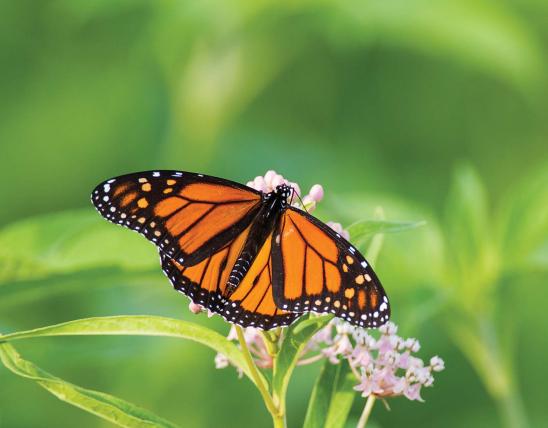
The flowers attract a wide range of pollinating insects including butterflies, skippers, bees, wasps, flies, beetles, moths, and more.
One longhorn bee species, the coreopsis longhorn bee (Melissodes coreopsis), is named for its fondness for visiting members of genus Coreopsis, but it has been recorded on several other kinds of flowers as well.
Many insects feed on coreopsis leaves, flowers, or other plant parts. Moth caterpillars that feed on coreopsis include at least three members of the geometrid or "looper" family: the dimorphic gray, the wavy-lined emerald, and the common tan wave. At least two species of calligraphy beetles (genus Calligrapha, in the leaf beetle family) feed on coreopsis: the ragweed leaf beetle (C. bidenticola) and the coreopsis leaf beetle (C. californica); both of these are attractive, boldly marked beetles.
The myriad of insects that feed on native plants play a critical role in feeding birds, which require the protein in insects to raise their young.
In China and Japan, tickseed coreopsis was introduced as an ornamental and was planted to help prevent erosion and to beautify along railroads and other disturbed soils. But in those regions and in parts of Australia, where it is not native, it has proven to be invasive. In Japan, it is considered one of that nation's worst invasive species.
The seedlike fruits of the sunflower family are called achenes. A good example of an achene (uh-KEEN) is a sunflower "seed." It's a fruit type whose single seed is enclosed in a dry outer covering that doesn't split open; the seed is attached to its "shell" at only one point. It's the fruit type that helps define the sunflower family.
Relatives: The subject of this page, called tickseed coreopsis or lanceleaf coreopsis (Coreopsis lanceolata), is one of six species of Coreopsis recorded in Missouri. Here are the other five:
- Plains coreopsis, or calliopsis (Coreopsis tinctoria), scattered mostly south of the Missouri River. Easily distinguished by its ray flowers, which are yellow but have a well-defined zone of reddish brown or brownish purple at the base. Disk is reddish purple, too. Unlike the others, usually an annual plant.
- Finger coreopsis (Coreopsis palmata), scattered nearly statewide, but uncommon in the Bootheel lowlands. Ray flowers are usually rounded, not jagged at the tip, usually paler yellow than our other coreopsis species; disk yellow; leaf blades are divided into 3 narrowly lance-shaped lobes that divide well above the base.
- Tall tickseed, or tall coreopsis (Coreopsis tripteris), scattered nearly statewide but apparently absent from the Bootheel lowlands. Ray flowers are usually rounded, not jagged at the tip; disk reddish purple; leaves divided into 3 leaflets, which are all fairly even in size; stems 2–6 feet tall.
- Bigflower coreopsis (Coreopsis grandiflora), scattered mostly in the unglaciated plains of west-central Missouri and the eastern part of the Ozarks. Ray flowers have jagged teeth on the outer margin; leaves arise from 6 or more nodes along the stem (along at least ⅔ of the stem length); leaf blades are deeply divided into narrow, linear segments.
- Star tickseed (Coreopsis pubescens), scattered mostly in the Ozarks and Ozark border counties. Occurs in lower, moister, more wooded habitats than most in the genus. Ray flowers have jagged teeth on the outer margin; leaves arise from 6 or more nodes along the stem (along at least ⅔ of the stem length); leaf blades are undivided or else with 1 or 2 relatively broad, lanceolate or ovate lobes toward the base; the basal lobes are much smaller than the central lobe. Typically a hairy plant, especially on the undersides of the leaves.
Genus Coreopsis belongs to the sunflower tribe (subfamily) of the sunflower, daisy, or aster family. This tribe, Heliantheae, is enormous. It includes sunflowers, coneflowers, black-eyed Susans, zinnias, ragweeds, and many more. Globally, there are about 200–300 genera, comprising about 2,500–3,300 species.