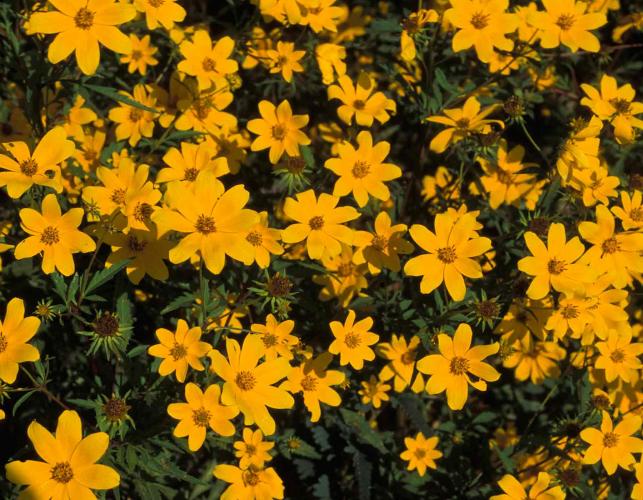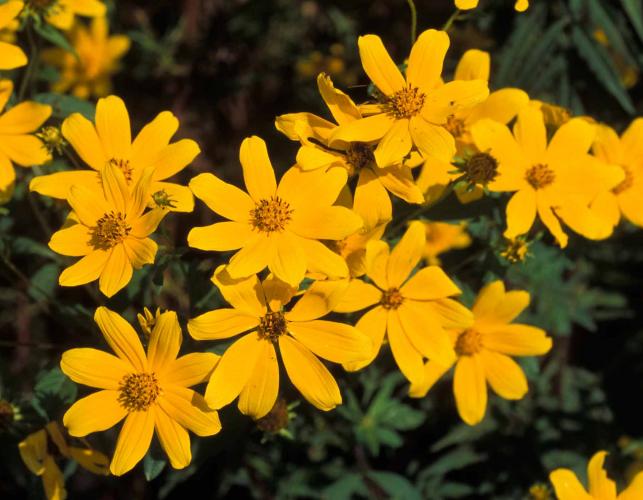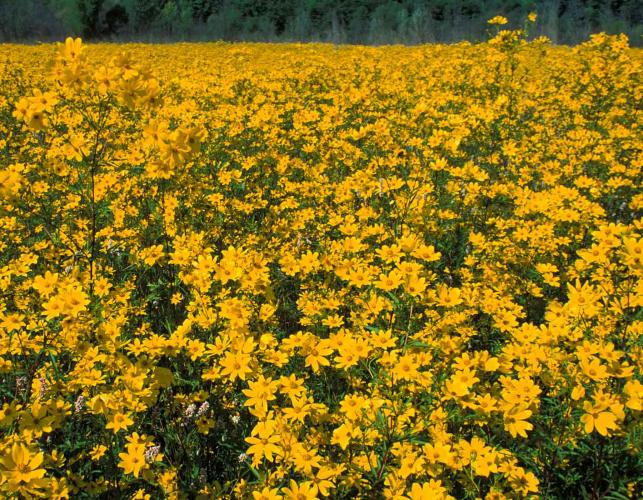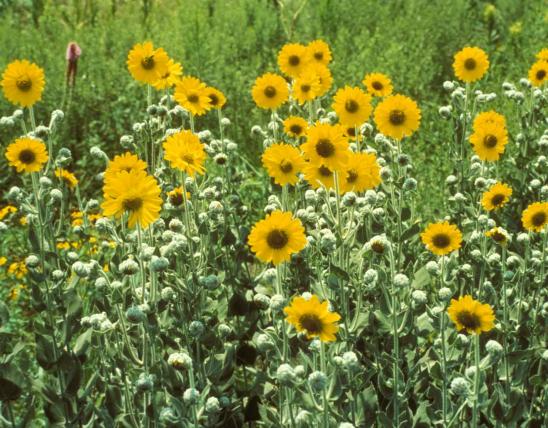











Tickseed sunflower has flattened black seeds that attach themselves to clothing and pets via two needlelike awns. In flower, it creates massive displays in moist bottomlands.
Tickseed sunflower is a much-branched annual or biennial. The plants are hairless or with sparse hairs.
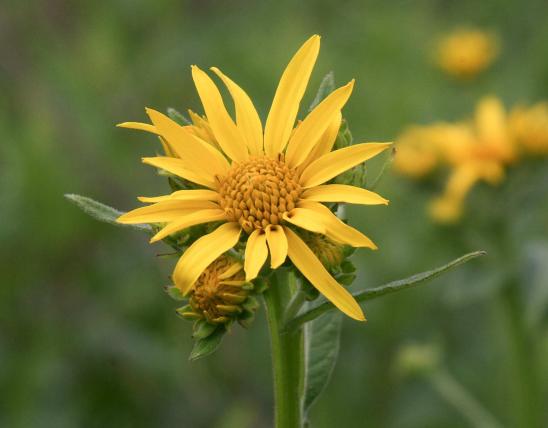
The flowerheads are daisylike, bright yellow, about 1¼ inches across, with usually 8 pointed ray florets. The bracts under the flowerhead are in 2 dissimilar rows: the outer series spreading or reflexed, linear, not leaflike, with hairs along the margins; the inner series lanceolate to narrowly ovate.
Blooms August–October.
The leaves are opposite, pinnately (like a feather) deeply lobed or compound with 3–7 divisions, pointed, each with sharp teeth.
The fruits are flattened, black, with 2 needlelike awns that attach themselves to clothing and pets, thus the names “tickseed” and “beggar-ticks.”
Similar species: Eleven species of Bidens have been recorded in Missouri, plus 6 of the similar genus Coreopsis. Distinguishing among these species involves many anatomical features, including leaf characteristics, numbers of ray and disk florets, configuration of involucral bracts, and details of the fruits, right down to their barbed awns.
Missouri has 11 species in genus Bidens (beggar’s ticks). Spanish needles (Bidens bipinnata) is one example. See Ecosystem Connections for a list of Missouri’s other Bidens species.
Height: usually to 3 feet, occasionally to 5 feet.
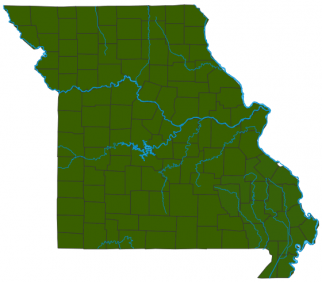
Scattered to common statewide.
Habitat and Conservation
Occurs in bottomland prairies, upland prairies, bottomland forests, margins of ponds and lakes, sloughs, and fens; also crop fields, fallow fields, railroads, roadsides, and open, disturbed areas.
This species often grows in massive displays in moist bottomlands.
Status
Native Missouri wildflower.
Human Connections
This species is sometimes grown by native wildflower and butterfly gardeners, but it self-seeds abundantly and can become quite weedy.
The seeds are an annoyance to hikers, who must pick them from pants and socks.
Pets and livestock can also collect the seeds in their fur.
Some people have suggested that the name “beggar-ticks” came from the seed- covered clothing of railroad-hitching migratory workers or homeless people.
Ecosystem Connections
Birds and mammals eat the seeds, and many insects visit the flowers.
By hitchhiking on the fur of animals, the seeds travel away from the parent plants. This reduces inbreeding and helps ensure that at least some offspring may find a suitable, safe environment in which to grow.
As their common names suggest, beggar-ticks (in genus Bidens) are closely related to genus Coreopsis (tickseeds):
- Not only can it be difficult to tell the difference among species within each genus, but also it can be tricky even to separate the two genera.
- DNA analysis has shown that both genera are not natural units.
- As scientists unlock the genetic and ancestral relationships of these plants, be prepared for some regrouping and renaming of them in the future.
Relatives: The subject of this page, tickseed sunflower or bearded beggarticks (Bidens aristosa), is one of eleven species of Bidens recorded in Missouri. Six of them are common to scattered to uncommon:
- Spanish needles (Bidens pipinnata)
- Sticktight, or nodding bur marigold (Bidens cernua)
- Few-bracted bur marigold (Bidens discoidea)
- Common beggarticks (Bidens frondosa)
- Three-lobed beggarticks, or swamp beggarticks (Bidens tripartita)
- Big devil’s beggarticks (Bidens vulgata)
The following are rare and only known from a few collections in our state:
- Common beggarticks (Bidens alba)
- Water marigold (Bidens beckii), a Missouri species of conservation concern
- Showy bur marigold (Bidens laevis), a Missouri species of conservation concern
- Crowned beggarticks (Bidens trichosperma)
Although this species is in the sunflower family, and it has sunflower in its common name, it is not in the same genus as true sunflowers (Helianthus).
- Common names of plants can be confusing; the name "sunflower" can technically apply to any of the thousands of species in the sunflower family, including species like this, in genus Bidens. However, many people only consider members of genus Helianthus (which translates to "sunflower") as "true" sunflowers. For more on members of that genus, visit their group page