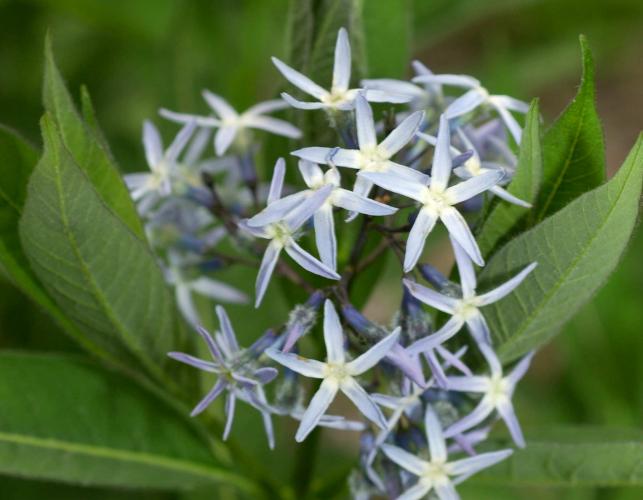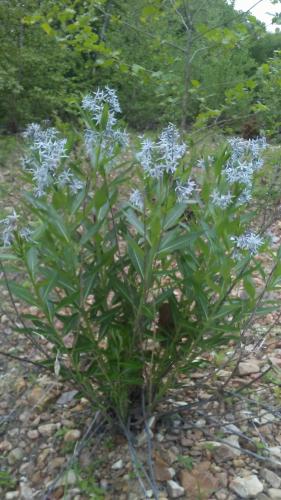










Often found on gravelly Ozark streamsides, shining blue star lifts its clusters of showy, light-blue flowers in late spring. A top choice for native wildflower gardening, it is interesting spring, summer, and fall.
Shining blue star is a striking, smooth perennial, branching and forming clumps.
The flowers are star-shaped, light blue, clustered in cymes at the tops of stems; the corolla lobes spreading; with a delicate scent.
Blooms April–May.
The leaves are alternate, narrowly lance-shaped, to 6 inches long, leathery, and shiny on the upper surfaces. The sap is milky.
The fruits are narrow seedpods that hang down, about 4 inches long.
Similar species: There are two other Amsonia species in Missouri:
- Ciliate blue star (Amsonia ciliata) has very narrow, almost threadlike leaves and is uncommon, found in our southern Ozark counties along the Arkansas border.
- Willow amsonia (Amsonia tabernaemontana) has dull leaves (not shiny), and its seedpods are held upright. It is scattered mostly in the southern half of the state.
Height: 18 inches to 3 feet.
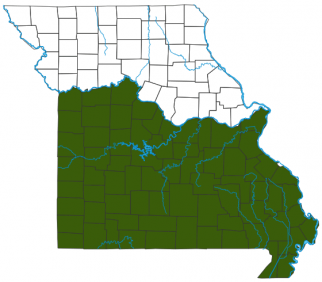
Scattered in the southern half of the state, mostly in the Ozark division.
Habitat and Conservation
Occurs on gravelly banks of streams and rivers, ledges and tops of bluffs, and occasionally glades and openings of dry upland forests.
This species is more commonly found in streamside, gravel-bar habitats than the closely related willow amsonia, which also lives in bottomland forests, dry upland forests, glades, bottomland prairies, pastures, ditches, levees, roadsides, and other disturbed areas.
Status
Native Missouri wildflower.
Human Connections
Easily grown from seed and available at most native plant nurseries, blue star makes an outstanding late-spring wildflower for sunny locations in moist, loamy, well-drained soils. In fall, the willow-like leaves often turn an attractive yellow. Don't dig plants from natural habitats; get starts from reputable native plant nurseries.
Ecosystem Connections
Few animals, including insects, eat the leaves of this plant, probably because of unpalatable, toxic chemicals in the milky sap.
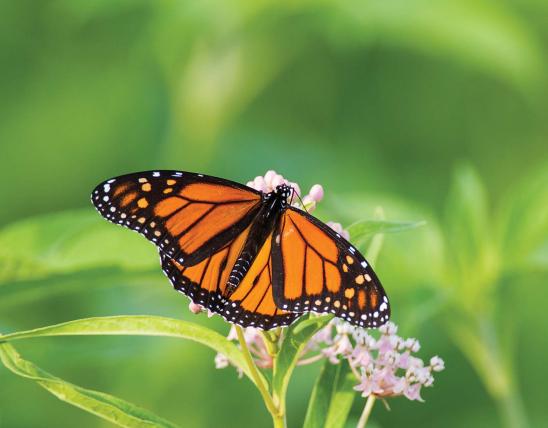
The sweet-smelling flowers attract butterflies, especially the zebra swallowtail and other swallowtails.
Relatives: Amsonias are related to the ubiquitous (and weedy) groundcover common periwinkle (Vinca minor), and to the fragrant tropical frangipani trees (Plumeria spp.).
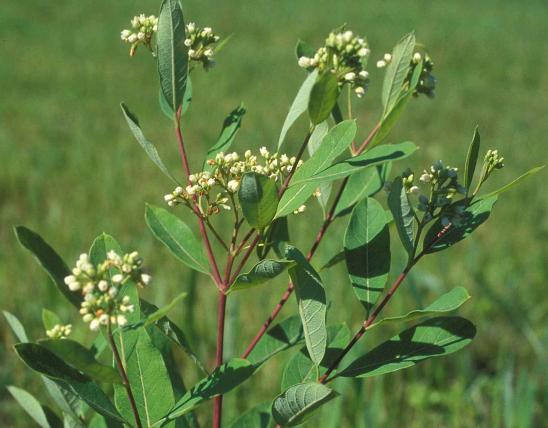
The dogbane family (Apocynaceae) has recently been expanded to include the milkweeds, which used to have their own family. You can see some resemblance in the milky latex, stout, simple leaves, and the seedpods (technically, follicles), which split along a single seam. The flowers of milkweeds are quite different, however, and the milkweeds are still viewed as a distinct lineage within the dogbane family.