







Field cress, also called cow cress or field pepper grass, is an Old World plant that was introduced to America long ago. In Missouri, it is weedy and found mainly in disturbed habitats such as pastures and roadsides. It is one of 10 pepper grass (Lepidium) species recorded for Missouri.
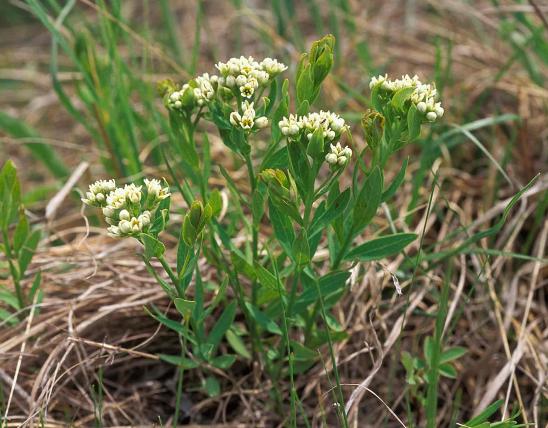
Field cress is an annual with densely hairy stems, much branched toward the top. It looks grayish due to its fine hairs.
The flowers are typical of the mustard family, with 4 small, white petals, arising from the many upper branches.
Blooms April–June.
The basal leaves are dandelion-like with rounded tops, short; the stem leaves are alternate, ascending, about 1½ inches long, entire or crenate (shallowly toothed), clasping the stem, and having 2 pointed "ears" (auricles).
The fruits are seedpods that are egg-shaped in outline, winged and flattened, to about ¼ inch long, with a shallow notch at the tip, containing 2 seeds (1 on each half of the fruit). The fruits are ornamental due to their quantity; they make the plant look like a candelabra.
Similar species: Missouri has 10 species of pepper grasses (Lepidium); also, our common species of penny cress (Thlaspi) might also be confused with field cress:
- Field penny cress, or stinkweed (Thlaspi arvense) is common statewide and looks superficially similar. But it is a glabrous (smooth) plant (not densely hairy), and it has 3–8 seeds (not just 1) on each half of the fruit.
Of the remaining pepper grass species (Lepidium), four are uncommon, but five are sporadic to common. All members of this genus have thin seed capsules bearing 2 seeds (1 seed on each half):
- Poor man's pepper grass, or Virginia pepper grass (Lepidium virginicum), is native, common nearly statewide; it occurs in the same habitats as its close relative L. densiflorum. Annual or biennial. Distinguish it from field cress (L. campestre) by its stems not densely hairy, to 20 inches tall, much branched near the top; also, its basal leaves are featherlike and can be sharply toothed; its stem leaves do not clasp the stem (though the upper stem leaves are stalkless) and are narrowly lanceolate to linear, with a few pronounced teeth.
- Green-flowered pepper grass (Lepidium densiflorum) is native, scattered nearly statewide; it occurs on glades, blufftops, prairies, rocky openings in dry upland woodlands, pastures, fields, roadsides, and other open, disturbed areas. Annual or biennial. The flowers lack petals; if petals are present, they are very small (shorter than the sepals); thus the flowers look green. Closely related to L. virginicum.
- Lens-podded hoary cress (Lepidium chalepense) is nonnative, introduced, and occurs sporadically in open, disturbed areas. It is very similar to L. draba; both are perennials with long-creeping, branched rhizomes, forming dense colonies, and their fruits lack wings.
- Heart-podded hoary cress, or heart-podded whitetop (Lepidium draba), is nonnative, introduced, and occurs sporadically in disturbed areas; it is very similar to L. chalepense.
- Shield cress, or perfoliate pepper grass (Lepidium perfoliatum), is nonnative, introduced, and is widely scattered in open, disturbed areas. An annual or biennial, it is named for its middle and upper stem leaves, which are oval to circular, with the bases perfoliate or strongly clasping the stems with rounded, strongly overlapping auricles ("ears"). The petals are yellow.
Height: usually 10–18 inches.
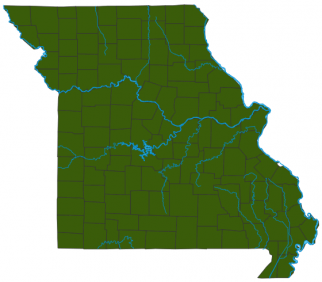
Scattered nearly statewide.
Habitat and Conservation
Occurs on roadsides, railroads, fallow fields, pastures, and other disturbed places.
A native of Europe and Asia that is widely naturalized on our continent.
Status
Nonnative, introduced. Native to Eurasia; widely naturalized in the United States and Canada. Often considered a weed.
Human Connections
The peppery seeds of various types of pepper grass (genus Lepidium) have been used as a flavoring for meat, salads, and soups.
Seed-eating pet birds such as canaries also relish the seeds.
Other historic uses include various medicinal applications, with varying degrees of effectiveness.
The genus name, Lepidium, is from the Greek for "small scale," referring to the thin seed capsules. A key feature of this genus is having only 1 seed per locule (a locule is a chamber within the fruit; in this case, there are two locules per fruit, each with a single seed).
The species name, campestre, translates to the English word campestral; both describe something from a rural area; from fields or the open countryside.
Ecosystem Connections
Several types of wild birds eat the seeds, and insects visit the flowers.
Globally, the ecology of small, annual plants makes them important colonizers of disturbed ground, binding the soil with their roots and breaking the force of raindrops with their leaves, preventing erosion. They prepare the soil for other plants.