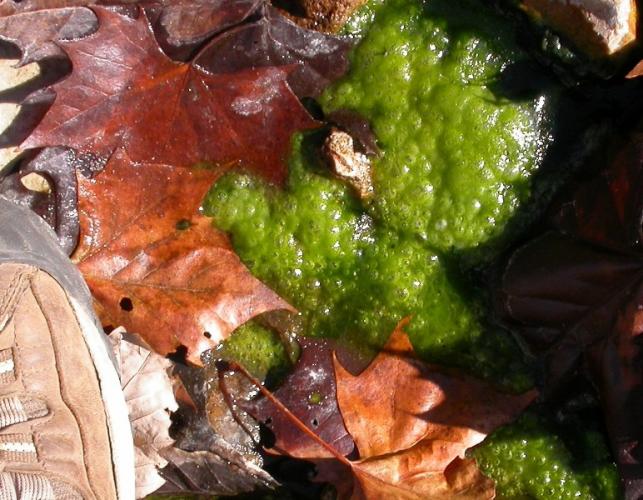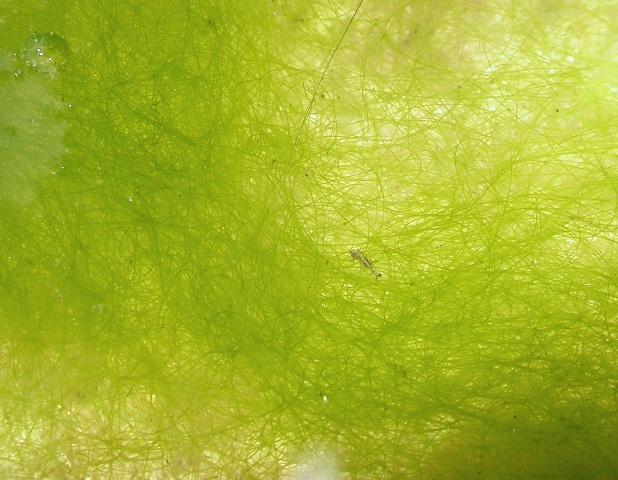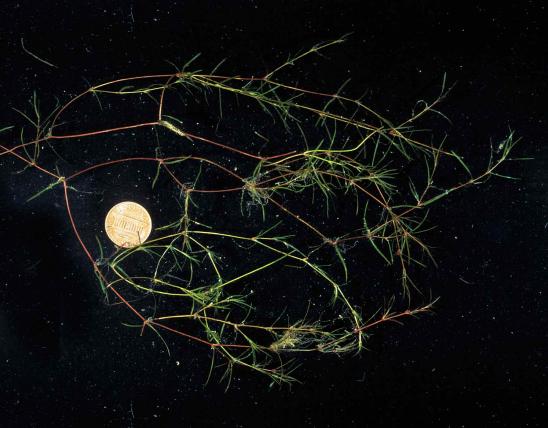







Filamentous green algae forms green, cottony masses that are free-floating or attached to rocks, debris, or other plants.
It consists of fine, green filaments that have no leaves, roots, stems, or flowers. The filaments often form dense mats.
On warm, sunny days, filamentous green algae commonly floats to the surface when bubbles — generated by its own photosynthesis or respiration, or created by decay of its tissues — get trapped in the mats and make them buoyant.
The three genera listed below are examples.
- Cladophora feels cottony and can form balls that float when the core decays; magnification reveals long, slender cells and a branching habit.
- Pithophora is sometimes called “horsehair algae” because of its coarse texture, which can feel like steel wool.
- Spirogyra is bright green and slimy; magnification reveals the chlorophyll-bearing pigments are shaped as spirals; the filaments do not branch.
Note: Not all types of green algae are filamentous; they occur in a great variety of forms, including single cells and colonies.
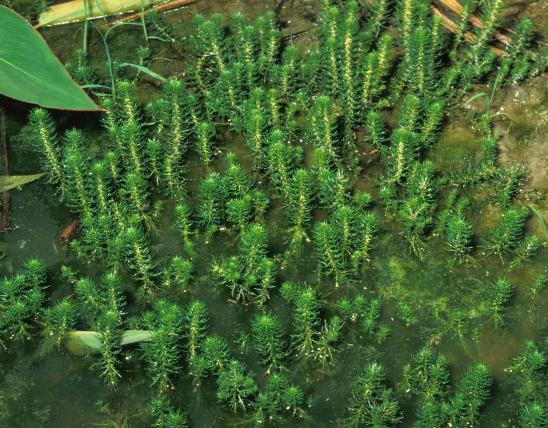
Similar species: Many types of plants live in water, and some (such as the liverwort called crystalwort) even have rather formless shapes. But filamentous green algae are fundamentally different from these other lookalikes:
- Algae are microscopic plants whose cells replicate and form hairlike strands.
- Other pond plants have their cells differentiated and organized into specialized tissues and organs such as stems, leaves, roots, veins, seed- or spore-bearing structures, and so on.

Statewide.
Habitat and Conservation
Green algae grow in practically any water that is capable of supporting life and receives good light.
It initially grows on the surfaces of rocks or other solid objects, but as it grows, it breaks away and floats up to the surface, buoyed by air bubbles caught in its strands.
In early spring and again in late fall, hairlike strands of filamentous green algae have a heyday in forest streams, when leafless trees permit light to reach the water. In forested streams, the algae decreases dramatically in late spring, as the trees leaf out and the streams are shaded.
In ponds and lakes, however, filamentous green algae are most abundant and noticeable during the hottest months of the year.
When a body of water receives excessive nutrients — such as an abundance of decaying animals, or excessive fertilizer or manure runoff — green algae can grow (“bloom”) in quantities that unbalance the ecology of the lake, pond, or stream.
The situation is common in ponds and small lakes surrounded by grassy lawns that are generously fertilized:
- The algae population explodes (blooms) and covers large amounts of the water area.
- Very large algae mats covering the water surface can prevent oxygen from the air from getting into the water, making the water stagnant, reducing oxygen, and sometimes causing fish kills.
- The algae outgrows available nutrients and experiences a die-off ("crashes"). Or, attempts are made to kill the algae with herbicide chemicals, causing large amounts of it to die.
- Then, the decaying algae depletes the pond's dissolved oxygen, as the decay process consumes oxygen and produces carbon dioxide and other waste gases. The reduction in oxygen can kill fish.
- This sets the stage for another bloom to occur.
- A seesawing, boom-and-bust cycle can result, effecting the water chemistry and all the organisms that live in the pond.
- Thus, managing the amount of nutrients entering the pond is key to keeping the algae in control.
Status
Filamentous green algae are a natural part of aquatic ecosystems.
They are considered a nuisance when they become overabundant, especially in ponds; this is usually a result of nutrient imbalances in the water, caused by fertilizer or other nutrient runoff from the land.
Control
Human Connections
As a base of aquatic food chains, algae are tremendously important for healthy rivers, streams, ponds, and lakes, and all the human interests that involve water, including boating and fishing.
When filamentous algae gets out of hand, it can impede fishing and swimming and clog water intake screens.
Ecosystem Connections
Green algae is vital for healthy aquatic ecosystems. As the base for aquatic food chains, it feeds and shelters tiny animals, insects, and young fish.
Greenside darters spawn in late March to the end of April, earlier than most Missouri darters. Timing is everything: this species of fish typically attaches its eggs to strands of filamentous algae (Cladophora spp.) attached to rocks. This hairlike green algae has its big "bloom" in early spring before trees gain their leaves and shade forest streams, causing the algae to decline.
Algae used to be called “primitive,” but a more accurate term is “ancestral” for organisms that have not changed much for billions of years.