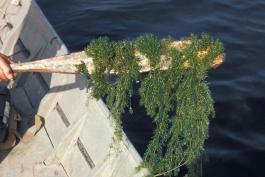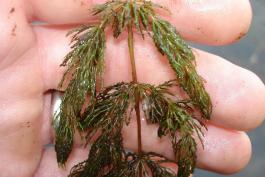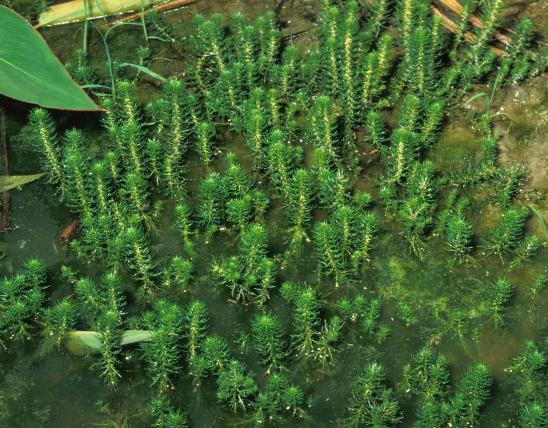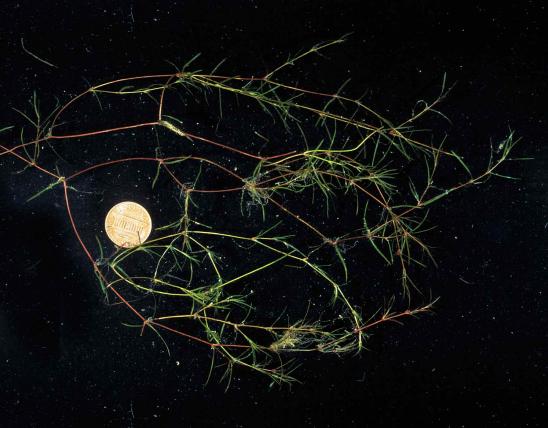











Coontail, or hornwort, is a common submerged aquatic plant, growing in tangled masses just under the surface. It got its name from the crowded upper leaves, which make the stem tip appear bushy like the tail of a raccoon.
Coontail forms large, tangled masses that float freely in the water. The stems can be several feet long, with much branching. It is usually completely underwater, floating just under the surface, and it feels stiff and brittle.
The leaves are grouped in whorls around the stems, and each leaf is needlelike, forked once or twice, and covered with small teeth (thorny projections).
The flowers are inconspicuous, greenish brown, arising usually singly in the leaf axils; male and female flowers arise separately on the same plant.
- Several other aquatic plants have narrow leaves that resemble coontail. Coontail is distinguished by its needlelike leaves that are forked only once or twice and have thorny projections.
Similar species: Missouri has one other species in genus Ceratophyllum: Prickly hornwort, or spiny hornwort (C. echinatum), is uncommon and widely scattered in Missouri, occurring in spring branches, ponds, and sinkhole ponds. It is a Missouri species of conservation concern, ranked as critically imperiled.
- In prickly hornwort, the edges of the leaf segments lack teeth (while C. demersum has teeth relatively prominent). It is named for its seeds, which have numerous spines (while C. demersum's seeds have only 3 spines: 2 at the base and 1 at the tip).
Length: stems to 6 feet or more.
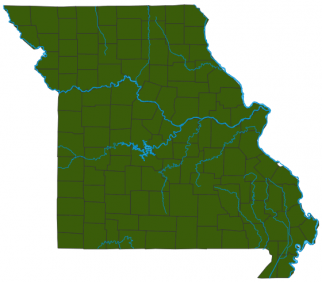
Statewide.
Habitat and Conservation
A submerged aquatic plant that usually grows in slow-moving waters of streams, rivers, and spring branches, and in the still waters of ponds, lakes, and sloughs. It often grows well out from the shore in water several feet deep.
Coontail occurs nearly worldwide; it has been declared an invasive weed in some places. With its fast growth, it can outcompete native plants. It also produces chemicals that suppress the growth of several types of microscopic plants.
Status
Common statewide; widespread, with a global distribution. Sometimes considered a nuisance aquatic plant. Sometimes used in aquatic gardening and in aquariums.
Its close relative, prickly hornwort (C. echinatum), is a Missouri species of conservation concern, ranked as critically imperiled.
Control
Human Connections
This species, under the name of hornwort, is a popular aquatic plant sold in pet stores. In an aquarium it is attractive and hardy. It can provide dense, floating cover for shy fish, spawning fish, and fry. It helps reduce algae by competing with algae for nutrients, and (when it spreads densely along the water's surface) by shading out the algae.
It is sometimes sold for use in pools, ponds, and lakes, but it can multiply quickly and become a nuisance plant. Its dense masses can crowd out other plants and interfere with fishing and boating.
Worldwide, members of this genus have been used in folk medicine to treat a wide variety of conditions.
Ecosystem Connections
Like other aquatic plants, coontail provides shelter for innumerable aquatic animals, from tiny daphnia to lunker bass, and all the food-chain links in between.
Waterfowl eat the fruits and foliage, which helps disperse the plants.
When coontail grows too abundantly, it is often a result of excessive nutrients (fertilizer, farm runoff, etc.) entering the water.
Botanists have disagreed on how many species are in genus Ceratophyllum, ranging from 30 to 7 or even fewer.