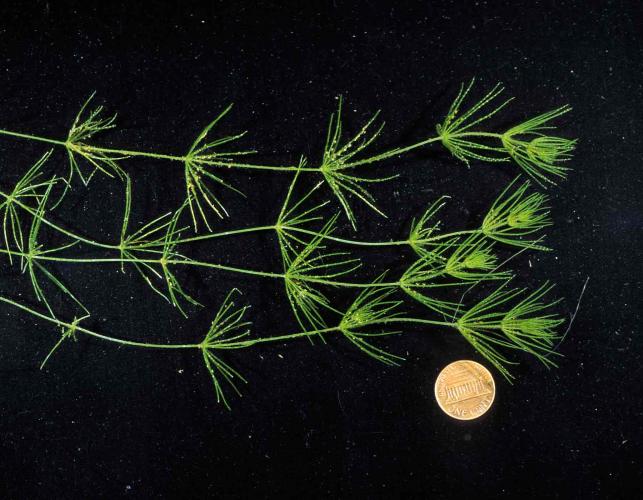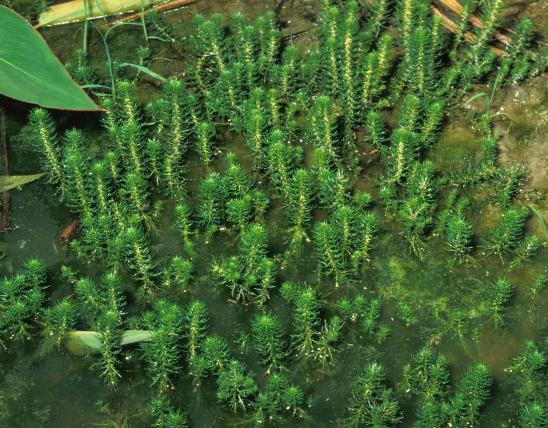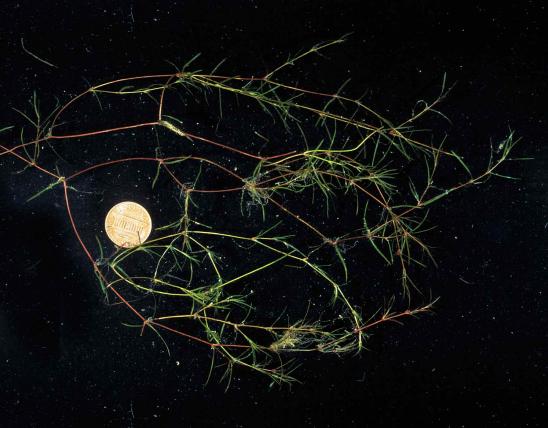











Members of genus Chara are aquatic algae that look like vascular plants. They have a crisp, gritty texture, a musky or garlicky odor, and whorls of gray-green, needlelike structures that resemble leaves.
Chara (pronounced care-uh or karr-uh) looks like a regular vascular plant because it forms stemlike, leaflike, and rootlike structures. It grows attached to the bottom of lakes, ponds, and other bodies of calm water.
The tiny dark balls that form on the whorls of plant are spore-forming reproductive structures.
Removed from water, chara becomes grayish or white once it dries.
Statewide.
Habitat and Conservation
Chara grows attached to muddy bottoms in calm waters.
The gritty feel of chara comes from a thick coating of lime, which it extracts from the hard, alkaline water in which it is commonly found. The name “stonewort” arose from the lime that often encrusts these plants.
Status
In Missouri, the genus Chara includes native and nonnative (introduced) species.
Members of this group are the most familiar macrophytic algae in Missouri. (Macrophytic algae are algae that grow large enough to be visible without magnification, and they also have more than one cell type: the cells differentiate to form stemlike, leaflike, and rootlike structures, for example. The seaweeds called kelp are familiar saltwater macrophytic algae.)
Life Cycle
Chara can reproduced asexually (vegetatively) or sexually.
In asexual reproduction, the alga creates small packages of itself that can break off to start new plants. These are exact genetic copies, or clones, of the original; essentially, "cuttings."
In sexual reproduction, chara creates sperm and eggs in separate organs; sperm is released to join with the eggs of other plants; the new plants that develop possess a combination of the genetics of the two parents.
Control
Human Connections
Chara can be undesirable in ponds and lakes because it can carpet the bottom and crowd out other species.
An overabundance of chara is often brought about by excessive nutrients entering the water, such as fertilizer, agricultural runoff, and leaking septic systems.
Limnology is the science that studies inland aquatic systems; it is something like oceanography, only for freshwater. It includes not only aquatic plants and animals (and their interactions), but also water chemistry, the way that land moves over and through the land, and the physics of water itself.
- Chara's preference for hard, alkaline water, and its ability to build up calcium on its cell walls, shows a clear relationship between water chemistry and the plant's biochemistry.
- Limnologists do important work in helping protect natural lakes, ponds, streams, and rivers, as well as helping people and communities manage lakes and ponds for human uses.
Ecosystem Connections
As with other submerged aquatic plants, chara provides important food and habitat for aquatic animals, large and small. The smallest animals, such as daphnia and tiny insects, are eaten by progressively larger ones, fish, amphibians, birds, and so on.
Some waterfowl, such as coots, eat chara.
These curious underwater plants are actually large algae, growing in a form that makes them resemble vascular plants. Botanists believe that the various species of chara are the closest living algal relatives to the land plants.
Globally, there are about 400 species in the family Characeae, with about 160 species in genus Chara. Most live in freshwater or brackish habitats.