














Taking the Pulse of the Land
The Community Health Index allows biologists to quickly assess habitat condition
Fully evaluating a habitat — its plants, animals, soils, etc. — is a time-consuming endeavor, often taking weeks or months to complete. When agencies manage hundreds of thousands of acres, this level of effort is not possible across all their lands, so land managers need a less stringent but effective method. To better meet this need, MDC and partners recently developed the Community Health Index (CHI).
“CHI is a way to more rapidly assess and monitor our different natural communities, particularly those that have declined and we’re trying to restore,” MDC Natural Community Ecologist Mike Leahy explained.
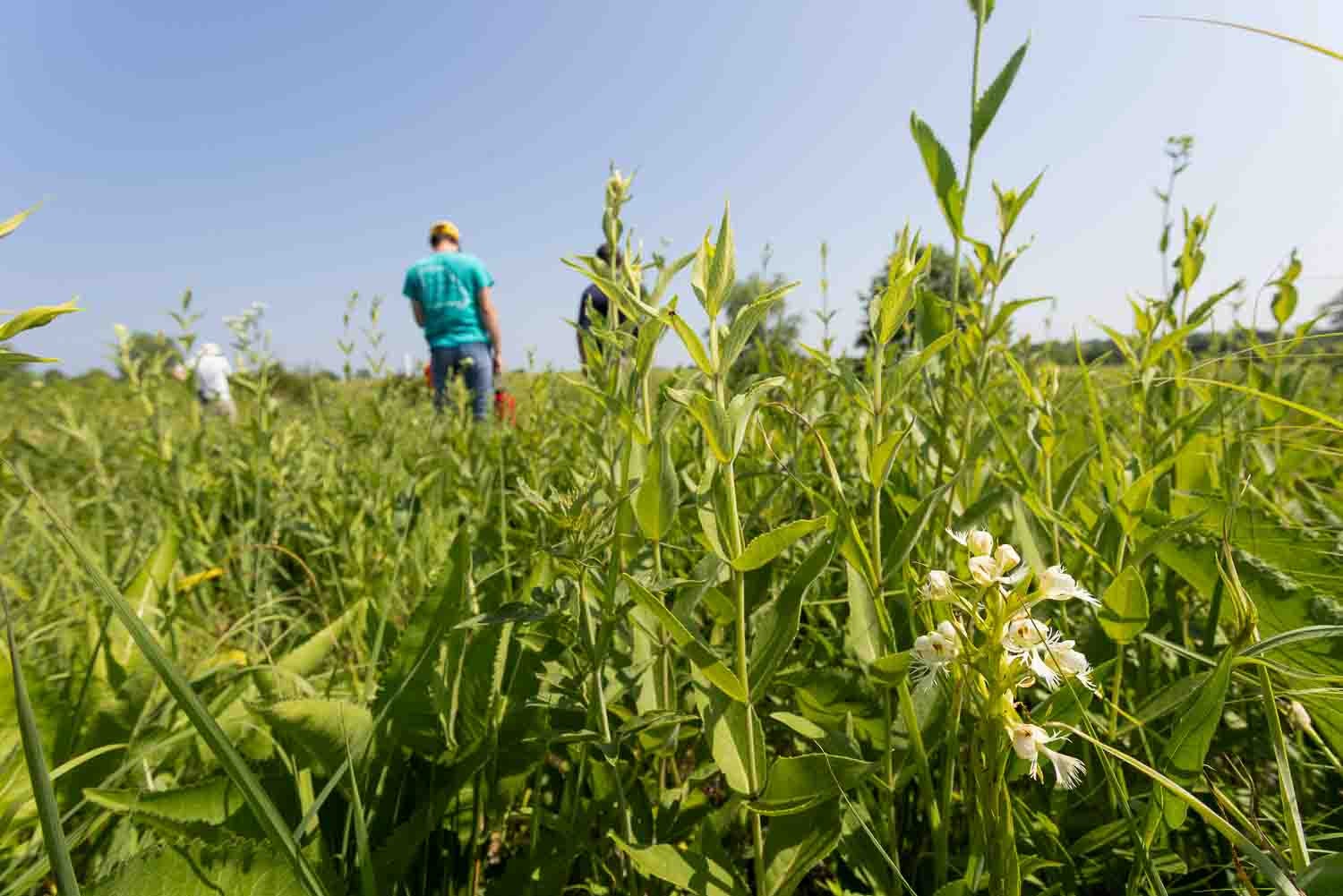
With CHI, biologists look at key factors within a habitat type, covering a 40-acre survey unit in an hour or less depending on the terrain. The size and total number of survey units depend on the overall habitat acreage. The data are then plugged into a point system that generates a relative health score. It is somewhat like a doctor using blood pressure, cholesterol, and blood sugar as baseline indicators of a patient’s general health.
Most of a CHI score comes from vegetation. This is because vegetation influences everything else — it provides habitat for animals, is the base of the food chain, and is directly connected to soil.
“Based on expert opinion and field testing,” Leahy said, “we have a list of target indicator plant species. We then assign random points across the prairie or woodland, and as we navigate to those points, we check off the native plants as well as the nonnative, invasive species that we see. At the end, we assess the amount of shrub, tree, grass, and flowering plant cover.”
Data on birds, insects, reptiles, and amphibians are added when available from other surveys but are not required. CHI scores can be used to compare sites and to see how an area changes over time.
“We’re now going through the first run for the native grasslands and the pine-oak woodland restoration units,” said Leahy. “Our next effort will be looking at some of our glades and oak woodlands and then we’ll develop CHIs to assess some of our bottomland forest communities.”
At a Glance
The Community Health Index (CHI) provides a quick assessment of habitat health. Each habitat type has its own list of indicator species and landscape criteria that biologists look for during site surveys. These data are plugged into a scoring system, totaling up to 100 possible points.
CHI Components
- Landscape type and site size — up to 10 points
- Vegetation characteristics — up to 80 points
- Animal species — up to 10 points
- Degrading factors (invasive species, soil disturbance, etc.) — up to 11 points can be subtracted
Partners
U.S. Forest Service, Missouri Prairie Foundation, The Nature Conservancy, University of Missouri
And More...
This Issue's Staff
Editor – Angie Daly Morfeld
Associate Editor – Larry Archer
Photography Editor – Ben Nickelson
Staff Writer – Kristie Hilgedick
Staff Writer – Joe Jerek
Staff Writer – Dianne Van Dien
Designer – Marci Porter
Designer – Kate Morrow
Photographer – Noppadol Paothong
Photographer – David Stonner
Circulation – Marcia Hale