






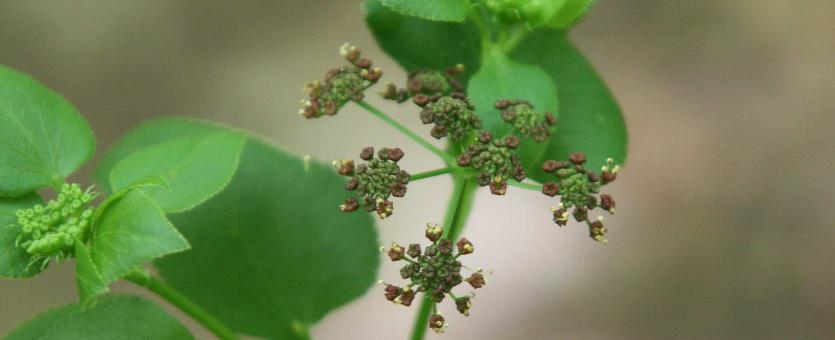
One of our more challenging plants to identify, meadow parsnip looks a lot like golden Alexanders. But look closely at the flower clusters and the edges of the leaves, and then check the seeds.
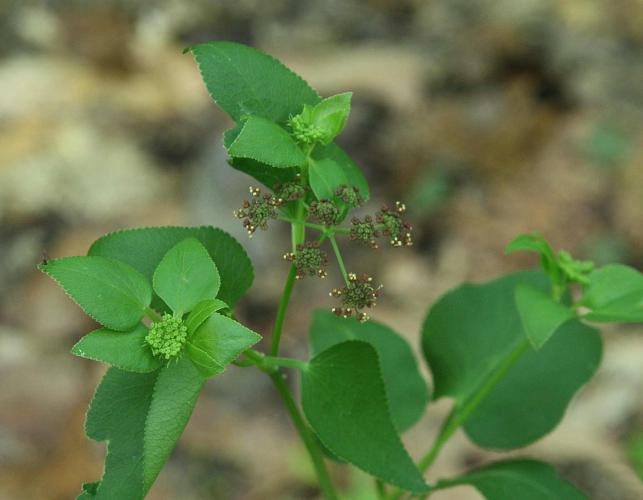
Meadow parsnip is a much-branched, upright perennial, without hairs.
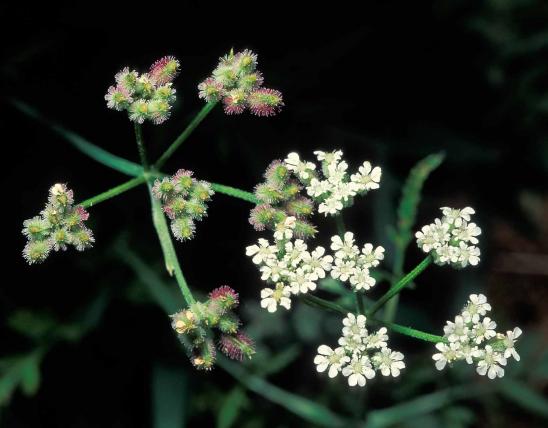
The flowers are minute, in compound, flat umbels, dark yellow, rarely purple or brownish purple. The central floret of each umbellet (smaller division of the compound umbel) is slightly raised, on a stalk.
Blooms April–June.
The basal leaves are simple, heart-shaped or only once-divided. The stem leaves are on long stems (petioles) and are divided into three egg-shaped, pointed, finely toothed leaflets that have rounded bases. All leaflets have a very narrow yellowish-white margin, a ready identification characteristic.
Two varieties of meadow parsnip occur in Missouri, with the only difference being the flower color:
- Yellow meadow parsnip (Thaspium trifoliatum var. flavum) has yellow flowers. It is scattered nearly statewide, though more common south of the Missouri River.
- Purple meadow parsnip (Thaspium trifoliatum var. trifoliatum) has maroon or purplish flowers. It is uncommon and widely scattered in the Ozarks.
Similar species: Members of the carrot-parsley family can be confusingly similar.
- Missouri's other meadow parsnip species, hairy-jointed meadow parsnip (Thaspium barbinode), lacks the pale borders of the leaves. It's named for the stiff hairs that usually occur on the bases of the leaf stems, where they attach to the otherwise hairless plant stem.
- Golden Alexanders (Zizia spp.) are similar, but they don’t have the center flower in each umbellet slightly raised; instead, that floret is mostly stalkless and recessed. A surer way to distinguish between these genera is to examine the fruits: Those of Thaspium are strongly winged, while those of Zizia are unwinged or are only ribbed or slightly winged.
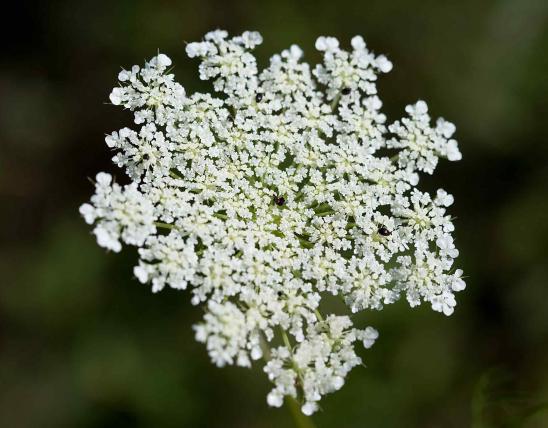
- Wild parsnip (Pastinaca sativa) is more weedy, has flatter flower clusters, and the flowers are more brightly yellow. The leaves are different, too.
Height: to 2½ feet.

Scattered nearly statewide, but more common south of the Missouri River.
Habitat and Conservation
Grows in mesic to dry upland forests, upland prairies, savannas, glades, ledges and tops of bluffs, and less commonly banks of streams; also old fields, roadsides, and railroads.
Status
Native Missouri wildflower.
Human Connections
This species is cultivated in native plant gardens for its showy flower clusters and foliage.
Distinguishing, with certainty, between this plant and the similar-looking golden Alexanders is a bit of a challenge. But people love challenges. Indeed, it is part of our human nature, and being able to identify plants, with certainty, was once a matter of survival.
Ecosystem Connections
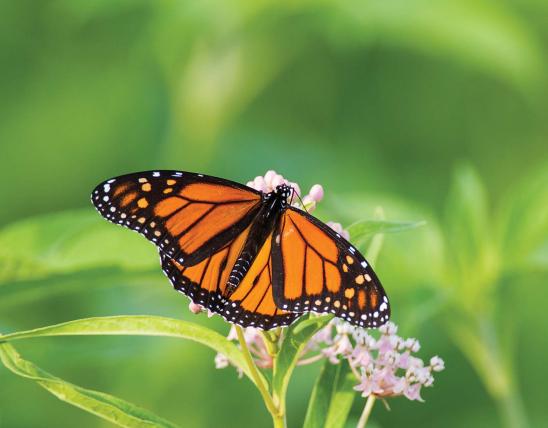
Bees, butterflies, flies, and other insects collect nectar and pollen from the flowers.
Black swallowtails and Missouri woodland (or Ozark) swallowtails use this and other wild carrot-family species as natural food plants for their larvae.