












This 320-acre prairie was purchased in 2009 with funds donated from the Wade and June Shelton Family. The area is mostly open prairie with a small amount of brushy cover.
Media
Status
Name
Endangered
Name
Species of Conservation Concern
Scientific Name
Tympanuchus cupido
Family
Phasianidae (pheasants) in the order Galliformes
Description
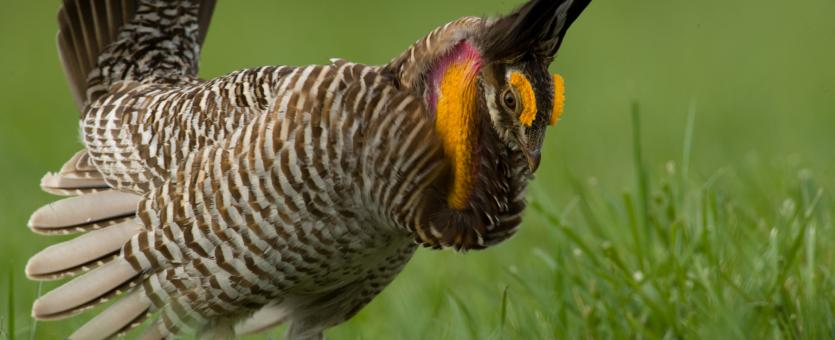
Adult greater prairie-chickens are barred with brown, tan, and rust colors throughout and are similar in size to a small domestic chicken. The tail is short and rounded at the tip. There are tufts of long feathers on the sides of the neck; these tufts are longer in males. Orange air sacs and eyebrows are conspicuous on males in the spring.
Size
Length: 17 inches (tip of bill to tip of tail).
Where To Find

A small population survives in Harrison County in northern Missouri and in bordering Ringgold County in Iowa; sporadic individual birds (1–2 males) have been reported in St. Clair County via eBird observations; however, official counts have not observed the species there since 2023.
Habitat and Conservation
Missouri’s remaining prairie-chickens live on native prairies and in properly managed grasslands. They require wide open vistas of permanent, diverse grasslands with minimal trees and woody vegetation. These grassland areas must provide a variety of structures: short, grazed areas for lekking and breeding; unburned or managed grassy areas for nesting and concealment; and recently managed, recovering areas with bare ground, forbs, and grass for brood rearing and foraging, all in close proximity.
Loss of suitable habitat from agricultural conversion and nonnative grass establishment and grazing is the largest reason for this species’ decline. Without substantial increases in suitable habitat, the species, which once numbered in the hundreds of thousands in our state, will likely soon be extirpated. Large-scale grassland reconstruction, restoration, and enhancement is the key to their survival. Greater prairie-chickens will avoid grassland areas with large trees or forested areas that obscure views, as well as tall rank unmanaged or disturbed grasslands.
Food
Prairie-chickens eat insects, forb seeds, and greens, as well as some grains. During summer, broods heavily use legume hayfields, soybean fields, weedy pastures, and prairies recovering from recent fires.
Status
Endangered within Missouri; a Missouri species of conservation concern. Rare permanent resident. Nongame. Fewer than 25 birds remain in isolated populations in northwest and west-central Missouri.
Life Cycle
Life Cycle
Breeding season lasts from March through mid-April. Cocks visit booming grounds (leks), where they dance, call, and fight among themselves. Hens visit the lek and select the most fit mate; mating occurs on the lek during this time. Nests are simple and hidden in grasses; clutches usually contain 12–13 eggs. Incubation lasts about 24 days. Chicks remain with the hen for 8–10 weeks before the brood breaks up. Brood survival is very low.
In fall and winter, both males and females will form small flocks and will forage in fallow crop fields, pasture, and recently disturbed (via fire or grazing) prairie and warm-season grass plantings. Additionally, they will roost and conceal themselves in grasslands that are more than 12–14 inches tall, but might avoid overly tall and rank grassland vegetation (over 24–30 inches tall).
Human Connections
The prairie-chicken was once a prized game bird in Missouri and is an important symbol of our prairie and grassland heritage in the state. Its colorful habits and life history keep it popular among wildlife enthusiasts and birders. It is up to humans to preserve the prairie and grassland habitats that these magnificent birds require to persist.
Ecosystem Connections
Prairie-chickens are indicators of healthy grassland ecosystems and are part of the unique, interconnected community of plants and animals in Missouri prairies. Management for prairie chickens benefits many other species as well.
Title
Media Gallery
Image

Caption
With their numbers dwindling, greater prairie-chickens need strong conservation support.
Right to Use
Photo by MDC Staff, courtesy Missouri Department of Conservation
Image

Caption
Male greater prairie-chicken.
Credit
Jim Rathert
Right to Use
Photo by Jim Rathert, courtesy Missouri Department of Conservation
Image

Caption
Female greater prairie-chicken.
Credit
Jim Rathert
Right to Use
Photo by Jim Rathert, courtesy Missouri Department of Conservation
Image

Right to Use
Photo by MDC Staff, courtesy Missouri Department of Conservation
Image

Right to Use
Photo by MDC Staff, courtesy Missouri Department of Conservation
Image

Image

Caption
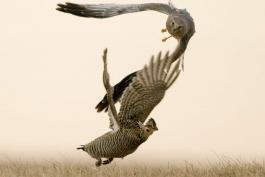
Northern harriers forage in open areas for rodents, birds, snakes, and insects.
Credit
Noppadol Paothong
Right to Use
Photo by Noppadol Paothong, courtesy Missouri Department of Conservation
Image

Caption
Northern harriers are nimble, graceful fliers that use their impressive agility to capture birds and other prey.
Credit
Noppadol Paothong
Right to Use
Photo by Noppadol Paothong, courtesy Missouri Department of Conservation
Video file
Caption
Video of prairie chickens in the wild.
Audio file
Caption
Male greater prairie chickens make haunting mating sounds, also known as "booming," on special areas called "leks."
Image

Image
Image

Image

Image
Image

Image

Image
Thumbnail

Thumbnail

Title
Similar Species
Similar Species
Where to See Species
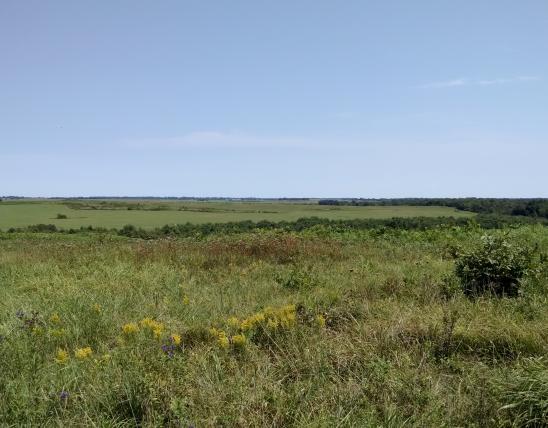
Taberville Prairie is a remnant of the prairie ecosystem that once covered more than one-quarter of Missouri.
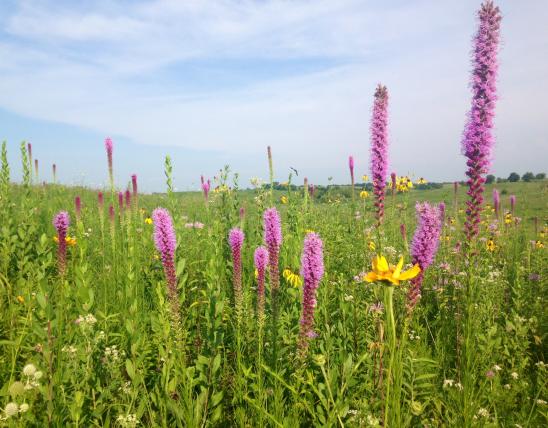
Pawnee Prairie Natural Area is in northern Harrison County.
Pawnee Prairie was named for a Native American tribe that occupied the area. It is also the name of a nearby town.
Pawnee Prairie was named for a Native American tribe that occupied the area. It is also the name of a nearby town.
About Birds in Missouri
About 350 species of birds are likely to be seen in Missouri, though nearly 400 have been recorded within our borders. Most people know a bird when they see one — it has feathers, wings, and a bill. Birds are warm-blooded, and most species can fly. Many migrate hundreds or thousands of miles. Birds lay hard-shelled eggs (often in a nest), and the parents care for the young. Many communicate with songs and calls.
Reviewed On