








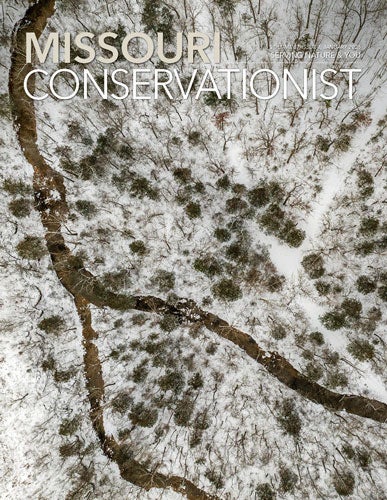
Beaver Dam Analogs
Biologists test a new method for restoring prairie streams
When it comes to restoring landscapes, we can learn much from the American beaver, whose dams have a hefty effect on stream function, water quality, the aquatic community, and surrounding vegetation.
So, when MDC Stream Program Specialist Ange Corson stumbled upon an article about fake beaver dams being used to improve stream habitat in western states, she took notice.
“We’re very concerned about our streams,” Corson said. “Many of them have been channelized, and now they’re highly incised [eroded] and no longer attached to their floodplains.”
Fake beaver dams, known as beaver dam analogs (BDAs), offer a low-cost way to slow the flow of water in streams to help restore them to a more ecologically friendly form.
Corson’s inquiry led to a joint project between MDC, The Nature Conservancy, U.S. Geological Survey, and the University of Missouri to test BDAs on streams at Dunn and Pawnee prairies in northwest Missouri.
In the fall of 2024, the team built 24 BDAs (six each on four streams), while also leaving sections of those streams untouched to serve as a control for comparison.
To measure the success of the BDAs, several components are now being evaluated, explained Jacob Westhoff, assistant leader of the U.S. Geological Survey Missouri Cooperative Fish and Wildlife Research Unit at the University of Missouri. These include the fish community, fish movement, water quality, water temperature, groundwater levels, stream morphology, and vegetation.
“For some things we expect to see changes rather rapidly,” Westhoff said. “The accumulation of sediment behind the structures, you can expect to see rather quickly if they’re doing the job as we anticipated … [while other things might have] a more delayed response.”
In time, said MDC Floodplain Ecologist Grant Sprague, “We’re expecting to see a shift in the plant community to more wetland-associated species.”
Although the timeframe allotted for this project focuses on the short-term changes, some monitoring will continue afterward. If the BDAs are successful, they may be installed on conservation areas in the future to help restore streams in those locations.
At a Glance
Beaver Dam Analogs (BDAs)
BDAs mimic beaver dams as a low-cost, low-tech method to restore stream health and function. They are built by pounding wooden posts into a streambed and weaving vegetation — often saplings and tree branches — through the posts, then adding mud and gravel.
What BDAs do:
- Slow water flow
- Reduce erosion
- Create pools
- Build up sediments
Potential BDA outcomes:
- Water table rises to natural level
- Stream reconnects to floodplain
- Native vegetation returns
- Habitat improves for native fishes and other aquatic life herd
MDC and partners are testing the effectiveness of BDAs on four prairie streams in northwest Missouri.


Also In This Issue

Cold-weather treks have much to offer the prepared hiker

SERVING NATURE AND YOU
Fiscal Year July 1, 2024–June 30, 2025
And More...
This Issue's Staff
Editor – Angie Daly Morfeld
Associate Editor – Larry Archer
Photography Editor – Ben Nickelson
Staff Writer – Kristie Hilgedick
Staff Writer – Joe Jerek
Staff Writer – Dianne Van Dien
Designer – Marci Porter
Designer – Kate Morrow
Photographer – Noppadol Paothong
Photographer – David Stonner
Circulation – Marcia Hale