










On a slightly warmer than normal early October weekend, MDC Curriculum Coordinator Mary Beth Factor walks point on a line of nearly 20 other backpackers along an ever-changing 4-mile stretch of the Ozark Trail connecting the National Park Service campground at Round Spring to Echo Bluff State Park (SP).
Through the inclines and declines and over the roots and rocks that characterize hiking in the Ozarks, Factor shares more than insights on backpacking — she leads a walking class on nature, pointing out a variety of trees, signs of wildlife, and geological features.
At the back of the line, Texas County Conservation Agent Chris Ely gives his own outdoor lesson, only his topic is black bears, and his goal is to allay the fears of another participant. Stationed in the middle, MDC Ozark Region Conservation Educator Sam Stewart discusses backpacking gear, tips, and tricks.
In between are 17 participants of MDC’s fall Introduction to Backpacking, a biennial course aimed at teaching the basics of not only hitting the trail but preparing oneself for an overnight stay in the wilderness with just what you can carry on your back.
Current River Challenge
This weekend, the plan is to complete the Current River Challenge — a hiking and floating route developed by the National Park Service, Missouri State Parks, and the Ozark Trail Association that has participants hiking more than 8 miles from Round Spring to Current River SP and then floating the Current River back to Round Spring. In this version, participants camp midway through the hike at Echo Bluff SP. While still challenging, the route’s access to the state parks and their facilities makes this event more beginner friendly than its spring counterpart on the Paddy Creek Wilderness Trail in the Mark Twain National Forest, Factor says.
“It’s a bougie trip,” she says. “It’s a nice introductory trip. I mean, most of the time when you backpack, you’re not going to come across flushing toilets. You’re not going to come across the option to go get yourself a hot cocoa.”
And while not as demanding as the spring route, “bougie” by no means equates to “easy,” and the event still challenges backpackers enough to determine if the sport is for them, she says.
“This backpacking is a challenge,” she says. “It’s not something that’s taken lightly, and I feel like once you can work past your mental obstacles — because everybody runs into them — then you get to have that joy of saying, ‘I did it.’ And my hope in the end is that people will take inspiration and continue their backpacking adventures without being with MDC to do that, that they feel like, ‘I have the skills to continue this.’”
Removing the Barriers
While participants are carrying their own gear, including tents, sleeping bags and pads, food, water, and other personal essentials, it is the program staff, like Factor, Ely, and Stewart, who are doing the heavy lifting of logistics and, in some cases, equipping participants.
For 15-year-old Haileigh Schroeger, it is the handling of the logistics — identifying which trails to take, coordinating equipment transfers, arranging campsites and programming with state parks, and more — that makes the backpacking program, as well as other outdoor pursuits, possible.
“I really like doing anything outdoors,” Haileigh says. “The problem is that we had only moved out here not too long ago, so we didn’t know the places to go. That’s whenever we started getting in with the Conservation Department. Basically, anything I do outdoors is with the Conservation Department and with the programs that they have.”
Although some participants arrive on Saturday morning with their own gear, most are assigned equipment from MDC’s inventory, which was upgraded thanks to a grant Ely secured from the Missouri Conservation Heritage Foundation.
“I believe we had done at least two of these overnight backpacking programs with kind of a hodgepodge of equipment, some from Twin Pines (Conservation Education Center), some from other places in the Education Branch,” he says.
By removing the barriers and giving participants an easier entry to the sport, the organizers hope the backpackers will be able to focus on the activity, Factor says.
“We take away that barrier of costs and expense,” she says. “And so, it’s like, let’s see if you actually enjoy doing this. Let’s see if this is something that you feel like would be really neat to do. So, I think the reason why it’s so successful is because we just remove those two barriers.”
Ely hopes the students will in turn become teachers.
“What we really want to do is give the backpackers the knowledge and the skills to not only go out and be comfortable backpacking, but to be able to put their own program together for themselves, or if it’s a mother, for her kids, or father, if he wants to, for his family,” he says. “Whoever is interested in it, the bottom line is to be able to have that knowledge and skill and ability to plan a backpacking trip and to feel comfortable doing it.”
A Good Reminder
Establishing that comfort level begins well before anyone arrives at Round Spring. Nearly a month before the event, staff meet with participants online. Topics include food, personal gear, what to wear, and — perhaps most importantly — making sure you’re physically fit for the trek.
“I would suggest that if you’re not sure if you’re physically capable, start doing that 1 to 2 miles a day, and that’ll tell you pretty quick,” says Stewart. “And as you get better and better at that, then you can start adding. If you have a backpack with some stuff in it, you can put that on your back to understand what it feels like to have weight.”
The morning begins on Saturday at the Round Spring pavilion with Stewart’s demonstration on how to pack a backpack and an inventory of what he carries in his. Each participant then packs their own pack and submits it for weighing, with a goal of not exceeding 20 percent of the backpacker’s body weight. Managing that weight can mean the difference between comfort and agony on the trail, Stewart says.
“You can carry everything that you need,” he says. “It heightens our awareness of what we need and what we don’t. You find that first timers often bring way too much stuff, things that they don’t necessarily need, and then they find out, ‘Well, I could really do with a whole lot less.’ And that’s a good reminder for backpacking, but maybe a good reminder in life, too.”
A Family Affair
For Waynesville resident Irene Muir, the program is already an extended family affair. Along with her daughter, Calleigh, 17, Muir is providing the experience to the family’s two foreign exchange students, Chihoro Yoshida of Japan and Joao Marques of Brazil.
“We do glamping, but this is the first time like this, setting up your own tent and everything,” Muir says. “My daughter, she said, ‘I wanna try camping.’ I’ve never done camping, so I’ll join her. So, we’ll try; we’ll learn together.”
And while technically an introductory program, not all participants are true beginners. Springfield residents Danielle Buzbee and Amy McIntosh bring with them the experience of the spring’s Paddy Creek Trail event.
“I didn’t know anything going into it,” Buzbee says. “So, it was very helpful, just knowing where to camp, knowing not to camp under dead branches, just things you would not think about, like learning how to do the bear bag.”
The last item is of particular importance to McIntosh.
“I’ve already learned a whole lot talking to Chris,” she says. “I learned a lot talking to Beth. I had a fear of bears that was not rational. The more knowledge helped put my mind at ease, which is really, really helpful.”
A Change of Perspective
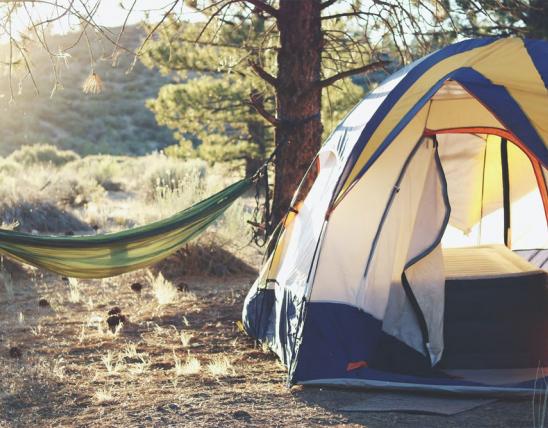
Come mid-afternoon, the group arrives at the Echo Bluff SP campground, ahead of schedule and apparently none the worse for wear. After a tutorial on choosing a site for pitching one’s tent, participants set up their tents, stow their gear, and either relax in their tents or head down to Sinking Creek to soak their tired feet in the cool, spring-fed water.
Among those are Marta Howard, Jaslyn Johnson, and Katie McAnally, all students of Missouri State University in Springfield and members of the university’s Wildlife Society. Each has outdoor experience growing up, but the backpacking program allows them to expand on their experience. They hope to use that experience to encourage more young women to head outdoors.
“I actually tried it because I like being outdoors and I was like, ‘Hey, let’s go do outdoorsy things,’” says McAnally, a Colorado resident. “Then you realize that you can do a lot more than you think once you actually try.”
For Howard, a Jefferson City resident, backpacking offers a unique experience, but getting others outdoors may begin with something simpler.
“I would recommend bringing a friend along and going out for an hour or so around the park,” she said. “It doesn’t have to be like camping in the woods, just something we can go outside in nature and really just take time to look at the world and see how pretty it is. It’ll change your perspective.”
Stronger Than You Think
After dawn on the second day, the campsite slowly awakens. Campers eat breakfast, strike tents, and reload backpacks before setting out on a day similar to the previous in distance and terrain but with a very different ending. Instead of setting up camp, the hike ends with lunch at Current River SP, followed by loading gear into a trailer, and launching kayaks onto the Current River for the challenge’s last leg.
Once again, Stewart provides instruction for those new to kayaking and reminders for those with experience. As on the trail, staff position themselves at the front, middle, and back of the group to ensure anyone having trouble receives prompt assistance.
Finally off their feet, the group enjoys a relatively mild, 4-mile float on the popular river, which by October is void of the crowds found during hot summer weekends.
After the kayaks are pulled from the water and loaded onto trailers, Factor circles up the group for reflection. For most, the takeaway from the weekend is the realization that achievements once thought impossible are reachable with preparation, effort, and persistence.
“My favorite part of the trip is truly at the very end when we reflect,” Factor says. “Because that is when I get to hear the genuine feedback from everyone, and 95 percent of the time people are so appreciative of the experience, and they truly walk away with the idea of, ‘I really am stronger than what I think.’”
At 62, Associate Editor Larry Archer was the oldest participant in last October’s Introduction to Backpacking event. His most recent previous overnight backpacking outing was in 1980.


Also In This Issue

Managed hunts, mentoring provide a way into the sport

Resurgent black bear population restores bears from nearly gone to elusive game
And More...
This Issue's Staff
Editor – Angie Daly Morfeld
Associate Editor – Larry Archer
Photography Editor – Ben Nickelson
Staff Writer – Kristie Hilgedick
Staff Writer – Joe Jerek
Staff Writer – Dianne Van Dien
Designer – Kate Morrow
Designer – Marci Porter
Photographer – Noppadol Paothong
Photographer – David Stonner
Circulation – Marcia Hale