











Go Native!
Buy native tree and shrub seedlings from MDC’s George O. White State Forest Nursery
Need trees and shrubs for your landscape? Go native with tree and shrub seedlings from MDC’s George O. White State Forest Nursery. Native trees and shrubs can help improve wildlife habitat and soil and water conservation while also improving the appearance and value of private property.
The state nursery offers a variety of low-cost native tree and shrub seedlings for reforestation, windbreaks, erosion control, wildlife food and cover, and other purposes.
The nursery provides mainly 1-year-old, bare-root seedlings with sizes varying by species. Seedling varieties include pine, bald cypress, cottonwood, black walnut, hickory, oak, pecan, persimmon, river birch, maple, willow, sycamore, blackberry, buttonbush, hazelnut, redbud, ninebark, elderberry, sumac, wild plum, witch hazel, and others. MDC recommends ordering early for the best selection.
Seedlings are available in bundles of 10 or increments of 25 per species. Prices range from 40 cents to $1.17 per seedling. Sales tax will be added to orders unless tax exempt. There is a shipping fee and a $9 handling charge for each order. Receive a 15 percent discount up to $20 off seedling orders with a Conservation ID number. Orders will be shipped or can be picked up at the nursery, located near Licking, from February through May.
New this year, MDC is offering four different types of seedling bundles: pollinator, wildlife, edible, and nut bundles. Each customer is limited to only two of each bundle.
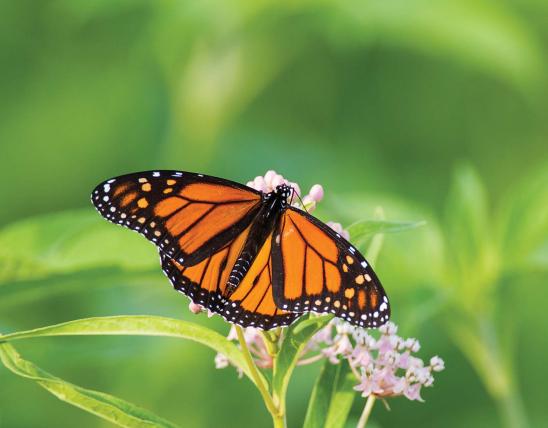
- Pollinator bundles include five each of the following: false indigo, buttonbush, elderberry (cook before eating), witch-hazel, and redbud. These provide much-needed nectar for bees, butterflies, moths, and other pollinators.
- Wildlife bundles include five of each of the following: false indigo, blackberry, smooth sumac, white oak, and Nuttall oak. These provide food and cover for a wide variety of insects and other wildlife.
- Edible bundles include five of each of the following: blackberry, elderberry (cook before eating), American plum, hazelnut, and black walnut. These provide food for both humans and wildlife.
- Nut bundles include five of each of the following: black walnut, pecan, and shellbark hickory. These species are edible for humans and are a great source of protein.
Find the 2025–2026 Seedling Order Form in the September issue of the Missouri Conservationist. You can also get a copy at MDC regional offices and nature centers or by contacting the State Forest Nursery at 573-674-3229 or StateForestNursery@mdc.mo.gov.
Orders can be placed through April 15, 2026, online at short.mdc.mo.gov/ZNZ.
Find fall color with MDC
The peak of fall color in Missouri is usually around mid-October. This is when maples, ashes, oaks, and hickories are at the height of their fall display. By late October, the colors are normally fading, and the leaves are beginning to drop from the trees. Fall color is typically finished by the middle of November.
The progression of color change usually starts earliest in northern and western Missouri and moves southward and eastward across the state. Generally, the color change is predictable, but it can vary from year to year, much of it depending on the weather.
Find some of the best places to view fall color, related events, and a weekly update on how colors are looking throughout the state at short.mdc.mo.gov/ZVf.
Join us for Deer Management Open Houses Around the State
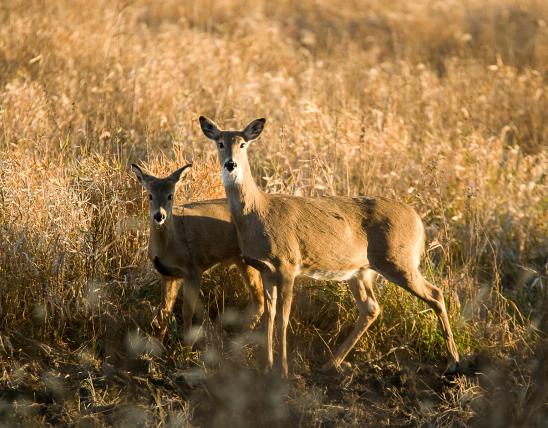
Enjoy hunting deer or watching them? Want help managing private land for deer? Want to know more about our efforts to keep deer healthy? MDC invites deer hunters, landowners and managers, wildlife watchers, and others interested in Missouri’s white-tailed deer to a series of community open houses around the state.
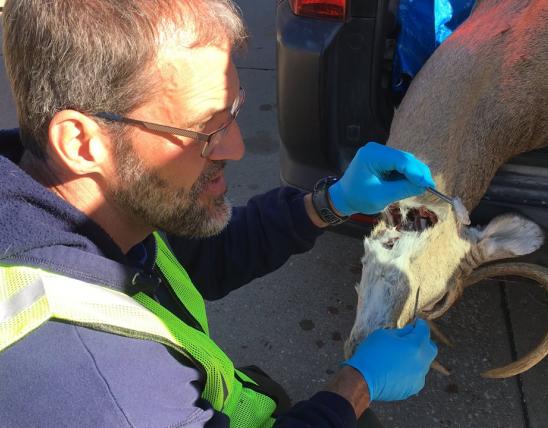
Attendees can talk with MDC staff about deer management and regulations, impacts of chronic wasting disease (CWD) and epizootic hemorrhagic disease (EHD) on deer populations, managing private land for deer, and MDC’s Deer Management Assistance Program. In addition, MDC staff will share new information on CWD and how MDC is working with hunters, landowners, and other partners to minimize the threat of CWD and keep Missouri deer healthy.
“For generations, Missourians have worked together to protect deer and deer hunting,” said MDC Director Jason Sumners. “Fueled by a shared passion for white-tailed deer, hunters and other wildlife enthusiasts inside and outside MDC have built a healthy, abundant herd. These open houses offer a chance to build on that foundation.”
MDC staff will share information on the previously mentioned topics and welcome questions and comments from attendees.
MDC invites the public to stop by the community open houses anytime between 4–8 p.m. No registration is required. They will be:
- Sept. 30 in St. Joseph at the Stoney Creek Conference Center,
1201 N. Woodbine Road - Oct. 1 in Chillicothe at the Litton Agri-Science Learning Center,
10780 Liv 235 - Oct. 2 in Lone Jack at the Civic Center, 509 S. Bynum Road
- Oct. 6 in Palmyra at the American Legion Hall, 600 Short St.
- Oct. 7 in Macon at the Expo Center, 1303 S. Missouri St.
- Oct. 8 in Eugene at the Cole County R-V School, 14803 Hwy. 17
- Oct. 9 in Eureka at the Eureka Community Center, 333 Bald Hill Road
- Oct. 14 in Poplar Bluff at the Three Rivers College Tinnin Fine Arts
Center, 2080 Three Rivers Blvd. - Oct. 15 in West Plains at the Civic Center, 110 St. Louis St.
- Oct. 16 in Mount Vernon at the University of Missouri Southwest Research Center Educational Building, 14548 State Road H
In addition to welcoming public comments at the community open houses, MDC is also accepting public comments on the related topics online through Oct. 17 at short.mdc.mo.gov/4yd.
Corporal Kaleb Neece
Reynolds County
Conservation Agent
October is a great time to hike in Missouri. The mornings are cool, and the trees are in prime fall color. It’s also the peak of the elk rut, so if you’re hiking in the Ozarks, you may hear their distinctive bugle. Before you lace up your hiking shoes and head out, consider a few things. Dress in layers and carry plenty of water. Though the mornings may be cool, it can still get warm by afternoon. Know your route and tell someone where you will be and when you plan to return. Have a map or a GPS system that doesn’t require Wi-Fi. Some trails are remote, and it’s easy to get turned around. A little pre-planning can make a fun, safe, enjoyable day.
Chinese Mysterysnail
by Angela Sokolowski
Invasive nonnative species destroy habitat and compete with native plants and animals. Please do what you can to control invasive species when you landscape, farm, hunt, fish, camp, or explore nature.

Chinese mysterysnails (Cipangopaludina chinensis) are freshwater snails that were imported to the U.S. for aquariums and international food markets.
Their shells are round, smooth, strong, olive green or brown, up to 2.5 inches long with 6–7 whorls, and an operculum or “trap door” that can be closed to seal the shell for protection. They feed on algae and plankton. Females do not lay eggs, but instead birth live young, which “mysteriously” appear.
Mysterysnails can live in lakes, ponds, rice fields, irrigation and roadside ditches, and rivers.
Why It’s Bad
These snails can host parasites that pose health risks to humans and wildlife. They out-compete native freshwater snails and mollusks, which are natural prey for otters, muskrats, waterfowl, and fish. With their large size, strong shell and operculum, mysterysnails are not as easy to prey upon, which alters aquatic food chains. Large populations can clog water intake pipes and alter the nutrient cycle, causing algal blooms.
What You Can Do
Controlling invasive mysterysnails in natural habitats is very difficult, so preventing their spread is most important. Never release aquarium species or aquarium water into natural aquatic habitats. State regulations prohibit the possession of mysterysnails. Report potential sighting to local MDC offices with photos. Notably, there are native snail species that look similar.


Title
Answer
Wolf Spider Babies
Female wolf spiders carry their babies in a unique way, both during incubation and after birth. The female attaches a pea-sized egg sac to her spinnerets, which are silk-spinning organs found on the underside of her abdomen, near the rear, and carries on with normal life. Once the babies — known as spiderlings — emerge, they climb on their mother’s back and remain there for two weeks or more.
And More...
This Issue's Staff
Editor – Angie Daly Morfeld
Associate Editor – Larry Archer
Photography Editor – Ben Nickelson
Staff Writer – Kristie Hilgedick
Staff Writer – Joe Jerek
Staff Writer – Dianne Van Dien
Designer – Kate Morrow
Designer – Marci Porter
Photographer – Noppadol Paothong
Photographer – David Stonner
Circulation – Marcia Hale