









The night sky inspires a deep sense of wonder. Almost every known culture and civilization has stories, myths, rituals, and calendars based on events, stars, and constellations in the night sky. The night sky connects humanity over space and time. Our ancestors looked up at the majestic sky and wondered, “What is out there?” And we still do today. Astronomical events like meteor showers, eclipses, or seeing our home galaxy, the Milky Way, in a dark summer sky and viewing distant objects like our sister galaxy, Andromeda, from a telescope create excitement, thrills, and wonder for people of all ages. Darkness at night is a natural resource that can easily be preserved for the benefit of all.
Yet, our experience with darkness and our connection with the night is being lost. Electric lighting has transformed our outdoor spaces at night. As people spend more time indoors, we become oblivious to the nighttime environment. Despite this, we are overlighting the night, ostensibly for the sake of safety. Humans can get blackout curtains or move further away from this problem we created, but insects, birds, and wildlife do not have this luxury. The good news is that, by using light more responsibly, we can have all the benefits without disrupting the ecological balance.
Sky Glow
Electrical outdoor lighting is not new. It has been around for just over 150 years. Astronomers were among the first to notice “sky glow” — the fog of light from towns and cities — interfering with their observations. With the transition to LED lighting in the past decade, the impacts of outdoor lighting have changed dramatically. Though if used properly, LEDs are more efficient and controllable. They are also generally broad-spectrum, often resulting in more light scattering further in the environment.
If used irresponsibly and disrespectfully to the natural world, LED technology can have hidden costs and unintended consequences.
With LED technology, one can get the same or more amount of light or lumens from a lesser amount of electricity (wattage). Unfortunately, this efficiency comes at a price:
The lower cost has led to overconsumption.
Bright blue-white LEDs at night disrupt the circadian rhythm of living things.
Increased light scattering means that even unlit areas of the countryside lose their view of the night sky, washing out truly magnificent sights.
Daytime “white light” corresponds to a correlated color temperature (CCT) of about 5,500 Kelvin as depicted above. Lighting technologies (some of them obsolete) are shown for comparison. LED lights can come in a range of CCTs, but LEDs with CCT less than 3000K are less destructive to nocturnal habitat.
All Living Things Need Darkness
It’s easier to understand the effects of outdoor lighting at night on wildlife when you remember that human vision adapts instantaneously to daylight. In contrast, humans take 30 minutes to fully adapt to darkness. The amber/red hue of a campfire doesn’t disrupt our night vision, but a flashlight can disable it for several minutes. Just as glare and overlighting at night causes human eyes to squint, dilating our pupils and forcing us to look away, it also affects nocturnal wildlife.
The vision of nocturnal animals and most insects is especially sensitive to artificial light. Artificial lighting can overwhelm them, causing impaired vision, temporary blindness, disorientation, and avoidance, and leading to reduced access to critical habitats or food sources.
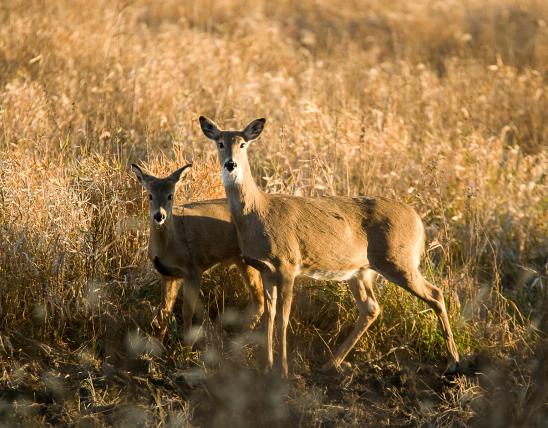
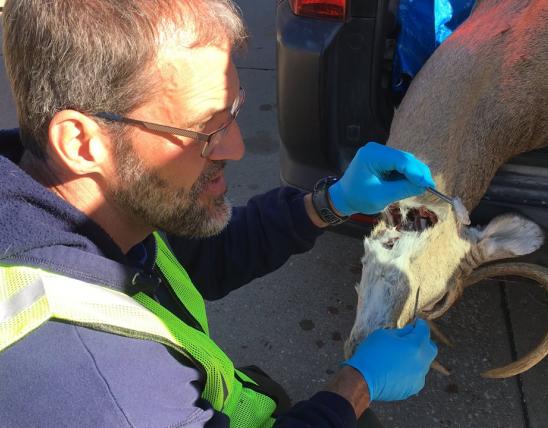
A deer in the road may be in fright/freeze mode, but it’s also temporarily blinded by the sudden appearance of headlamps, unable to see the edge of the road to escape. We don’t want this effect with outdoor lighting.
The adaptations of nocturnal wildlife are amazing, each highly specialized for success. For example:
- Bat echolocation calls can be as loud as a smoke alarm.
- Large ears of the red fox allow it to locate and ambush rodents.
- The asymmetrical position of ears of some owls allows them to triangulate the location of prey.
- Tapetum lucidum, reflective tissue in the eyes of some animals that increases available light, allows them to be successful in low-light conditions (white-tailed deer, Virginia opossum, cougar, raccoon, red fox, and many others).
The predictable rhythms of light and darkness are encoded in the DNA of all plants and animals. Daily, lunar, and seasonal cycles have governed life processes across evolutionary history, including foraging, sleep, reproduction, predator-prey relationships, and migration. Every living thing has a kind of “master clock” tuned daily by natural light, regulating biological rhythms so that the right processes occur at the right time. Even niches created by moon cycles are essential to many species.
Just as light with shorter wavelengths (blue light) is essential in daytime, exposure to these same wavelengths at night can be injurious. Complex behaviors and life cycles of mammals, birds, fish, amphibians, insects, and plants can be disrupted by outdoor artificial lighting, with broad implications. For example, secretion of melatonin, which plays a role in cellular repair and other essential functions, even for insects, can be disrupted. Artificial light can be a barrier, fragmenting habitat, and it can be a trap. If it’s a barrier, the animal can turn around and go the other way. It survives, but its range, dispersal, reproduction, and other natural behaviors may be disrupted.
But lighting as a trap often causes death. North and eastern Missouri is within the largest migratory flyway in North America. Sky glow attracts migrating birds into towns and cities. Once entrapped in an alien environment, they become disoriented, circling to exhaustion. For billions of birds, this spiral ends with mortality, colliding with a window or death by cat. Artificial light also interferes with a songbird’s ability to calibrate its internal compass. In response to these mortality events, dozens of cities have adopted voluntary “Lights Out” programs.
Even for resident songbirds, outdoor lighting can interfere with seasonal behaviors, potentially reducing food availability for raising young. Non-migratory birds and even hawks and owls also collide with glass due to multiple factors, including artificial light spilling from windows.
In 2007, two bat scientists were studying the feeding behavior of little brown bats (Myotis lucifugus) when they began hearing bats crashing into their study trailer and nearby brush. They found their light was interfering with the bats’ navigational skills. Though some more common bat species, such as the eastern red bat, do feed on insects in illuminated areas, Missouri’s rare bat species tend to avoid lights and illuminated areas.
The economic and ecological benefits of crepuscular and nocturnal mammals as well as many birds and invertebrates are incalculable yet often overlooked. For example, the benefit of North American bats to agriculture is estimated in the tens of billions of dollars by controlling crop pests. Red foxes and coyotes prey on rodents at night while we sleep, providing a key ecosystem service for human health.
Pollinators and Insects
Many nocturnal insects, including moths and certain beetles, use the moon and stars for navigation and orientation. Once attracted to artificial light at night, they may be temporarily dazzled, blinded, or trapped in the light and die. This is the vacuum cleaner effect — about a third of insects die within 24 hours of being attracted to light.
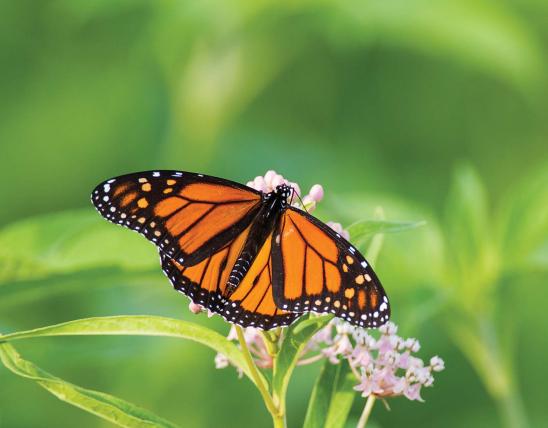
Diurnal insects and pollinators are also impacted. For example, monarch butterflies migrate during the day and rest at night. Artificial lighting interrupts this crucial rest period. Better lighting choices, even eliminating decorative lighting, can help mitigate these impacts.
Most firefly species cannot reproduce in the presence of artificial light. The knock-on effects are that rapidly declining insect populations affect other taxa that rely on them for food or pollination.
Fish and Aquatic insects
Aquatic ecosystems experience a wide range of natural illumination. Light penetration affects primary production and species distribution within each niche. Aquatic organisms are particularly sensitive to, and their life cycles may be disrupted by, artificial light above and cast into the water. Light at night can alter key behaviors such as schooling, feeding, and predator-prey interactions. The early life-cycle stages of mayflies, caddisflies, and other invertebrates are aquatic, creating a foundation of the food chain for many fish. Damselflies, dragonflies, aquatic beetles, and others feed on mosquito larvae both as nymphs and adults. In their short-lived adult stage, these insects require natural darkness for successful dispersal and reproduction.
Conserving darkness near water allows insects to complete their life cycles and benefits fish populations.
Better Lighting
Doing even small things to conserve natural darkness and watching out for nocturnal creatures can make a big difference. Here are a few things you can do to make a difference:
- Use light only when and where needed.
- Reduce light intensity by reducing lumen levels. Using lights that are no brighter than necessary will save money and reduce glare.
- Use lights with an amber or yellow tone, between 2200K and 2700K (Kelvin).
- Ensure that any new outdoor light fixture is fully shielded, so that all light is directed downward.
- Where possible, use motion sensors, timers, and dimmers to save money and reduce unintended impacts.
For more information about conserving darkness and using outdoor lighting responsibly, refer to the following resources:
Milky Way brochure: short.mdc.mo.gov/49i
Missouri’s Darkest Skies: short.mdc.mo.gov/49S
Outdoor Lighting: short.mdc.mo.gov/49q
Artificial Light at Night: short.mdc.mo.gov/49p
Lights Out Heartland: lightsoutheartland.org
DeAnn Gregory is retired from the Missouri Department of Natural Resources. A Missouri Master Naturalist and board member of DarkSky Missouri, she enjoys exploring Missouri outdoors with her husband.
Vayujeet Gokhale is a professor of physics and astronomy at Truman State University. He loves the night sky and America’s national parks, and dreams of someday becoming an astronomy park ranger at Arches National Park in Utah.


Also In This Issue

Maysville teachers bring lessons from the field into the classroom

Autumn offers a front-row seat to nature’s beauty
And More...
This Issue's Staff
Editor - Angie Daly Morfeld
Associate Editor – Larry Archer
Photography Editor – Ben Nickelson
Staff Writer – Kristie Hilgedick
Staff Writer – Joe Jerek
Staff Writer – Dianne Van Dien
Designer – Marci Porter
Designer – Kate Morrow
Photographer – Noppadol Paothong
Photographer – David Stonner
Circulation – Marcia Hale