












Got a question for Ask MDC? Send it to AskMDC@mdc.mo.gov or call 573-522-4115, ext. 3848.
Q: Is this just a standard hoverfly or something else? I found it in my native wildflower garden last September in St. Louis.
This is likely a northern plushback fly (Palpada vinetorum), which is in the hoverfly family (Syrphidae). The horizontal stripes on the abdomen, the dense golden hairs, and the strong whitish-gray bands on the thorax are characteristic.
These robust, beelike flies consume nectar, which means they are frequently found on flowers. They like to crawl into the inner whorl of a flower. Their dense fuzz is efficient at collecting pollen, making them important pollinators. You can even see the pollen grains caught in the hairs of the fly pictured here.
This fly will visit almost any flower with available nectar.
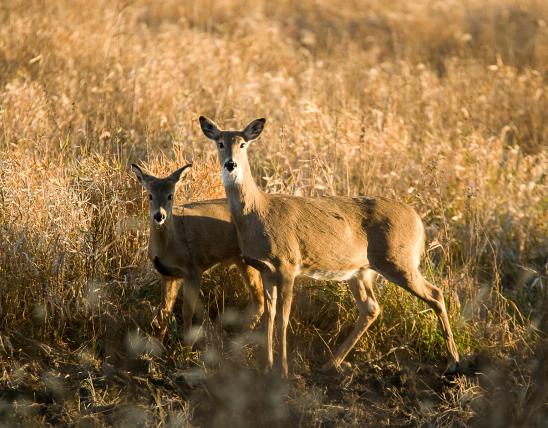
Q: I was out walking at dusk a couple of nights ago, and I spotted two fawns and a doe. I watched them from about 10 feet away and noticed something about the fawns. They were both small, but one had spots and the other didn’t. Why are they different?
As they transition from summer to winter fur, white-tailed fawns typically lose their white spots completely during their first molt at three to four months, thus acquiring a gray uniform coloration.
Most, but not all, fawns are born in late May or early June. It’s likely the fawn on the left was born earlier than the fawn on the right. Born earlier, it has also molted earlier — which is why it has a grayish color. The fawn on the right is likely to be slightly younger and so had not started the molting process yet. Missouri’s white-tailed deer shed their hair twice a year. Each fall they replace their summer coat (shorter, reddish hair) with their winter coat (longer, gray hair).
Q: I have a huge persimmon tree in the yard, and every fall something starts chewing small twigs that drop all over the yard. What could be doing this?
When you see this damage in the fall, twig girdlers — a species of long-horned beetle (Oncideres cingulata) — are a likely explanation.
Damage caused by twig girdlers is very common in the fall, as female beetles are actively laying eggs in host trees. First, female beetles chew a concentric circle around the twig, cutting off the flow of water. The female then chews egg sites and lays eggs in the portion of the twig beyond the girdling cut. The branch may remain attached to the tree (with brown, flagging leaves) or it may break away and fall due to wind or its own weight. The cut made by the female twig girdler results in twigs with smooth edges and a ragged center.
Twig girdler damage is typically not significant on mature trees. Homeowners may be able to reduce local numbers of twig girdlers by removing and destroying fallen twigs, beginning in September or no later than May.
More information on twig girdlers and pruners is available on the University of Missouri Extension website at short.mdc.mo.gov/4td.
And More...
This Issue's Staff
Editor - Angie Daly Morfeld
Associate Editor – Larry Archer
Photography Editor – Ben Nickelson
Staff Writer – Kristie Hilgedick
Staff Writer – Joe Jerek
Staff Writer – Dianne Van Dien
Designer – Marci Porter
Designer – Kate Morrow
Photographer – Noppadol Paothong
Photographer – David Stonner
Circulation – Marcia Hale