










MDC Announces New Commissioner
Gov. Mike Kehoe appoints Centertown man to serve on commission
MDC and the Missouri Conservation Commission welcome Edward C. Clausen of Centertown to the Missouri Conservation Commission following his recent appointment by Gov. Mike Kehoe and pending confirmation by the Missouri Senate.
“We’re excited to have Ed’s professional experience and personal passion for conservation on the commission,” said MDC Director Jason Sumners. “He knows how important the outdoors are to our quality of life in Missouri, including managing private land for wildlife and outdoor recreation opportunities on public lands.”
Clausen is a partner at Newman, Comley, and Ruth P.C., a law firm specializing in defending medical malpractice claims. He is an active member of several organizations, including the Conservation Federation of Missouri, the Association of Defense Trial Attorneys, and Sigma Phi Epsilon fraternity. He previously served on the board of directors for the Friends of the Eleven Point River. Clausen earned his Juris Doctor from the University of Missouri School of Law.
He lives in Centertown with his wife, Debby, and their land adjoins the Roger V. and Viola Wachal Smith Conservation Area.
“I’m humbled and honored to be appointed as a conservation commissioner,” Clausen said. “Ours is the premier conservation department in the nation and I’m grateful to the people of Missouri for supporting such a bounty of nature-focused public land for everyone to enjoy.”
He added that the hunting, fishing, floating, hiking, wildlife-watching, and other outdoor opportunities in Missouri are amazing.
“I’ve been to many, many conservation areas around the state, and our family did a lot of floating, camping, fishing, and hunting when our three kids were little,” he said. “We still enjoy floating Missouri streams and other outdoor activities with them as adults — and also now with our grandson, Hudson.”
Clausen and his family also have a history of managing their land for wildlife. They recently cleared cedar trees that were invading several acres along the road and then planted wildflowers. He added that they’ve also done timber-stand improvements over the years and maintain trails on their property.
His ties to nature go back to his childhood and he has shared them with his kids.
“My dad informally showed me how to hunt when I was a kid, but some of the most valuable outdoor learning for me was through MDC’s Hunter Education program,” Clausen explained. “I took the class with my oldest son when he started to hunt decades ago, and it was incredibly helpful.”
Commissioner Clausen was appointed for a six-year term that will expire in 2031. He replaces outgoing commissioner Mark McHenry of Kansas City, whose term expired July 1. Clausen joins Commissioners Margaret F. (Margy) Eckelkamp of Washington, Raymond T. (Ray) Wagner Jr. of Town and Country in St. Louis County, and Steven D. Harrison of Rolla.
“I also look forward to helping our next generations of conservationists,” Clausen added. “To paraphrase an old quote, ‘Wise are those who plant trees under which they will never sit.’ This future focus applies to fisheries and wildlife conservation, as well.”
The Missouri Conservation Commission consists of four members appointed by the governor with the advice and consent of the Senate. Commissioners serve six-year terms with no salary or other compensation with not more than two allowed from the same political party. Their responsibilities include appointing the MDC director, serving as MDC policy makers, approving regulations of the Wildlife Code of Missouri, strategic planning, and budget development and major expenditure decisions.
Managed Waterfowl Hunts
Reservations are required to guarantee an opportunity to hunt on MDC’s 14 intensively managed wetland conservation areas. There are two ways to obtain a managed waterfowl hunt reservation online. The pre-season reservation period will run Sept. 1–18. Hunters may apply for pre-season reservations at up to three managed waterfowl hunting areas. In-season weekly drawings will take place on Monday afternoons starting in mid-October with a seven-day application period that opens the Tuesday before and closes the Monday of the drawing at 3 p.m.
Pre-season and in-season waterfowl hunting reservations together will comprise 50 percent of daily hunting positions. Of the 50 percent of positions going to reservation holders, half will be from pre-season applications and half from in-season applications.
The remaining 50 percent of spots will go to hunters who do not have reservations but who participate in the daily morning drawing, called the “poor line.” For example, if an area has 20 hunting spots, 10 will be allocated through the poor line, five through pre-season reservations, and five through in-season reservations.
Only Missouri residents and qualifying non-residents, such as students from out of state attending a school in Missouri or members of the military stationed in Missouri, can apply online for a reservation to guarantee them an opportunity to hunt on a specific day on a specific area. Residents and nonresidents can arrive at a managed waterfowl hunting area the morning they wish to hunt and wait in line for the possibility of getting a hunting spot. Residents and nonresidents can also hunt with a reservation holder. Hunting parties are limited to a maximum of four people.
Applicants for waterfowl reservations must have their required permits to apply, and their Federal Duck Stamp to hunt.
Successful pre-season and in-season reservation applicants will be notified after their respective drawings via email or text message with their hunt date, area, and pill assignment. “Pills” designate the order hunting parties select their hunting location on the area. The lower the number, the sooner hunting parties get to select their hunting location.
Hunters with disabilities can apply to use ADA hunting blinds through the online reservation system during the same timeframe as the pre-season application period. ADA blinds that are not allocated during the pre-season drawing will be placed in the weekly in-season draws.
In addition to managed waterfowl hunts offered by MDC, waterfowl hunting opportunities can be found on other conservation areas, as well as Missouri’s rivers, streams, and reservoirs.
Kelsey Gillenwater
Buchanan County
Conservation Agent
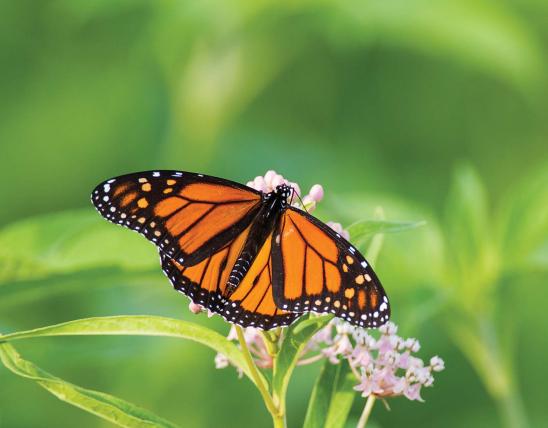
If the hot summer months kept you indoors, fall is a great time to reconnect with nature. And conservation areas are a great place to start. With more than 1,000 areas located statewide, you can find one just about anywhere. Plan a hiking trip and take in the scenery. Conservation areas are alive with color this time of year. The leaves of trees, shrubs, and vines will begin transforming into their fall palette. The areas are abuzz with activity as migrating birds, like blue-winged teal, make their appearance. And monarchs flutter around our native wildflowers, like goldenrods, as they make their migration south. Step onto one of our areas and let time slow down as you take it all in. To find an area, visit short.mdc.mo.gov/Z9o.
Auriculate False Foxglove
Auriculate false foxglove (Agalinis auriculata) is scattered throughout Missouri, but it is mostly found in the northern and western parts of the state in prairies, glades, savannas, and sometimes in old fields. Because the leaves are much wider than other false foxglove species in Missouri, it is very easy to identify even before it flowers. The pink flowers are about an inch long and widely spaced down the hairy stem. These blooms appear in August to September, especially in areas that have had a recent disturbance like haying or burning. Unlike some other false foxglove species, this one does not turn black after it has dried.


Why It’s Imperiled
Auriculate false foxglove’s native habitats are vulnerable to agriculture, urbanization, and invasive species. Lack of periodic burning or haying in these areas also leads to this species becoming crowded out by more competitive forbs and grasses.
MDC Restoration Efforts
Efforts to maintain or restore populations of this rare species include management of both prairie remnants and prairie restorations. MDC also works with partners that manage and own prairie remnants or are working on prairie restoration projects on both public and private land.
What Can You Do?
If you are visiting a prairie, glade, or savanna in Missouri and see auriculate false foxglove, contact Malissa Briggler, the department’s wildlife diversity coordinator, at Malissa.Briggler@mdc.mo.gov. Your help can provide valuable information needed to determine the status of this rare species in our state.


Title
Answer
Northern Bobwhite
Northern bobwhites are ground-dwelling quails that are reddish-brown and white. They have distinctive brown caps, but the males’ caps are darker. Named Missouri’s official state game bird in 2007, northern bobwhites are still fairly common. However, populations have been declining due to habitat loss and unfavorable weather during winter and nesting season. MDC is helping to reverse the downward trend through several initiatives including public education, recreation opportunities, and landowner assistance.
And More...
This Issue's Staff
Editor - Angie Daly Morfeld
Associate Editor – Larry Archer
Photography Editor – Ben Nickelson
Staff Writer – Kristie Hilgedick
Staff Writer – Joe Jerek
Staff Writer – Dianne Van Dien
Designer – Marci Porter
Designer – Kate Morrow
Photographer – Noppadol Paothong
Photographer – David Stonner
Circulation – Marcia Hale