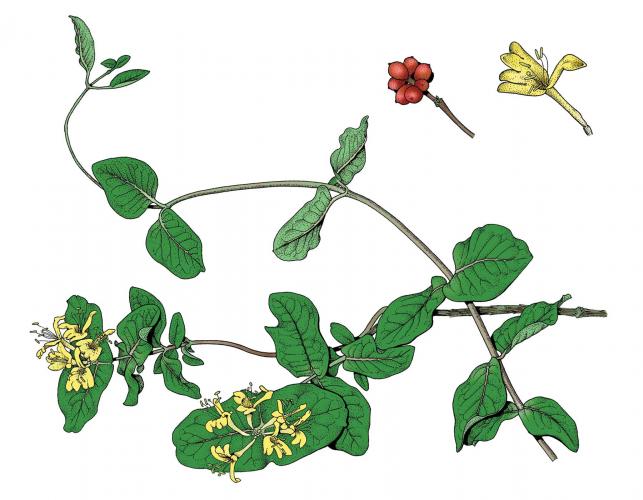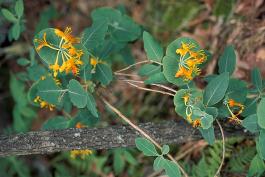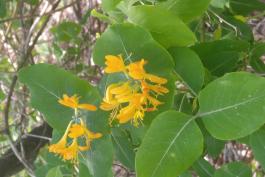






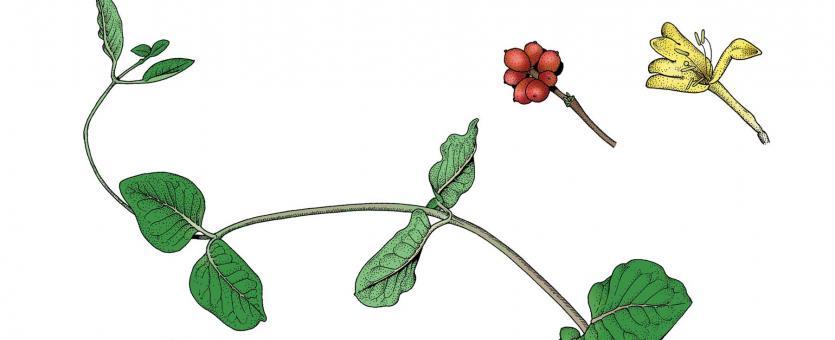
Yellow honeysuckle is a woody, trailing, climbing vine that can sometimes be shrublike.
Flowers are 1 inch long, tubular, with protruding stamens, in crowded, terminal clusters above a platterlike union of 2 joined leaves that clasp the stem, bright yellow or orange yellow, lacking purple, rose, or brick red along the tube.
Blooms April–May.
Leaves are simple, opposite, sessile (stalkless), thick, egg-shaped, with a gray, not white underside, the tips round to blunt. The upper pair just below the flowers are united at the base to form a disk that is about 6 inches across and 2 inches wide, sometimes rounded.
Fruit is a red or reddish-orange berry.
Key identifiers: Pay attention to the platterlike pair of joined leaves beneath the flower clusters: The invasive exotic Japanese honeysuckle has no such united leaves.
Similar species: Several other species of honeysuckles (Lonicera) occur in Missouri. Below are the ones you are most likely to encounter.
- In addition to yellow honeysuckle (L. flava), other native Missouri species of honeysuckles include limber honeysuckle (L. dioica) and grape honeysuckle (L. reticulata). Our three Missouri native honeysuckles are all woody vines.
- Another woody, vining honeysuckle you may encounter in natural places is trumpet or coral honeysuckle (L. sempervirens). It is not native to Missouri but is native to US states to our east and south and is not particularly invasive in Missouri. It has bright red or orangish-red flowers and is scattered mostly south of the Missouri River, often persisting in places where people planted it long ago.
- Unfortunately, some nonnative, invasive honeysuckles are well-established in Missouri, too: Japanese honeysuckle (L. japonica, a woody vine), and bush honeysuckles (L. x bella and L. maackii, which are shrubs). These are native to Eurasia, outcompete and overwhelm native plant communities, and harm the natural environment.
Stem length: up to 13 feet.

Found primarily in the Ozarks, but it is increasingly available at native plant nurseries and might be found in cultivation statewide.
Habitat and Conservation
Occurs in openings and borders of rocky woods, on ledges and upper slopes above bluffs, and rocky ground along steams.
Unlike the invasive Japanese honeysuckle, this plant is not aggressive and makes a wonderful trellis vine for the ecology-minded gardener.
Status
Native Missouri woody vine. A good choice for landscaping.
Human Connections
Beautiful, fragrant flowers, attractiveness to hummingbirds, and overall hardiness make honeysuckles popular vines for arbors.
Yellow honeysuckle is more robust and colorful than the other native honeysuckles and is increasingly available at native plant nurseries. It has been cultivated since 1810.
Ecosystem Connections
The deep, tubular flowers provide nectar to pollinators that are able to reach inside. Hummingbirds have long, pointy bills and extendable tongues for this purpose.
Birds and small animals eat the ripe berries of this native vine.
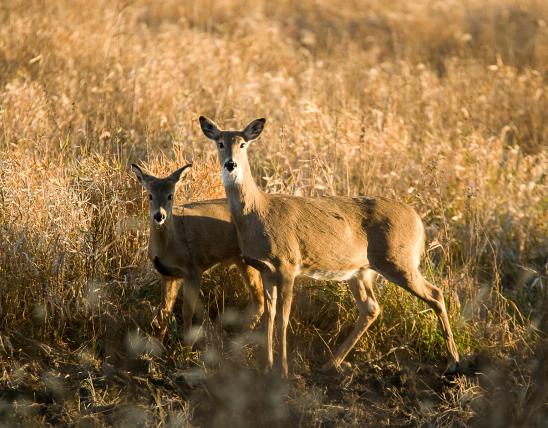
Deer browse the stems and leaves.