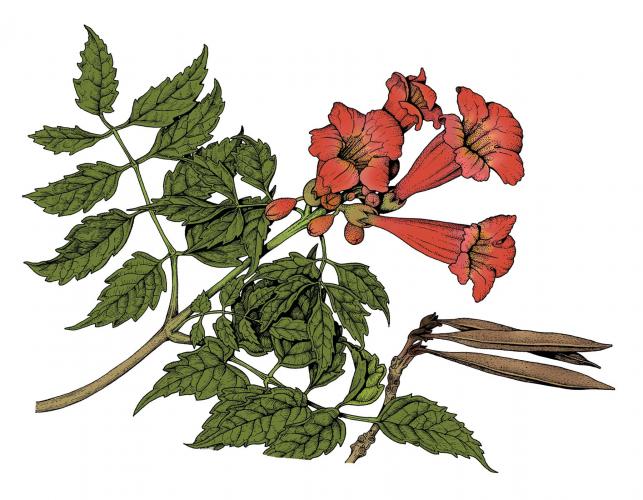









Trumpet creeper is a fast-growing, even aggressive native woody vine with aerial rootlets on stems that become woody with age.
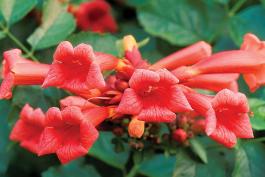
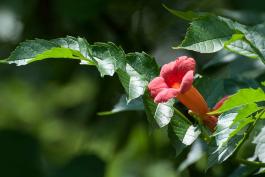
Flowers May–August; tube-shaped in terminal clusters, 5-lobed, to 3 inches long, orange or reddish orange, rarely all red.
Leaves are opposite, compound, with 6–10 opposite leaflets (plus one leaflet at the tip) that are ovate-lanceolate, coarsely toothed, with long points.
Fruits are podlike, woody, splitting open on each side, 2–6 inches long.
Similar species: Trumpet creeper has some relatives you might encounter in Missouri.
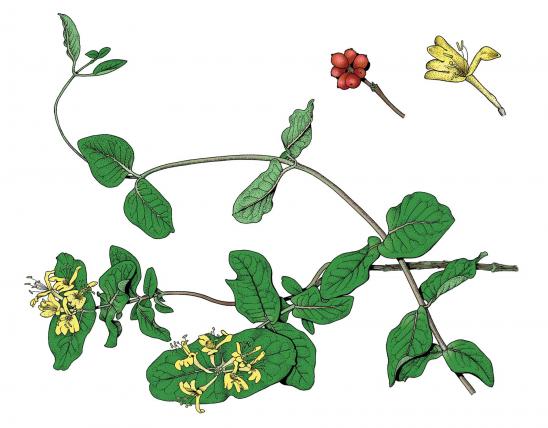
- Cross vine (Bignonia capreolata) occurs natively in our Bootheel counties, growing in low, swampy bottomlands and in low thickets, fields, and fencerows. If you cut a stem crosswise, the pith is in the shape of a cross (hence the name). Recognize it by its flowers, which are red to orange on the outside and yellow on the inside. It can climb up to 70 feet with the help of its forked tendrils, and its foliage persists through most of winter. The opposite, compound leaves are trifoliate (have 3 leaflets), with each leaflet tapering at both ends and having untoothed, but rather wavy margins. The fruits are podlike, much like trumpet creeper's.
- The structure of the trumpet creeper's tubular flowers and its elongated pods, which split into two portions, reflect trumpet creeper’s relationship to catalpa, which is in the same family.
Stem length: to 60 feet.
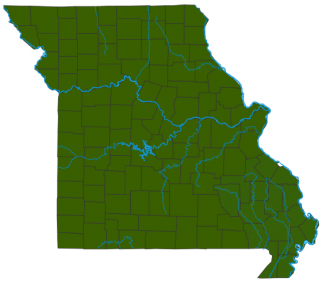
Statewide.
Habitat and Conservation
Bottomland forests, open woods, banks of streams and rivers, cliffs, pastures, old fields, fencerows, thickets, waste places, roadsides, railroads, and other disturbed areas.
Trumpet creeper is well-adapted for disturbed areas, and it is commonly seen growing on telephone poles along roadsides.
It is often cultivated for trellises and fences, but it can outcompete nearby vegetation and grow massive enough to collapse insufficiently supported structures.
Status
Native Missouri woody vine.
Human Connections
Trumpet creeper is often cultivated as an ornamental vine, but because of its aggressive growth, it is best suited for areas where it will not overwhelm other plants. It requires a strong support and heavy pruning.
Some people develop a skin rash after touching this plant, so another common name for it is “cow-itch.”
Ecosystem Connections
The flowers of this plant are favored by hummingbirds, which cross-pollinate the flowers as they forage. The range of trumpet creeper nearly matches that of the ruby-throated hummingbird.
The big clumps of these vines provide valuable cover for many birds and small mammals. When it grows on cliff faces and rocky road cuts, it provides habitat for the many interesting animals that live on those stark surfaces.