








Trumpet honeysuckle is a twining woody vine, occasionally dense, that is native to states to our southeast and is naturalized in Missouri. Its flowers are bright red. It is scattered mostly south of the Missouri River, often persisting in places where people planted it long ago.
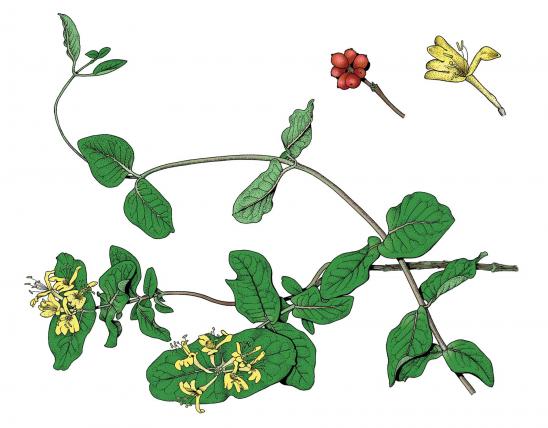
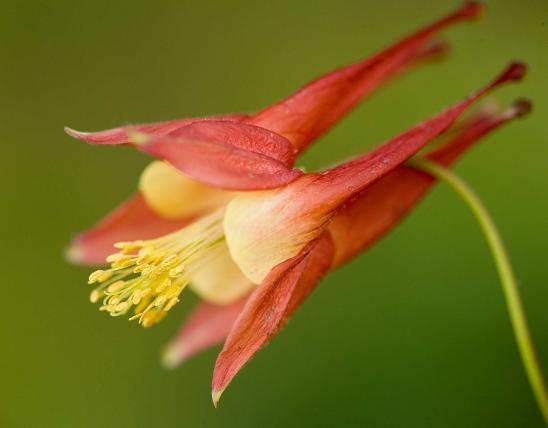
Flowers are in clusters at the end of the stems on new growth, in 2–4 whorls of 3–6 flowers each; flowers are deep red, 1½–2 inches long, tubular, slender, the tip of the tube spreading into 5 lobes with rounded tips; the 5 yellow stamens and style extend beyond the flower.
Blooms April–July.
Leaves are simple, opposite, with the upper pair just below the flowers united to form a single disk, both sides of the disk totaling 2–2½ inches long, 1½–1¾ inches wide, each side triangular, the tip rounded or blunt and slightly notched, the margin entire (untoothed), smooth; leaves below the disk not united, each 1½ to 3 inches long, generally oval, margin entire; leaf stalk short or absent.
Fruits are in whorls of 2–4; smooth, egg-shaped, about ⅜ inch long, bright red with a minute black tip, 1-seeded.
Key identifiers:
- flowers are red
- flowers are 1½–2 inches long
- the pair of leaves just below the flowers are united at the base to form a disk (similar to limber, yellow, and grape honeysuckles).
Similar species: Several other species of honeysuckles (Lonicera) occur in Missouri. Below are the ones you are most likely to encounter.
- Missouri has native honeysuckles, all of which are good choices for landscaping: limber honeysuckle (L. dioica), yellow honeysuckle (L. flava), and grape honeysuckle (L. reticulata). Our three Missouri native honeysuckles are all woody vines.
- Unfortunately, some nonnative, invasive honeysuckles are well-established in Missouri, too: Japanese honeysuckle (L. japonica, a woody vine), and bush honeysuckles (L. x bella and L. maackii, which are shrubs). These are native to Eurasia, outcompete and overwhelm native plant communities, and harm the natural environment.
Stem length: to 18 feet.
Scattered mostly south of the Missouri River. In cultivation, potentially statewide.
Habitat and Conservation
In Missouri, trumpet honeysuckle occurs in rich upland forests, banks of streams and rivers, and margins of sinkhole ponds. It also occurs in fencerows, old homesites, and roadsides, having escaped from cultivation.
Trumpet honeysuckle was introduced to Missouri from elsewhere in the United States. Its native range extends from Maine to Florida, west to Oklahoma and Texas, and in Canada; it has been introduced to states northwest of the original native range, so it now also occurs from Iowa to Kansas, including Missouri.
Although this honeysuckle is not native to Missouri, it is not nearly as aggressive as Japanese honeysuckle and is not particularly aggressive in native plant communities.
Status
Introduced to Missouri from states to our east and south. Naturalized and persisting at old homesites, but not considered invasive.
Human Connections
This attractive plant deserves more attention from gardeners. The showy, bright red flowers are abundantly produced throughout a long period if given full to partial sun. The vine does well on a trellis or fence.
The flowers have no scent, but they are very attractive to hummingbirds. The bloom time corresponds with the northward migration of the ruby-throated hummingbird.
If you are hiking in the woods and you spy this honeysuckle, try looking around for an old house foundation or cistern. Or try looking for other plants, such as irises, daffodils, dames’ rocket, and lilacs, which might also be persisting long after the people who planted them have passed away.
The genus name, Lonicera, was created by Carl Linnaeus to honor the German botanist and herbalist Adam Lonicer (Lonitzer) (1528–1586).
The species name, sempervirens, means “evergreen.” The name refers to the fact that in the southern part of its range, this plant is evergreen, retaining green leaves all year long.
Ecosystem Connections
Hummingbirds transfer pollen from flower to flower as they sip nectar. A variety of other animals have long enough tongues to reach into the floral tubes, and also serve as pollinators: clearwing moths and bumblebees, for example. Other insect visitors are probably too small to function as pollinators.
As with other honeysuckles, many types of insects feed on the leaves or suck the plant’s sap. The snowberry clearwing, hummingbird clearwing, and gray scoopwing are just a few of the many moths whose caterpillars are specialized to eat the foliage of plants in the honeysuckle family.
Birds that eat honeysuckle fruits include catbirds, waxwings, thrashers, finches, and more.
The leaves and stems are browsed by white-tailed deer.
It might seem confusing to have so many categories of plants: native/nonnative, endemic, introduced, escaped, naturalized, invasive, and so on. A species like trumpet honeysuckle, which is native to the United States, still isn’t native to Missouri. Organisms do not “know” political boundaries. This is how a crayfish species that is native to Missouri (limited to particular stream systems) can be considered nonnative, even invasive, when introduced into a different stream system in the same state.