


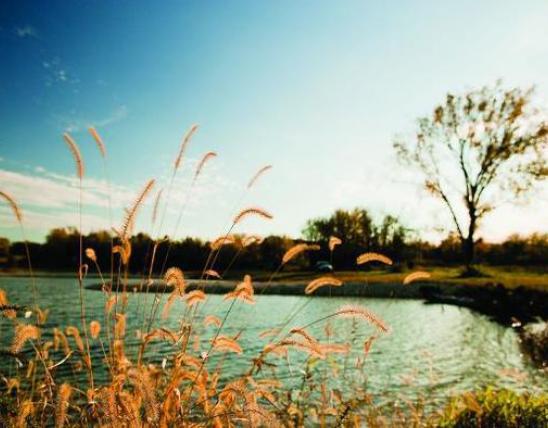






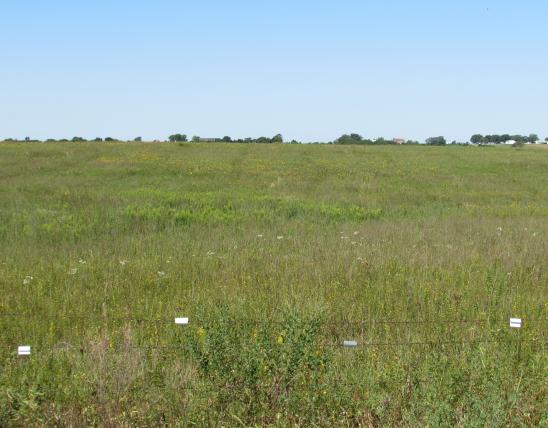
This 80-acre native prairie remnant is owned by the Missouri Prairie Foundation and is jointly managed with the Conservation Department.
Media

Safety Concerns
Name
Edible
Scientific Name
Fragaria virginiana
Family
Rosaceae (roses)
Description
Wild strawberry is one of the parents of the cultivated strawberry and is one of our prized native wild edibles. It’s also a valuable food for innumerable animals, and it’s attractive in native wildflower gardens.
Wild strawberry is a low, ground-hugging herbaceous perennial, rooting from runners.
The leaves are compound, with 3 egg-shaped leaflets with toothed lobes, on hairy stems, dark green.
The flowers are borne in clusters, each with 5 white petals and many stamens, in the arrangement typical of the rose family.
Blooms April–May.
The fruit is a delicious red “berry” (technically it’s an aggregate fruit; notice the many "seeds" on the outside of the fruit), about ½ inch across, ripening June–July.
Similar species: The nonnative Indian strawberry (mock strawberry), Duchesnea indica, has yellow petals instead of white, and its “strawberries” lack juiciness and flavor. Native to eastern and southern Asia, it is usually considered a lawn and garden weed.
Globally, there are more than 20 species of strawberries (genus Fragaria). This is the only one native to Missouri.
Other Common Names
Virginia Strawberry
Size
Height: to about 6 inches.
Where To Find

Statewide.
Habitat and Conservation
Occurs on open slopes, prairies, rocky hillsides, borders of woods, old fields, and a variety of other situations.
Some people cultivate wild strawberry as a groundcover or rock garden plant, although it tends to become dormant during the hottest months.
Status
Native Missouri wildflower. The fruits, though small, are a choice wild edible.
Human Connections
This species is one of the parents of the cultivated strawberry (Fragaria × ananassa): The cultivated strawberries available at garden centers are hybrids between this native species and a strawberry species native to Chile. So far, there are around 250 different cultivated varieties of strawberries available for gardeners.
The U.S. commercial strawberry industry is worth hundreds of millions of dollars a year.
Strawberries, of course, are eaten fresh, frozen, made into juice and wine, and cooked into delicious pies.
Ecosystem Connections
This plant is valuable to many different animals:
- The nectar and pollen feed numerous species of bees, butterflies, and other insects, which are eaten by birds and other insectivores.
- Several kinds of mammals nibble the leaves.
- The fruits are savored by creatures ranging from box turtles and birds to bunnies and boys (and everyone else)!
The structure of strawberries is fascinating. Examine a strawberry before you bite into one: the fleshy red part that makes up most of the "berry" is actually a swollen, enlarged receptacle (the base of the flower, not an enlarged ovary or pistil). Each "seed" on the surface is a tiny whole fruit unto itself, each the result of a single ovary.
- Speaking in terms of how it's used as food, we call a single strawberry "a fruit." But it's actually many seedlike fruits attached to a single, fleshy structure.
- Raspberries and blackberries are also aggregate fruits, but in their case, each "berry" is a cluster of small berries (each like a miniature grape: a seed covered by a fleshy, juicy pulp), attached to the flower's receptacle.
Strawberry plants provide a textbook example of stolons. A stolon is a special type of stem that develops near the ground surface, grows horizontally away from the parent plant, then takes root, forming a new plant, at the nodes.
- The stolons of strawberry plants, which are notably slender and take root only at the outmost tip, are often called runners.
- If you grow strawberries in a hanging basket, it's easy to see the runners, with their developing offspring plants, hanging down from the main plants.
- Stolons and runners are forms of vegetative reproduction, where each offspring plant is a genetic duplicate of the parent plant.
- Buttercups (Ranunculus) and zoysia grass are other plants that can spread by stolons.
Title
Media Gallery
Image

Credit
Julianna Schroeder
Right to Use
Photo by Julianna Schroeder, courtesy Missouri Department of Conservation
Image

Caption
Wild strawberry fruits are about a half inch wide. They ripen in June and July.
Credit
Julianna Schroeder
Right to Use
Use of this image is restricted to MDC only
Image

Right to Use
Photo by MDC Staff, courtesy Missouri Department of Conservation
Image

Image

Image

Title
Similar Species
Similar Species
Media

Media

Media

Media

Media

Where to See Species
About Wildflowers, Grasses and Other Nonwoody Plants in Missouri
A very simple way of thinking about the green world is to divide the vascular plants into two groups: woody and nonwoody (or herbaceous). But this is an artificial division; many plant families include some species that are woody and some that are not. The diversity of nonwoody vascular plants is staggering! Think of all the ferns, grasses, sedges, lilies, peas, sunflowers, nightshades, milkweeds, mustards, mints, and mallows — weeds and wildflowers — and many more!