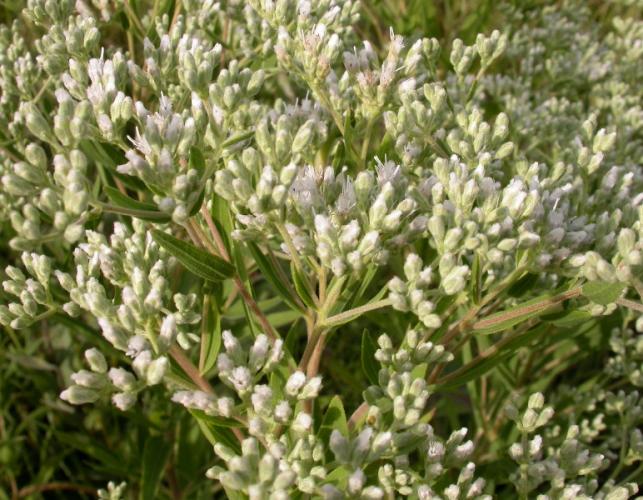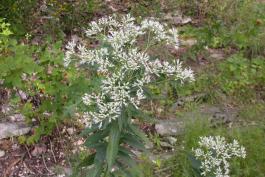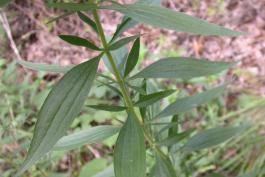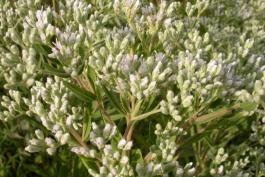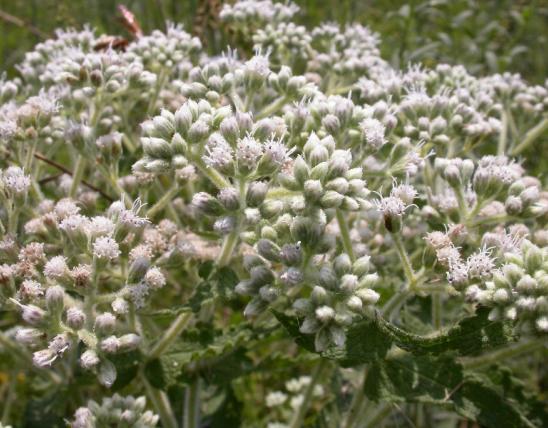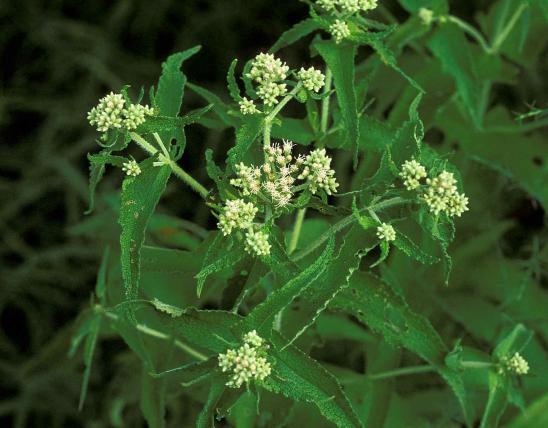







Tall thoroughwort is a member of the sunflower family than can reach 6 feet tall. It has dull white flowers and distinctive leaves that are opposite, slender, very short-stalked, and with three quite noticeable veins.
Tall thoroughwort is a stout native perennial whose stems are hairy in the top half of the plant.
The flowers are clustered loosely at the tops of the stems in narrow, flat-topped clusters; there are only 5 florets in each small flowerhead, and the flowers are dull white. The bracts beneath the flowerheads are broad and rounded.
Blooms August–October.
The leaves are mostly opposite, widely spaced, to 5 inches long, strongly 3-nerved, very short-stemmed or sessile (stalkless), slender lance-shaped and tapering nearly to the plant stalk, with short hairs and dotted with glands, with teeth above the middle of the leaves only.
Similar species: Nine species of Eupatorium have been recorded in Missouri. Leaf characteristics are usually the best way to distinguish among the species. Here are the ones most similar:
- Late boneset (E. serotinum) is the most common or widespread lookalike, and it’s the one most similar to tall thoroughwort. Late boneset, however, has wider and more coarsely serrated leaves that are less hairy than tall thoroughwort’s. Also, late boneset’s flowerheads contain 9–15 florets (not just 5). Note that late boneset can be just as tall as tall thoroughwort, and both bloom late, in August–October.
- Upland boneset (E. sessilifolium) is scattered in the Ozark and Ozark border regions and in the eastern half of northern Missouri. Its leaves are stalkless and lance-shaped to narrowly ovate, tapering to a sharply pointed tip, with margins sharply toothed. The leaf bases, however, are quite different than tall thoroughwort’s: ovate, rounded, or truncate (squared off at a right angle to the midvein) (not tapering); in the pairs of opposite leaves, the bases often overlap slightly. Also there is only 1 main vein.
- Smallflower thoroughwort (E. semiserratum) is also similar, but it is uncommon in Missouri, known only in the Bootheel lowlands. Like tall thoroughwort, its leaves are serrated mostly above the midpoint and it has three obvious veins in the leaves. But the two side veins branch out from the midvein well above the base of the leaf blade, instead of at the base of the leaf blade.
Learn more about Missouri’s thoroughworts, or bonesets, on their group page.
Height: generally 3–4 feet, but often more than 6 feet.

Scattered nearly statewide.
Habitat and Conservation
Occurs in upland prairies, loess hill prairies, glades, savannas, openings of moist to dry upland forests, banks of streams and rivers, and ledges and tops of bluffs; also in old fields, pastures, ditches, quarries, railroads, roadsides, and other open, disturbed, or waste places.
Status
Native Missouri wildflower.
Human Connections
Folk medicine has given this plant its enduring name of “boneset.” The first pharmacists and doctors were botanists: for millennia, humans have recognized the medicinal properties of plants. People are continually researching the chemicals in plants to find cures for human illness.
Ecosystem Connections
Many types of insects drink nectar from the flowers, and plants like this, that bloom late in the season, are crucial for insects that mature at that time.
Because of the foliage's bitterness, mammals don't usually eat this plant. Thus it can become increasingly abundant in pastures as livestock selectively eat more palatable plants.