









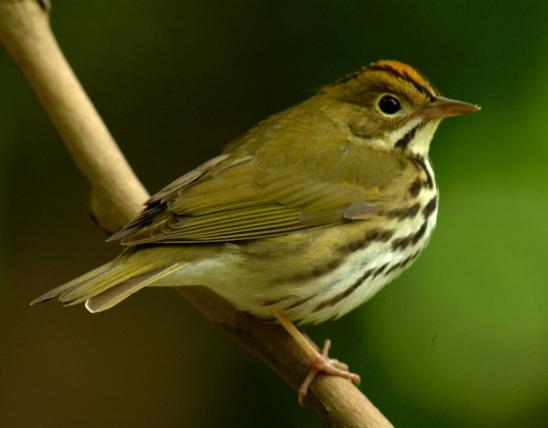
Swainson’s warbler is plain olive-brown above and pale yellow-white below, with no streaking. It has a rusty cap, a whitish stripe above the eye, and a dusky eyeline. It appears a bit stockier than most warblers and has a long, sharp bill. Males and females look alike.
The song is a series of three or four distinct whistles ending in a few rapid, slurred, descending notes, described as so, so, so, so, sweet-to-hear or whee-whee-whee-whip-poor-will. The call is a loud, sharp chip.
Similar Species: Several other songbirds are brownish overall, with a light stripe above the eye, and could be confused with Swainson’s warbler.
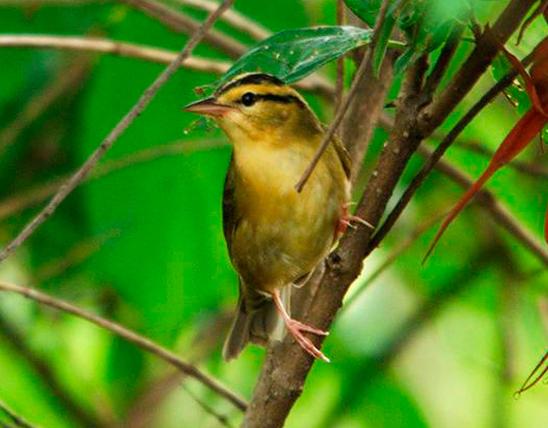
- The worm-eating warbler has thick black head stripes (not a solid rusty cap).
- The northern waterthrush and Louisiana waterthrush have a more distinct white eyebrow and streaky breast.
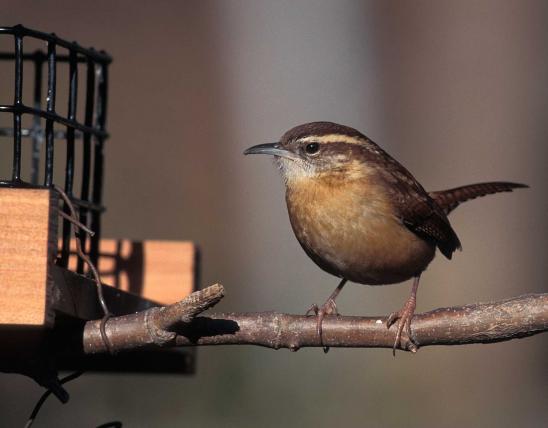
- The Carolina wren is a brighter chestnut color and has a whiter eyebrow and a barred tail that is often erect.
Length: 5–5½ inches.
Southeast Missouri and the Ozark region, especially the southernmost tier of counties, in appropriate habitats and seasons.
Habitat and Conservation
Occurs along streams and rivers in southeast and southern Missouri where “canebrakes” — dense thickets of giant cane (Arundinaria gigantea) — occur. Occasionally seen in dense tangles and thickets without the presence of giant cane. Rarely seen during breeding season; more likely to be seen during migration. Not present in Missouri during winter.
Both Swainson’s warbler and the hooded warbler are closely associated with dense growths of giant cane. Both are rare and difficult to find unless you visit their specific habitat — canebrakes in rich bottomland forests — in the lower Ozark region. Canoeing is one of the best ways to search for them, particularly on the Current, Eleven Point, and Black rivers. Alternatively, try stopping at a streamside park or river crossing where there is forest and dense understory vegetation.
Swainson’s warbler breeds in swamplands and forests with a thick understory and occurs throughout the southeastern United States.
Loss of habitat in both the breeding and wintering grounds is the main threat to this species. The draining and development of bottomland forests and the removal of canebrakes has reduced its habitat dramatically within our state and elsewhere.
Food
Swainson’s warblers eat insects, spiders, centipedes, and millipedes. They primarily forage on the ground under canebrakes, walking around and turning over leaves to find their prey. Wintering birds may also eat small lizards.
Status
Rare summer resident in Missouri’s extreme southern counties.
A Missouri species of conservation concern; state endangered. In other parts of its range, it is uncommon but considered stable.
Life Cycle
In Missouri, Swainson’s warblers are present, in low numbers, from late April through mid-September. They overwinter in the Yucatán Peninsula and the Caribbean. Their migration flights are at night.
The female constructs an open cup nest. Nests are built aboveground, suspended in thick vines, giant cane, or understory plants.
Females usually lay 3 or 4 eggs, but clutches of 1 to 7 have been recorded. The eggs are incubated for about 2 weeks. The hatchlings are naked and helpless. The female does all the incubating and brooding, but both parents feed the young. The chicks are ready to leave the nest in 8–12 days. There is only 1 brood a year, but if a nest fails, most pairs will attempt to nest again. Lifespan apparently can reach 10 years in the wild.
Human Connections
Swainson’s warblers frequently collide with lighthouses, communication towers, and similar structures during their migration, which occurs at night.
Because Swainson’s warblers live in dense vegetation and usually remain hidden from view, they are hard to observe and have not been studied extensively. Recent research is beginning to unravel details about their breeding biology, habitat use, and foraging behavior, but much remains to be learned, especially about their migration stopover and overwintering ecology.
This warbler was named after William Swainson (1789–1855), an English naturalist and friend of John James Audubon. In addition to his contributions to the study of birds, mollusks, insects, and other animals, Swainson is remembered for being the first nature illustrator to use lithography, a printing technology that, combined with a strict system for hand-coloring, allowed him to reproduce color images fairly inexpensively. Nine species of birds were named after Swainson, including two more species in North America: Swainson’s hawk and Swainson’s thrush.
This is the only species in genus Limnothlypis. The genus name means “marsh dweller,” which reminds us that this bird’s preferred habitat is amid swampy lowland areas and dense thickets of canebrakes.
Ecosystem Connections
Because of their exacting habitat needs, Swainson’s warblers are keenly affected by habitat degradation and loss. The draining and development of natural swamplands and bottomland forests has greatly reduced the amount of breeding habitat they can use. Missourians can employ best management practices to help protect their habitat in our state.
Hurricanes can adversely affect their breeding areas as well as their wintering grounds.




About 350 species of birds are likely to be seen in Missouri, though nearly 400 have been recorded within our borders. Most people know a bird when they see one — it has feathers, wings, and a bill. Birds are warm-blooded, and most species can fly. Many migrate hundreds or thousands of miles. Birds lay hard-shelled eggs (often in a nest), and the parents care for the young. Many communicate with songs and calls.