











The snowy egret is a slender, medium-sized white heron with black legs, yellow feet, and a black bill with yellow near the eyes. During breeding season, adults develop long, delicate plumes, and the yellow patch near the eye may turn reddish. Juveniles have duller, green legs. Adults use high- and low-pitched calls to communicate, while the young use quiet, buzzing calls.
Key identifiers:
- A slender white heron
- Black bill
- Black legs with yellow feet (adults).
Similar species: Besides the snowy egret, three other white herons occur in Missouri and may forage in flocks or singly in appropriate habitats.
- Western cattle-egrets are smaller than snowy egrets and have yellow legs and shorter, thicker, yellow bills.
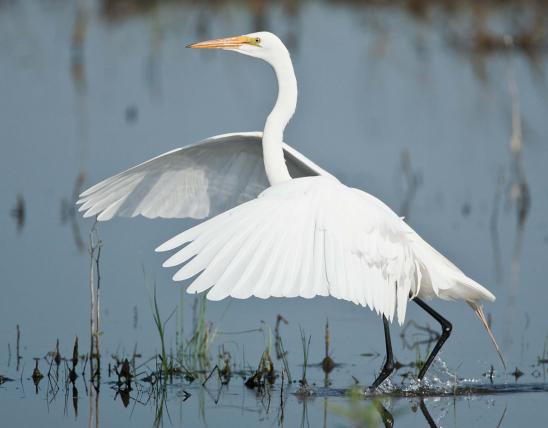
- Great egrets are much larger than snowy egrets and have yellow-orange bills (not black). Great egrets also have dark feet and fly more slowly.
- Juvenile little blue herons are white and similar in size to a snowy egret, but their bills are gray-based with a black tip (not all black as in adult snowy egrets). They also have dull yellow-green legs (not solid black), and the patch in front of the eye is gray (not yellow or reddish).
Length: 22–26 inches; wingspan: 39 inches.
Statewide during breeding and migration, in appropriate habitats.
Habitat and Conservation
Snowy egrets are often found in marshes, flooded fields, riverbanks, the shallow edges of lakes and ponds, and along seacoasts, salt marshes and estuaries. In Missouri, they are most likely to be seen in our southeastern (Bootheel) wetlands.
Hunted nearly to extinction for their breeding feathers in the late nineteenth century, their populations have since rebounded across their range. They are found throughout the United States (although less so in the northern states), Central America, and South America. They are more common in coastal areas. Habitat loss is the most significant threat to their population.
Food
The snowy egret feeds primarily on aquatic animals such as fish, frogs, crayfish, worms, and insects. It uses its feet to stir up prey in shallow water and impales the prey with its bill. Snowy egrets may hunt while hovering above the water or stand quietly to ambush their prey. They also may stand, walk, run, or hop while foraging.
Status
The snowy egret is a species of conservation concern, classified as endangered in Missouri. However, in other parts of its range, the species is considered of low conservation concern.
A rare summer (breeding) resident in southeast Missouri; elsewhere in the state, uncommon as a transient and summer (nonbreeding) visitor.
Life Cycle
Snowy egrets are present in Missouri April through mid-September, with numbers peaking during spring and fall migrations: in May, and from mid-July through early September. For winter, they migrate to the Gulf Coast, the Caribbean islands, Mexico, or South America.
Snowy egrets usually nest in colonies. Nests are made of twigs, sedges, and grasses. The typical nest measures about 15 inches in diameter and is built in the branches of trees or shrubs.
Clutches comprise 2–6 eggs, which are incubated for 24–25 days. The young leave the nest about 20–24 days after hatching. Both parents incubate the eggs and feed the chicks. There is only one brood per year.
Human Connections
In the late 1800s, snowy egrets were hunted to near extinction for their long breeding plumes, which were used as a fashion accessory on hats. Concerned citizens stepped in to protect them in the early twentieth century. The Migratory Bird Treaty Act, established in 1918, made the hunting of egrets illegal: Public activism and subsequent legislation saved this and many other species from extinction.
Ecosystem Connections
Snowy egrets are an indicator of habitat health. Because they feed on fish, frogs, and crustaceans, their bodies can accumulate chemicals and pollutants present in aquatic ecosystems.
Predators of snowy egrets include raccoons, great horned owls, barred owls, and American crows.








About 350 species of birds are likely to be seen in Missouri, though nearly 400 have been recorded within our borders. Most people know a bird when they see one — it has feathers, wings, and a bill. Birds are warm-blooded, and most species can fly. Many migrate hundreds or thousands of miles. Birds lay hard-shelled eggs (often in a nest), and the parents care for the young. Many communicate with songs and calls.