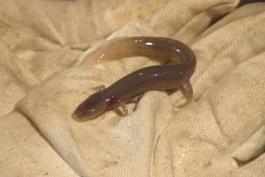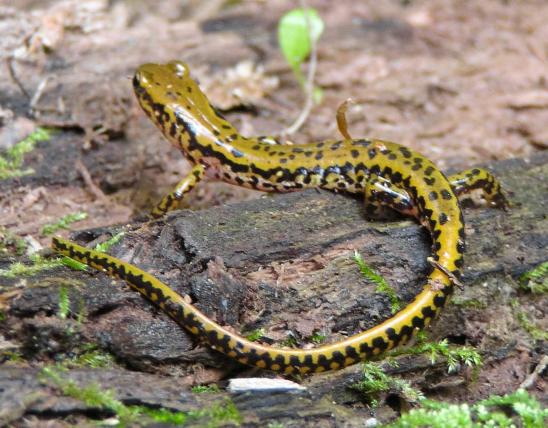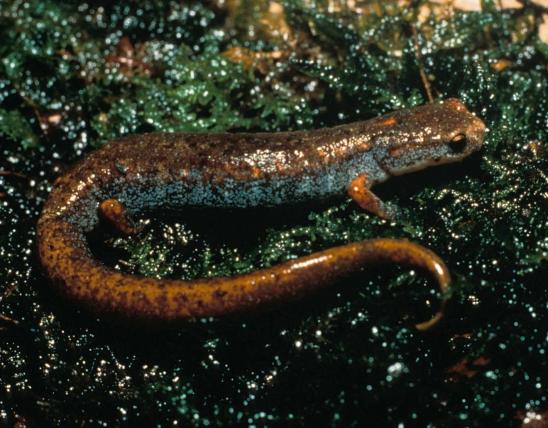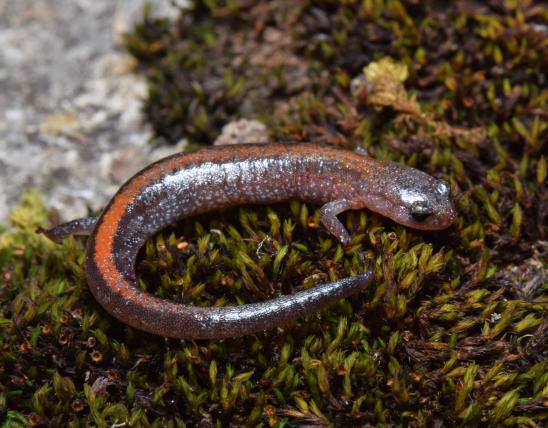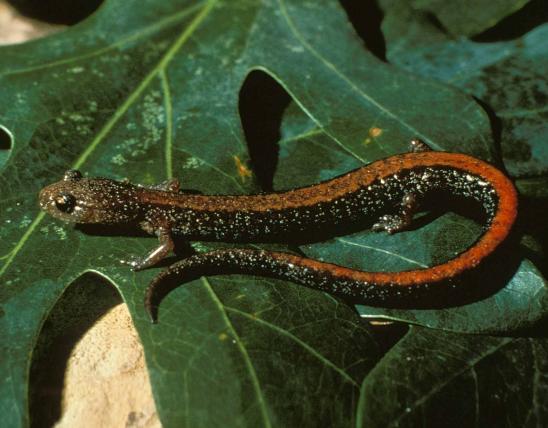









Missouri has two species of grotto salamanders, which live in caves in total darkness and are blind, with small eyes that are completely or partially covered by their pink or beige skin. Both occur in wet caves in the Ozarks:
- the northern grotto salamander (Eurycea nerea) occurs mainly in the Salem Plateau of central and southern Missouri
- the southern grotto salamander (Eurycea spelaea) occurs in the Springfield Plateau of southwestern Missouri.
Although they occur in different regions, the two species look very similar. Adults are pale tan to pale pink. Both species are cave-dwellers, lacking gills in the adult form and partly or completely blind. The head is rather wide and flat. The tail is long, slender, and finless. There are 16–19 grooves along the side. The eyes are small and are partially or fully covered by the eyelids. The eyes may appear sunken into the head.
The larvae have gills, functional eyes, and broad tail fins; they have more pigment than adults, being brown to dark gray, sometimes with spots or streaking on the sides and tail.
Similar species: Our two species of grotto salamanders used to be considered subspecies of Eurycea spelaea, but they have been separated as distinct species based on genetic analysis.
- The southern grotto salamander (Eurycea braggi) was also once considered a subspecies of E. spelaea, and it, too has been elevated to full species; however, it does not occur in Missouri, although it occurs nearby in northern Arkansas.
Genetic testing is the certain way to distinguish among these lineages, but because they are found in different regions, geography is the most practical way of separating them.
Adult length: 3–4¾ inches; occasionally to 5¼ inches.
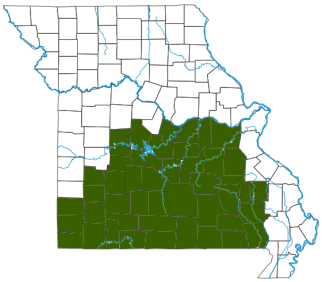
Occur in wet caves in Missouri's Ozark Highlands region. They are endemic (completely limited to) the Ozark Highlands: the northern grotto salamander mainly in the Salem Plateau of central and southern Missouri; the southern grotto salamander in the Springfield Plateau of southwestern Missouri.
Habitat and Conservation
These are Missouri's only blind salamanders, occurring only in Ozark wet caves. Adults are true troglobites, living in total darkness and requiring caves with a spring or stream running through them.
The larvae, which possess functional eyes, can occur in small streams and springs outside of caves.
Because of the delicate balance of cave ecosystems, grotto salamanders and their cave and spring habitats need to be protected from human disturbance, overcollecting, and water and groundwater pollution.
Food
Adults eat mainly small aquatic and terrestrial invertebrates, as well as the larvae of other Eurycea salamanders. Grotto salamanders occur in greater abundance in caves with many bats, probably because they feed on insects attracted to the bat guano.
The larvae eat many types of small freshwater aquatic invertebrates, such as amphipods (scuds), isopods (pillbugs), copepods (such as cyclops), and so on. The larvae have also been known to occasionally consume bat guano to supplement their diet.
Status
Both of Missouri's grotto salamanders are species of conservation concern because of their extremely restricted range in Ozark highland karst (cave and spring) habitats; their relatively low population sizes; their affinity to cave ecosystems; and our limited information on their basic biology.
The survival of grotto salamanders requires healthy cave ecosystems, which in turn require clean groundwater and lack of disturbance by humans.
Life Cycle
Reproduction in grotto salamanders is not well studied due mainly to their secretive habits in caves. Apparently, adults mate during the late spring into the summer due to an influx of nutrients (in the form of bat guano) that support this period, when the salamanders require their greatest food supply.
Fertilization is internal (as with most salamanders), and females apparently lay eggs within 1–4 months after mating. The eggs are probably attached to stones in or near water in caves. The larvae are aquatic and normally inhabit cave streams; sometimes they are found in springs or streams that flow out of caves.
They may take 2–3 years, or sometimes up to 6 years, to transform into adults. The estimated lifespan in the wild is at least 9 years.
Human Connections
Human activities on the surface of the land can have profound impacts in cave systems below. Pesticides, fertilizers, and other chemicals can drain from the land into sinkholes and into cave systems. When land is disturbed, silt can also wash into cave systems, altering those sensitive environments. Learn about vegetated buffer zones around sinkholes and other karst features, erosion and sediment controls, and other habitat best-management practices.
These smooth, graceful, pink salamanders remind us of the delicacy of their cave ecosystem. It is important for people to be extremely careful to protect caves, their inhabitants, and the archaeological artifacts they contain.
Ecosystem Connections
In the unique ecosystem within a cave, grotto salamanders function as predators to insects and other small prey. Meanwhile, they and their eggs and larvae serve as prey to larger creatures, such as mammals venturing into caverns. Even their bodies, after they die, serve as nutrients for other cave life.
Grotto salamanders rely heavily on the nutrients provided seasonally by bat guano. Their destiny is intertwined with that of Missouri's cave-dwelling bats, many of which are species of conservation concern.
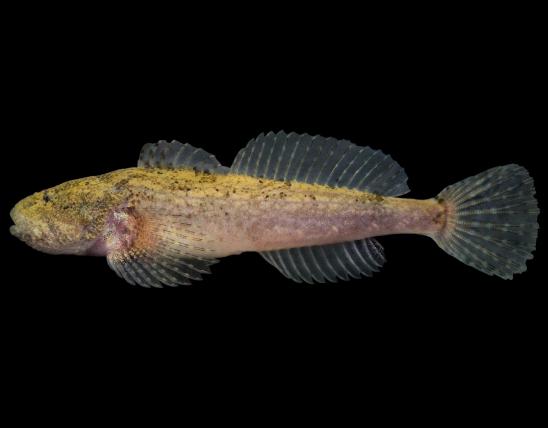
The adaptations and geographical distribution of the grotto salamander have many parallels with other cave-dwelling animals, including cave crayfish, cavefish, and certain sculpins.
This is a member of the lungless salamander family (Plethodontidae). It’s a large family with 27 genera and about 443 species. The family probably originated in the southern Appalachian Mountains; its members now occur over the eastern half of North America, the West Coast, and into Mexico, Central America, and northern South America. A few species also occur in southern Europe and South Korea.
The lungless salamander family is named because the adults lack lungs, and most lack gills; the oxygen they require is taken from their environment through the skin and mucous membrane of the mouth.