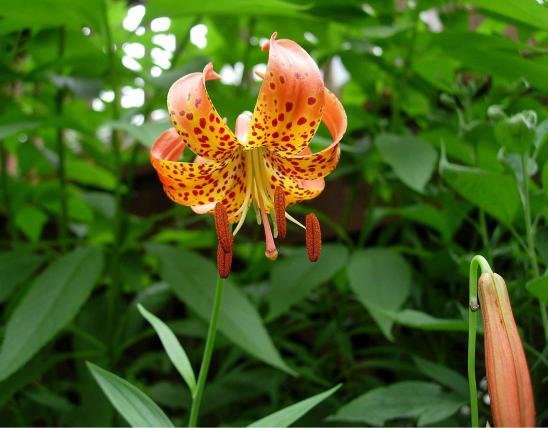









Blackberry lily is a perennial with bladelike leaves growing from yellowish-orange rhizomes.
The flowers arise in terminal cymes at ends of branches and are 1½ to 2½ inches across. The sepals and petals (together called tepals) are similar, spreading, orange, with crimson or brownish spots. Each flower remains open for only a single day. There are 3 stamens. Blooms July–August.
The leaves grow in flattened fans, nearly identical to those of typical garden irises, long and broad.
The fruit is a pear-shaped capsule, about an inch long, that splits open and withers, revealing shiny black seeds; the cluster looks very much like a blackberry. The seeds remain attached for many weeks.
Similar species: At a glance, blooming blackberry lilies may be confused with daylilies (Hemerocallis), which have also escaped from cultivation. Daylilies more often occur in dense colonies in grassy areas, and less in dry, rocky areas, and although their leaves are creased somewhat, they are not folded into flattened, swordlike fans like those of this and other irises.
Blackberry lily is a type of iris (in genus Iris), though it is unusual for the genus. Eleven Iris species have been recorded growing out of cultivation in our state; seven are nonnative and four are native. This is one of the most common of the nonnative species, since it has been a garden subject for so long. To learn more about the irises you might encounter in Missouri's habitats, see their group page.
Height: aerial stems usually to about 3 feet, sometimes to 4 feet; leaf blades to 15 inches.

Scattered nearly statewide.
Habitat and Conservation
Occurs along roadsides, old homesites, edges of dolomite glades and bluffs, disturbed, dry, brushy areas, and rocky, open woods.
Introduced; native to central and eastern Asia, but naturalized widely in the eastern United States. Populations tend to survive where they were planted, sometimes for many years.
Status
Nonnative wildflower. Introduced as an ornamental; can persist where it was planted and form small populations.
Botanists, using the relatively new technique of molecular DNA sequencing, in 2005 determined that this plant should be placed into the genus Iris. It had long been the sole member of the genus Belamcanda. Its attractive orange flowers, with petals and sepals that look quite similar to each other, do not resemble those of familiar garden irises. But as with paternity testing in humans, DNA evidence in blackberry lilies has proven a relationship not obvious to the naked eye.
Human Connections
Blackberry lily is a favorite low-maintenance ornamental in Ozark yards where it has plenty of sun, little competition, and moist soils with excellent drainage. It self-seeds readily. The interesting seed heads can be used in dried flower arrangements. Several cultivars are available.
Ecosystem Connections
Many exotic plants have been introduced to our country, and many of those have become naturalized (that is, they escape from cultivation, or persist where they were planted long ago, and live and reproduce on their own). Some of those that become naturalized are also invasive, but this does not seem to be one of them.