










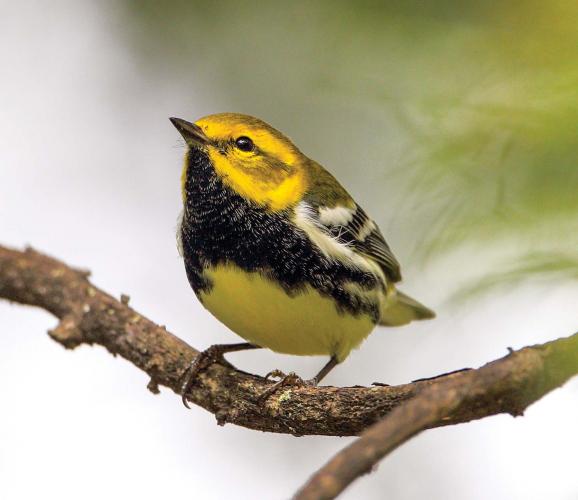
The black-throated green warbler migrates through Missouri in spring and fall. Often, the immediate impression is of olive-and-yellow above (with yellow on the sides of the head), and black-and-white below (with black-streaked sides and pale belly).
Adults have olive on top of the head and back, yellow eyebrows and sides of the head, and olive eyelines and ear-patch borders. The undersides are white (sometimes yellow), with black-steaked sides; there is a hint of yellow around the vent (cloaca). The blackish wings have two white wing bars.
The male has black on the throat and upper breast. The female has a white throat.
The song is variable, but frequently sounds like ZEE-ZEE-ZEE-ZEE-zooZEE! Calls include a variety of high, sharp see and chip notes.
Similar species: About 40 species of warblers are known to occur in Missouri. Keep in mind the time of year you are seeing the bird. Black-throated green warblers are transients in Missouri: they are usually only seen here in spring and fall, during migration, with peak numbers in April–May and in mid-September. The possibility of them breeding during summer, especially in southern Missouri, is low but not out of the question.
Also keep in mind that most warblers are difficult to locate and see, and learning to recognize the male’s song helps a great deal with identification.
Length: 5 inches.
Statewide, during migration.
Habitat and Conservation
In Missouri, black-throated green warblers are seen in spring and fall during migration, as they rest in open forest, woodland, second-growth woods, and scrub and thicket habitats. They usually stay fairly high in the canopy.
Farther north, in their breeding range, they live in boreal forests dominated by spruce, fir, and pine trees.
As with many other warblers, people usually hear this species before they see it.
One common “translation” of their song, “TREES TREES TREES TREES love-TREES!” is a good way of remembering their favorite habitat.
Food
Like most migratory songbirds, during breeding season, this warbler’s diet is almost entirely of insects. This high-protein diet is important for the growing young and the hard-working parents. This species is especially fond of caterpillars, which they pluck from twigs and branches.
When breeding is over, from migration time through the winter, various types of berries are a big part of the diet. In Missouri, during fall migration, the "berries" (fleshy cones) of eastern red cedar, and the fruits of poison ivy and sumacs, are apparently among the favorite foods.
Status
Transient.
A Missouri species of conservation concern, currently listed as "unrankable" due to lack of information or due to substantially conflicting information about status or trends.
Life Cycle
Black-throated green warblers are seen in Missouri during migration. They are not known to breed or to overwinter in our state. In spring, they occur here from early April through the end of May (with numbers peaking in late April and early May), and in fall from early September through mid-October (peaking in mid-September).
The main breeding range for black-throated green warblers extends from Canada south into the Great Lakes Region, the US northeast, and south along the Appalachians as far as the northeastern corner of Alabama. The overwintering range is in Mexico, the Caribbean, and parts of Colombia and Venezuela.
There is a small, isolated breeding population in northwest Arkansas — much farther south of the main breeding range, and it is possible that black-throated green warblers seen in Missouri could be nesting here, too, especially in southwest Missouri.
Small cup nests are built of twigs and pieces of bark, bound together with silk from spider webs, and are positioned in small trees near the trunk. Clutches comprise 3–5 eggs, which are incubated for 12 days. After hatching, the young remain in the nest for another 8–11 days before fledging. There is only 1 brood per year.
The lifespan is at least about 5 years in the wild.
Human Connections
In 1883, Elliott Coues (1842–1899) founded the American Ornithological Union (now the American Ornithological Society). He had this to say about warblers: “With tireless industry do the Warblers befriend the human race. . . . They visit the orchard when the apple and pear, the peach, plum, and cherry are in bloom, seeming to revel carelessly amid the sweet-scented and delicately-tinted blossoms, but never faltering in their good work. They peer into the crevices of the bark, scrutinize each leaf, and explore the very heart of the buds, to detect, drag forth, and destroy these tiny creatures, singly insignificant, collectively a scourge, which prey upon the hopes of the fruit-grower and which, if undisturbed, would bring his care to naught.”
Ecosystem Connections
Biologists point out that the principal reason why birds migrate north for breeding is to take advantage of the bounty of insects that emerge in springtime. A diet of insects provides critically important protein for successful breeding and the growing young. Had they remained in Central America, these birds would face stiff competition for the available insects and nesting territory. It’s truly amazing that these tiny birds fly across a continent in order to access a lot of caterpillars.
But pay attention to the explosions of life in spring: first, the massive flush of tender green leaves across the entire landscape, followed by the awakening of a multitude of young insects — caterpillars, bug nymphs, and more — that chew on those tender leaves. The migratory birds arrive in time to take full advantage of the big bloom of insects. Thus the first wave of leaves is followed by a wave of insects, which are followed by the wave of northbound birds.
This and nearly 30 other wood-warblers used to be in the genus Dendroica, but evidence from genetic research showed that the genus could not logically be kept separate from genus Setophaga. Today, all the Dendroica warblers are in genus Setophaga.





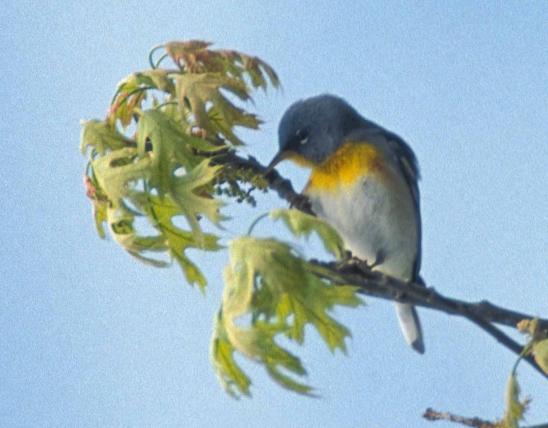


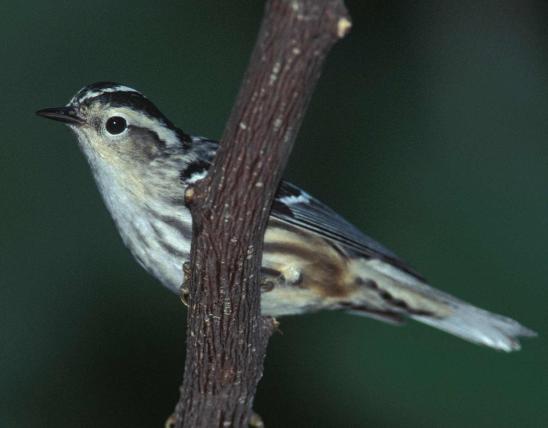
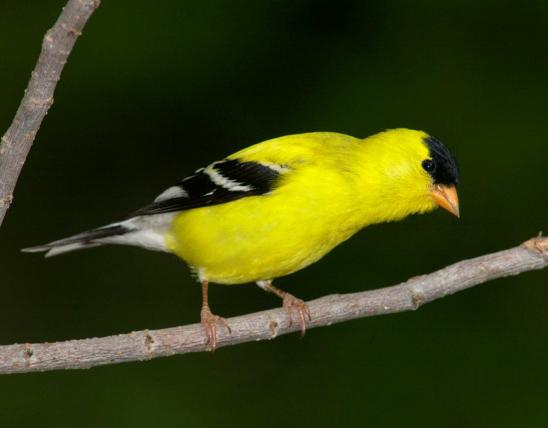
About 350 species of birds are likely to be seen in Missouri, though nearly 400 have been recorded within our borders. Most people know a bird when they see one — it has feathers, wings, and a bill. Birds are warm-blooded, and most species can fly. Many migrate hundreds or thousands of miles. Birds lay hard-shelled eggs (often in a nest), and the parents care for the young. Many communicate with songs and calls.