








The original portion of this 601-acre area was acquired by the Conservation Department in 1967.
Media
Scientific Name
Tyto furcata
Family
Tytonidae (barn owls) in the order Strigiformes (owls)
Description
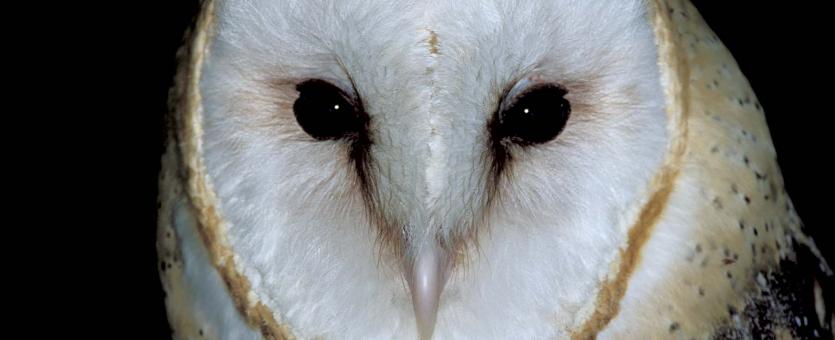
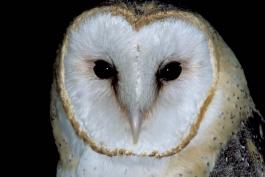
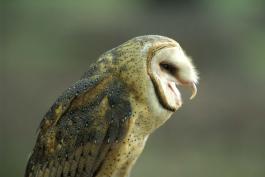
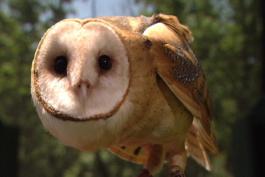
The American barn owl is cinnamon and gray above, white to buffy below, with small black spots; the legs are long and the eyes dark. The heart-shaped facial disk has caused this species to be dubbed the “monkey-faced owl.” In flight, they appear buoyant, with slow wingbeats.
The voice is harsh. The call is a bona fide screech or scream, each lasting a few seconds. Barn owls also make hissing, barking, and clicking sounds. (They do not hoot.)
Similar species: Several other types of owls live in Missouri, but this species is quite distinctive, with its whitish, heart-shaped face, overall pale coloration, dark eyes, and rounded head profile (lacking ear tufts).
By ear, American barn owl sounds might surprise you. They don't hoot, and a barn owl's screeches and shrieks might tempt you to misidentify it as an eastern screech-owl. But despite its name, the screech-owl's song is actually a descending tremolo or trill, much more like a descending coo, or a trilling whinny, than a real screech. When screech-owls screech, it is usually only in defense.
Other Common Names
Monkey-Faced Owl
Size
Length: 13 to 16 inches (tip of bill to tip of tail); wingspan: 3½ to 4 feet.
Where To Find

Statewide.
Habitat and Conservation
Barn owls live in landscapes that harbor good rodent populations, including open woodlands, grasslands, pastures, brushy fields, and agricultural areas. They can also be found in deserts and wetlands. Some live in urban and suburban areas.
They commonly nest in old barns, grain elevators, cotton gins, grain storage buildings, and occasionally hollow trees. Caves, cliff crevices, haystacks, and burrows along riverbanks may also be used as nesting sites.
Barn owls are highly nocturnal. They spend daytime secluded in rafters, behind hay bales, and so on.
Mortality is often high during hard winters, but even though populations may temporarily decline, they can repopulate an area quickly.
Many landowners take advantage of these owls’ rodent-hunting skills by putting up boxes so barn owls can nest without entering a building.
Food
The primary food is small rodents, but barn owls also eat birds, insects, bats, and reptiles. Nocturnal foragers, they fly slowly across grasslands searching for prey. Food is often swallowed whole.
Barn owls are great examples of how owls are adapted to hunting for rodents in the dark. In addition to having excellent night vision, they have superb hearing and their feathers allow them to flap without making noise.
- The saucer-shaped facial disk functions like a sonar dish, and the ears are positioned asymmetrically on the head (one ear being slightly higher than the other), allowing the bird to accurately locate the source of sounds in three dimensions. Barn owls are so good at hunting by sound, they can accurately capture prey in total darkness.
- The wing feathers are soft and fluffy, have tiny serrations on the leading edge, and have hairlike extensions on trailing edge, which minimizes air turbulence and eliminates the telltale whooshing sound that birds usually make in flight. Thus owls can fly silently toward their prey.
Status
Rare permanent resident.
Life Cycle
Life Cycle
These nocturnal predators often wait until several hours after dark before emerging from their roosts.
Barn owls are monogamous, remaining with their mates for life, only finding a new partner if one of the pair dies. Nesting may occur in any month of the year. There are usually 5–10 eggs in a clutch, but the number of eggs can range from 2–18. These are incubated for about a month. About 7 weeks after hatching, the young are ready to fledge, but they practice foraging with their parents for another week or so before leaving the area. Pairs may raise 1–3 broods per year.
Although most large, carnivorous birds have only a few young per year, which are tended carefully over a rather long period of time and have a high probability of surviving to adulthood, barn owls produce relatively large numbers of offspring per year, with a relatively low percentage surviving to adulthood.
For barn owls, life expectancy in nature is usually only 1 or 2 years. In captivity, a barn owl may live for 15 years or more.
Human Connections
Because of their effectiveness at hunting rodents, barn owls perform a great service to farmers and others in the grain business who continually face rodent pests. Barn owls are encouraged worldwide for this reason.
Old time Ozark folklore and other old American superstitions held that owls were bad omens, and that their presence signified that death was imminent. We know that's untrue, unless you're talking about the rodent population in and around the barn where the owls are living! The nocturnal habit, ghostly white face with staring eyes, and unnerving shrieks no doubt led to this owl's folklore stereotype. Indeed, old-time references to "screech owls" might actually refer to barn owls instead of to the pint-sized birds we now call screech-owls.
In Native American lore, owls can have a variety of meanings. Sometimes they signify that a death will occur; sometimes they represent spirits or incarnations of the dead. In some traditions, owls are viewed as important guardians, connected to the spirit world, who convey souls to the afterlife.
Barn owls have lived alongside humans for ages. Their bones have been found at Olduvai Gorge in Tanzania, where human bones were discovered. Missouri’s barn owls continue the tradition today.
Ecosystem Connections
With their ability to hunt by sound — in complete darkness — as well as by sight, barn owls are efficient mousers and do much to keep populations of those prolific breeders in check. Meanwhile, opossums, raccoons, and other owls feed on barn owls and their eggs and young.
Taxonomy: Barn owls have a large distribution globally and used to be considered all one species, "the barn owl," Tyto alba. Recent studies have elevated former subspecies to species level, so "barn owl" now refers to a genus.
- Our North American species is now Tyto furcata, the American barn owl; it occurs in North and South America.
- Populations in Europe, southwest Asia, and Africa kept the original Tyto alba scientific name, but their common name is now officially the western barn owl.
- Populations in southeast Asia and Australia are now called Tyto javanica, the eastern barn owl.
Title
Media Gallery
Image

Right to Use
Use of this image is restricted to MDC only
Image

Right to Use
Use of this image is restricted to MDC only
Video file
Caption
Video of a barn owl.
Right to Use
Audio file
Image

Credit
MDC
Right to Use
Photo by MDC, courtesy Missouri Department of Conservation
Image

Credit
MDC
Right to Use
Photo by MDC, courtesy Missouri Department of Conservation
Image
Image
Thumbnail
Thumbnail

Image

Image

Title
Similar Species
Similar Species
Media

Media

Media

Media
Media

Media

Media
Where to See Species
About Birds in Missouri
About 350 species of birds are likely to be seen in Missouri, though nearly 400 have been recorded within our borders. Most people know a bird when they see one — it has feathers, wings, and a bill. Birds are warm-blooded, and most species can fly. Many migrate hundreds or thousands of miles. Birds lay hard-shelled eggs (often in a nest), and the parents care for the young. Many communicate with songs and calls.
Reviewed On