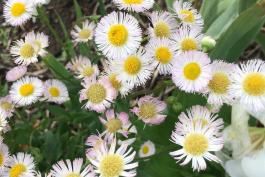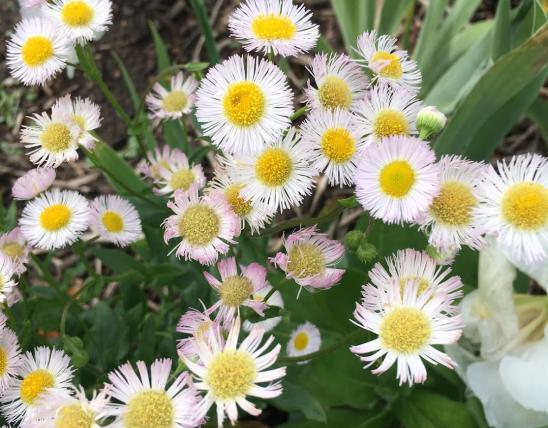










Missouri has five species of fleabanes (genus Erigeron), which all look something like tiny ox-eye daisies. They have yellow centers encircled with a fringe of numerous threadlike white rays.
It’s a little tricky to distinguish among the species, so we treat them here as a group.
Missouri’s fleabanes have some common characteristics:
- The stems are solitary, few, or several; often with lengthwise lines; more or less erect; branching; variously hairy.
- The basal leaves are whorled, sometimes withered at flowering time; the stem leaves are alternate, progressively smaller toward the tip, narrow, unlobed, sometimes with coarse teeth, frequently short-stemmed or sessile.
- The flowerheads are in branching panicles and resemble miniature ox-eye daisies, with numerous thin white rays around a golden yellow disk of tightly packed florets. The rays are often tinged with pink, purple, or blue, especially with age or on the undersurface. One species (prairie fleabane) often lacks ray florets entirely.
- Blooming usually begins before July, and in some species as early as April and May. A few species can bloom into September or even November.
- When mature, the tiny seeds (achenes) are tipped with fluffy-looking hairs and are distributed by the wind; the mature seedhead looks like a miniature dandelion seedhead.
Missouri has five fleabanes:
- Robin’s plantain (Erigeron pulchellus)
- Philadelphia fleabane (Erigeron philadelphicus)
- Annual fleabane, whitetop fleabane, or daisy fleabane (Erigeron annuus)
- Prairie fleabane, or daisy fleabane (Erigeron strigosus)
- Slenderleaf fleabane (Erigeron tenuis)
For a deeper dive into Missouri’s five species of fleabanes, see Ecosystem Connections below.
Similar species: Several Missouri plants look like fleabanes.
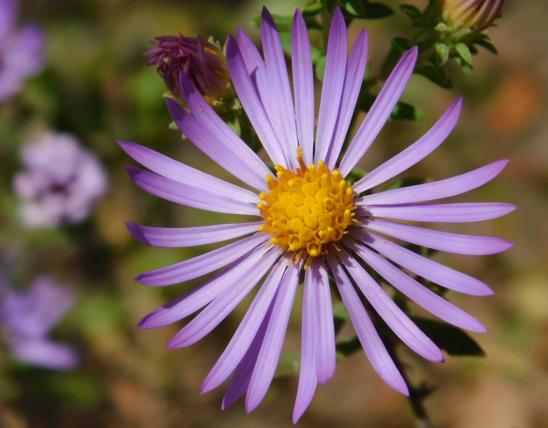
- New world asters (genus Symphyotrichum) usually have lavender ray flowers, but some, such as white heath aster, are white. They usually bloom in late summer into fall, and the bracts beneath the flowerheads overlap like shingles. Missouri has 24 species. Learn about them on their group page.
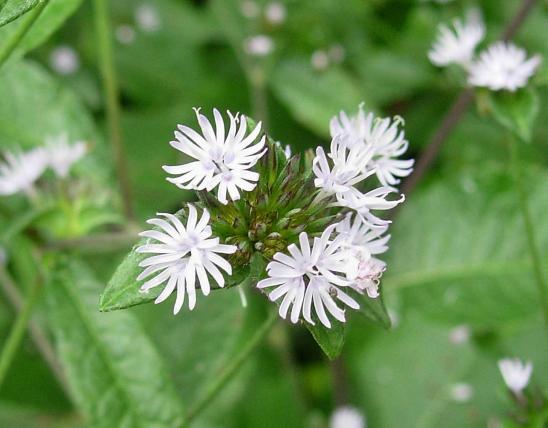
- False asters (genus Boltonia) are very similar to fleabanes. Missouri has three species:
- False aster, or false starwort (Boltonia asteroides)
- Decurrent false aster (Boltonia decurrens)
- Doll’s daisy (Boltonia diffusa)
- Horseweeds, or dwarf fleabanes (genus Conyza), are sometimes included in genus Erigeron, and botanists are still debating whether they should be grouped together. Missouri has two species of Conyza, both of them annuals:
- Horseweed (Conyza canadensis)
- Dwarf fleabane (Conyza ramosissima)
Height at flowering varies by species:
- The tallest, annual fleabane, typically flowers at 2–5 feet.
- Philadelphia fleabane usually only reaches 2½ feet, only rarely reaching 5 feet tall.
- The smallest, slenderleaf fleabane, flowers at only 4–18 inches.
All our fleabanes are present nearly statewide, except for slenderleaf fleabane (Erigeron tenuis), which is scattered in southern Missouri.
Habitat and Conservation
Most fleabanes are associated with open, sunny habitats and disturbed places, such as banks of streams and rivers, margins of ponds and lakes, openings of wooded areas, prairies, pastures, fields, railroads, and roadsides.
Status
Native Missouri wildflowers.
Our most common species is annual fleabane, which is widespread and occurs in the greatest variety of habitats. Our least common species is slenderleaf fleabane, scattered across southern Missouri and tricky to distinguish from annual and prairie fleabanes.
Fleabane species have sometimes been divided into subspecies and varieties, based on hairiness, leaf shapes, and other traits. Also, the boundaries among genera (fleabanes versus related groups) are also up for debate. The taxonomy in this group will certainly be adjusted with future research.
Human Connections
Robin’s plantain, with its large flowers and perennial habit, is an attractive species that deserves more widespread cultivation as a groundcover in woodland gardens.
Native Americans used fleabanes medicinally, for heart ailments, for pain relief, to treat diarrhea, as a poultice for sores, and to reduce excessive bleeding after childbirth.
The common name “fleabane” seems to have come from the mistaken belief that the plants somehow repelled fleas. Maybe “erigeron” (uh-RIH-juh-ron) would be a better common name.
Some species of North American fleabanes have been introduced to Europe and Asia, and some of them have proven invasive in those regions.
Ecosystem Connections
A variety of insects feed on fleabanes, including the caterpillars of a flower moth, the obscure schinia (Schinia obscurata), which appears to be limited to eating members of this genus.
Fleabane flowers attract butterflies, bees, and other insects as pollinators.
Deer and other herbivores browse the foliage of fleabanes.
Prairie fleabane, like other prairie wildflowers, is adapted to occasional fire. Its germination rates and populations usually increase within two to three years after a burn.
A single plant of annual fleabane (our “weediest” species) can produce 10,000–100,000 seeds in a single growing season, which helps account for its success in a large area and in many habitats.
Globally, there are about 400 species in genus Erigeron. About 170 species live in North America. On our continent, the genus is most diverse in the western mountains.
How can you distinguish among Missouri’s five fleabanes?
- Identifying fleabane species often revolves around features of the leaves, although botanists also painstakingly count the many thin white rays, or examine the pappus bristles (stiff hairs projecting from the seeds).
Identifications are also tricky because the characters can vary within a species, and even within a single plant. For example:
- Plants in the same species may be sparsely hairy, densely hairy, or even glabrous (hairless and smooth).
- The basal leaves and stem leaves have different shapes, and the stem leaves usually are smaller and simpler the higher they are on the stem — so evaluating leaf characters takes some patience. You should look at several leaves to determine general trends.
Here’s a quick guide to Missouri’s five species of fleabanes:
- Robin’s plantain (Erigeron pulchellus) is the most distinctive: the only one that’s perennial, growing from rhizomes (not merely fibrous roots), and forming large colonies from runners; the only one whose basal whorl of spoon-shaped leaves always persists at flowering time; it has fewer, but larger flowerheads (¾ to 1⅜ inch across). Blooms April–June.
- Philadelphia fleabane (Erigeron philadelphicus) is a biennial or short-lived perennial, most easily distinguished by its numerous stem leaves clasping the stem with earlike lobes. It’s also distinguished from our other annual fleabanes by more ray florets (120–400) (the others have only up to 125) and longer disk corollas (to 3.5 mm long) (the others are only up to 2.5 mm long). Blooms April–June.
- Annual fleabane (Erigeron annuus) is our most commonly encountered fleabane and the most “weedy,” common in fields and waste places. Hairy and leafy; to 3 feet tall. Basal leaves, if not withered at flowering time, are elliptical, coarsely toothed, to 4 inches long with long stems. Stem leaves are much shorter, numerous, most of them toothed, with conspicuously hairy margins. Flowerheads are many. Blooms well into the fall: May–November.
- Prairie fleabane (Erigeron strigosus) is hairy and very similar to annual fleabane, but living in drier sites and uncommon in crop fields; compared to annual fleabane, it’s generally shorter (usually to 2 feet tall) with fewer, narrower leaves, looking sparser and more open; its largest leaves are narrower and less toothed; basal leaves, if not withered at flowering time, are oblanceolate, with few or no teeth; stem leaves few, linear, sessile, without teeth (sometimes with a few irregular teeth near the tip). Flowerheads sometimes lack ray florets, consisting only of the yellow central disk. Blooms May–September.
- Slenderleaf fleabane (Erigeron tenuis) is our least common fleabane, scattered in southern Missouri, and difficult to distinguish from annual and prairie fleabanes. (To separate them, you must examine details of the hairlike pappus bristles at the tip of the seeds.) It blooms a few weeks earlier than those two.