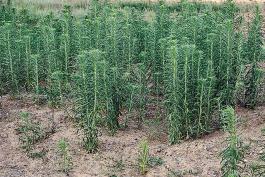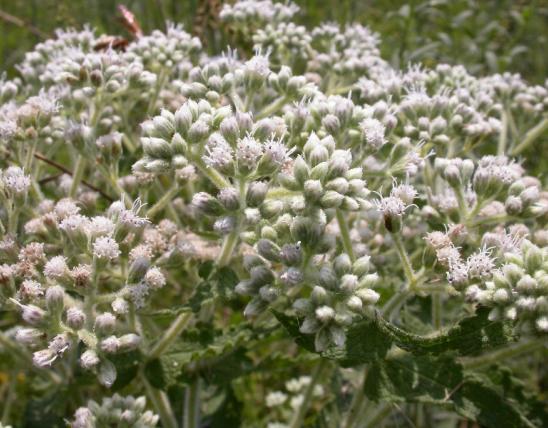








Horseweed looks it couldn't decide to be a goldenrod or a fleabane. Like goldenrods, it has tiny flowerheads in big panicles, though they are whitish, not yellow. Up close, they look like tiny fleabanes that haven't opened up completely.
In Missouri, this plant is especially associated with highly disturbed habitats and is a troublesome crop weed.
Horseweed is a flowering annual of variable height. The stem is solitary and upright. Large specimens may be densely branched in the top half of the plant and usually have very numerous leaves. The stems are ridged and are usually moderately to densely hairy.
The flowerheads are many, in a dense, elongate, terminal inflorescence. The heads are tiny, about ³⁄₁₆ inch across, the whitish, cream-colored, or pinkish-tinged rays so small that they are best seen only with a magnifying lens.
Blooms June–November.
The leaves are many, hairy, elongated, and alternate around the single, hairy stem.
The seeds (achenes) are tipped with hairs that enable them to be carried on the wind.
- Missouri has two subspecies of horseweed; one is a Missouri species of conservation concern. See Status, below, for more about them.
Similar species: Missouri has one other species in this genus.
- Dwarf fleabane, or spreading fleabane (Conyza ramosissima, syn. Erigeron divaricatus), is scattered nearly statewide and lives in similar open, sunny habitats. It often has several main stems (not just one), which are spreading, sometimes ascending at the tips (not erect), and moderately to densely branched nearly throughout the length of the stems (not branching only above the midpoint).
Other similar plants include Missouri's five species of fleabanes (genus Erigeron); horseweed has sometimes been placed in the same genus. Philadelphia fleabane is one example. Goldenrods, when they are not blooming bright yellow, might be confused with horseweed based on the growth habit and form of the flower clusters, especially in seed.
Height: commonly 2–7 feet, but quite variable. This species can bloom at only a few inches tall.
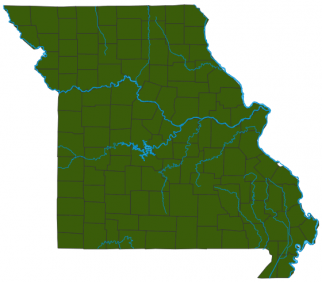
Statewide.
Habitat and Conservation
Occurs naturally on banks of streams and rivers, upland prairies, sand prairies, glades, openings in moist upland forests.
In Missouri, horseweed is known especially from open, disturbed areas such as pastures, old fields, fallow fields, crop fields, gardens, railroads, and roadsides.
Status
Native Missouri wildflower. Often considered a weed.
Missouri has two subspecies/varieties of horseweed, and although one is common enough to be a serious crop weed, the other is uncommon and listed among our Missouri species of conservation concern.
- Conyza canadensis var. pusilla is ranked as vulnerable to extirpation from our state. It is uncommon in southeastern Missouri and occurs on sand prairies (which are themselves a critically imperiled habitat in Missouri) and in openings of upland woodlands; it may also be found in old fields and other open, disturbed areas in southeast Missouri.
- Var. pusilla is identified by its stems, which are mostly smooth, hairless (glabrous) (not moderately to densely hairy), and its involucral bracts (at the base of each flowerhead), which have dark purple (not green or white) tips.
- Conyza canadensis var. canadensis is the common, weedy species found statewide.
Human Connections
Horseweed is a serious crop weed, especially of corn and soybeans. Like many similar plants, it has developed herbicide-resistant strains.
Good farmers naturally want to rid their fields of weeds. Missouri, an agricultural state, is home to one of the world's leading producers of herbicides. Researchers have also been combating weeds by genetically engineering crop plants that are resistant to increasingly strong herbicides.
Native Americans used horseweed medicinally to treat a variety of ailments, such as colds and coughs, nasal congestion, fevers, stomachache, and more.
Horseweed pollen contributes to late-season hay fever, and contact with the plant can cause skin irritation in some people.
Livestock generally avoid eating horseweed due to its bitter taste. The same chemicals that can cause skin irritation in people can also irritate the nostrils of horses. A 2025 study suggested that horseweed might cause severe allergic responses in horses.
If it's something livestock won't eat, and it can cause allergic reactions in horses, why is it called "horseweed"?
- A clue to the answer might be that it's also called "coltstail" and "marestail." Perhaps it was named for its look.
- Also, the word horse in a plant name often implies coarseness, large size, strength, or rank, weedy growth, which would apply here, too. (Think of horseradish, horse gentian, horse nettle, and horse-chestnut.)
Ecosystem Connections
The flowers are visited by insects, especially wasps and flies, which drink nectar. Other insects eat the leaves.
Mammals generally don't eat this plant because of bitter-tasting chemicals in the leaves.
Horseweed can bloom at 8 feet in height, or it can bloom as low as 2 inches, or it can bloom at any height in between.
- This extreme variability is one of its "superpowers" as a pioneer species, allowing it to compete in a wide variety of situations.
- It can raise its flowerheads high enough to capture the attention of insect pollinators in tallgrass prairies, where competing grasses easily grow to 6 feet tall.
- It can also produce flowers in places that are trampled, mowed, or overgrazed. Either way, it can create seeds.