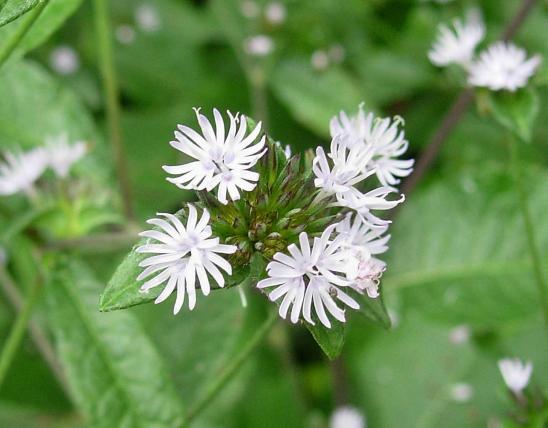











Fringed quickweed is a nonnative, hairy, branching, rather weedy annual. It is usually found on roadsides and in other disturbed habitats. The flowerheads have 5 white ray florets with 2 or 3 teeth, and yellow disk florets. The leaves are opposite, toothed, and hairy.
Fringed quickweed is a nonnative annual wildflower with small taproots. The stems are upright, with fine lengthwise ridges and grooves, and densely hairy with spreading hairs; on the outer branch tips, the hairs are tipped with tiny dark glands.
The flowerheads are in irregular, terminal panicles or loose clusters, sometimes from the upper leaf axils, with small, leaflike bracts at the branch points, the heads appearing long-stalked. Each flowerhead usually has 5 white ray florets, which have 2 or 3 somewhat rounded teeth, and (on average) about 25 yellow disk florets.
Blooms May–November.
The leaves are opposite, to nearly 3 inches long, lance-shaped to oval with a pointed tip, unlobed, toothed, hairy, usually with 3 prominent veins.
Similar species: Another, fairly common Missouri plant can be mistaken for fringed quickweed — but only if you're looking at the flowerheads, and not at the foliage and growth habit:
- Pale-flowered leaf cup (Polymnia canadensis) is tall (easily to 5 feet), with straight stems and opposite, large, lobed leaves. The flowerheads look very similar to quickweed but have about 8 white ray florets surrounding the yellow disk florets. The opposite pairs of leaf stem bases often have short, rounded, leafy appendages wrapping around the plant stem, forming a “leaf cup” around the node, hence the common name.
Height: 3–28 inches.
Widely scattered in the state.
Habitat and Conservation
Occurs on banks of streams and rivers, and in gardens, farmyards, railroads, roadsides, and other open, disturbed areas.
This species is probably native to Central America and South America; it has been introduced worldwide. In many regions, it is considered a troublesome, noxious, or invasive weed.
Status
Nonnative, introduced wildflower, usually growing in disturbed-soil habitats. Apparently fairly widespread in Missouri.
It spreads readily by seeds and is often considered a weed in regions where it is more common.
Human Connections
In U.S. states where fringed quickweed is more common, it is a troublesome weed to home gardeners as well as crop farmers. It is an alternate host for some types of crop pests. Learn to identify this plant, and if it appears in your garden or crop field, take measures to remove it as soon as possible, because it spreads quickly by seed. Pulled plants, if left laying on the soil, can survive by rerooting.
The name “quickweed” comes from this plant’s rapid ability to take root, grow, produce flowers, and set seed. There can be multiple generations within a single growing season.
Fringed quickweed is an edible plant for people and livestock. If you’re foraging, make sure you identify it correctly, and seek out the young greens. Use it cooked, in soups or in other dishes as you would use chard or spinach.
Quickweed has a history of various medicinal uses.
The genus name, Galinsoga, honors Spanish physician Ignacio Mariano Martinez de Galinsoga (1756–1797), who was a botanist and the director of the Royal Botanical Garden of Madrid. In 1784, he wrote a book describing the health hazards to women wearing tight-laced corsets.
The species name, quadriradiata, means “four-rayed,” apparently referring to the number of ray florets — but this species usually has five ray florets.
Ecosystem Connections
Fringed quickweed is used by various pollinator insects such as bees and flower flies (syphids).
Nonnative plants don’t contribute much to Missouri’s natural habitats, because they take up space that native plants would otherwise inhabit.
A very close relative to fringed quickweed is gallant soldier (Galinsoga parviflora). It could now be absent from our state, but in the past, it has been recorded in a few locations in western Missouri. It occurs in nearby states to our east and west, so it could possibly be found in Missouri again. It is very similar but is a less hairy plant, with hairs lacking the glandular tips. To be certain of the ID, you must examine details of the floret and seed bristles using magnification.
Globally, there are about 15 species in genus Galinsoga. They are native to North and South America, but various species have been introduced nearly worldwide.