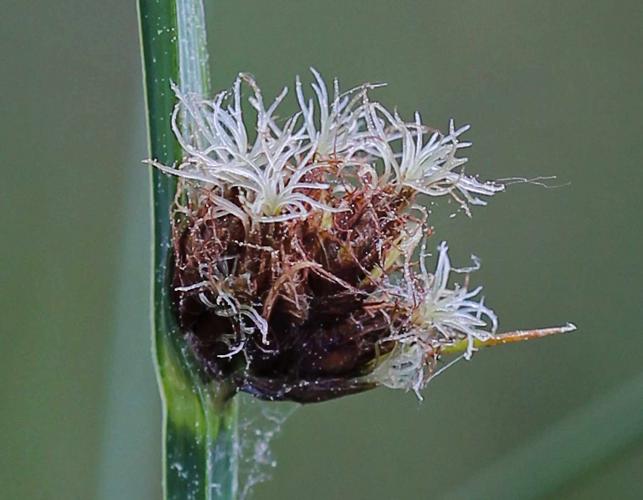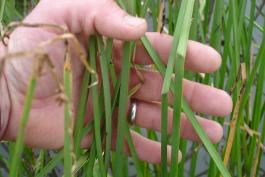







“Bulrush” is the common name for several species in the sedge family (Cyperaceae), especially those in genus Scirpus, but some others as well. They are typically robust, grasslike wetland plants that grow large compared to other sedges. Like other sedges, the stems are usually triangular in cross-section.
For an introduction to the sedge family, see its group page.
It’s a little confusing that there are several genera of sedges called bulrushes. Some of the confusion arose when the formerly large “bulrush” genus Scirpus was divided, and new genera were created for the split-off groups. (Globally, Scirpus had once contained about 300 species; now, it’s more like 120.)
- Although many plants left the original bulrush genus, their “bulrush” common names have persisted. Therefore “bulrush” generally refers to genus Scirpus in its old-fashioned sense: the former, broad sense, or Scirpus sensu lato.
Missouri’s bulrushes include about 27 species in the following genera:
- Scirpus (SKERR-pus), 8 species.
- Schoenoplectus (SKEE-no-PLEK-triss), 10 species.
- Schoenoplectiella (SKEE-no-PLEK-tee-el-uh), 4 species.
- Isolepis (eye-so-LEP-iss), 2 species.
- Bolboschoenus (bowl-boe-SKEE-nuss), 2 species.
- Trichophorum (TRICK-oh-FOR-um), 1 species.
This online field guide is an introduction. Botanists distinguish between sedge species by using microscopes to examine certain plant parts (especially the mature seeds). Rootstocks are usually required for surefire IDs, too. But many people will be able to start learning some of our most common bulrushes using photographs and helpful tips.
Below are seven of our most common and widespread species. For a full list of Missouri’s bulrushes, see Ecosystem Connections.
- Dark green bulrush, green bulrush, common bulrush, Scirpus atrovirens, scattered nearly statewide, with a wide distribution in the eastern United States; grows as an emergent aquatic along the margins of ponds, lakes, sloughs, and streams; also in ditches and wet depressions along roadsides. S. georgianus and S. pallidus were formerly lumped in with this species.
- Wool grass, woolgrass bulrush, cottongrass bulrush, Scirpus cyperinus, scattered in eastern and northern Missouri; grows as an emergent aquatic in swamps, sloughs, marshes, bottomland prairies, and margins of ponds and lakes; sometimes along streams and fens; also in roadside ditches and old quarries. Widely distributed in North America; a highly variable species; fine, smooth, twisting bristles protrude from the scales of the mature seed heads, creating a cottony or woolly look.
- Georgia bulrush, common bulrush, Scirpus georgianus, scattered nearly statewide, growing as an emergent aquatic along margins of ponds, lakes, sloughs, and streams, also ditches and wet depressions along roadsides. Related to S. atrovirens and formerly considered a part of that species, which explains why both are still called “common bulrush.” In North America, S. georgianus has a more southerly distribution; Missouri is in the area where the two species’ ranges overlap. The two are about equally as common in our state.
- Pendulous bulrush, nodding bulrush, rufous bulrush, red bulrush, Scirpus pendulus, scattered to common statewide; common and widespread in much in North America. Grows in bottomland and moist upland prairies, fens, moist depressions and ledges of calcareous glades and bluffs, and margins of streams, rivers, lakes, and ponds; also in ditches along roads.
- Chairmaker’s rush, common threesquare, Schoenoplectus pungens, scattered nearly statewide, but more common in southern Missouri. Lives in a range of wet habitats: along streams, lakes and ponds, and in sloughs, ditches, gravel bars, fens, and marshes; sometimes it grows in shallow water. It is variable, and it is quite similar to its close relatives S. deltarum and S. americanus.
- Great bulrush, softstem bulrush, Schoenoplectus tabernaemontani, scattered to locally common statewide, with a large global distribution. An emergent aquatic on river banks, margins of ponds and lakes, marshes, sloughs, and bottomland prairies; also in wet depressions along roadsides. One of the most common bulrushes in Missouri. Native Americans used this plant as food, drying and grinding the stout, starchy rootstocks into a flour, and eating the young shoots raw or boiled.
- River bulrush, Bolboschoenus fluviatilis, scattered nearly statewide; robust; forms large, dense colonies in floodplains of large rivers. Has stout, 3-angled, leafy stems that can be more than ½ inch in diameter at the base.
Similar species: Keep in mind that, although it is used for at least eight genera in the sedge family, the term “bulrush” is a common name that is used for other plants besides the current and past members of genus Scirpus. For example:
- Several species in other sedge genera are called “bulrushes,” though they’ve never been in genus Scirpus. One famous example is the sedge Cyperus papyrus, the papyrus sedge, which is native to Africa and famously used for making paper and basketry in ancient Egypt.
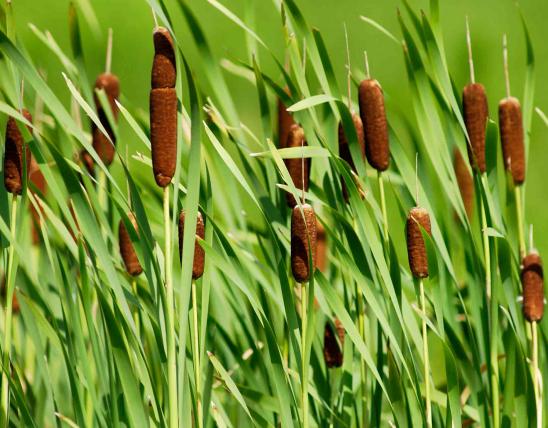
- Some people call cattails (Typha spp.) “bulrushes,” but they’re in a different family.
- The root of the word “bulrush” — the word “rush” — usually refers to plants in the rush family (Juncaceae). But bulrushes are in the sedge family.
To many people, three different plant families — the sedges (family Cyperaceae), rushes (Juncaceae), and grasses (Poaceae) — are a confusing grasslike jumble, so these families are often discussed loosely as “graminoids” (grassy plants). To help you remember which is which, here’s one version of the famous rhyme: “Sedges have edges / Rushes are round / Grasses are hollow with nodes — Which have you found?”
Height: varies according to species. The largest can have stems from 1 or 2 feet to 6 or 8 feet tall. One of the smallest species is Isolepis carinata, whose stems range from ½ to 8 inches tall.
Statewide. Different species have different distributional patterns within the state.
Habitat and Conservation
Most bulrushes are emergent aquatics, which grow with their roots submerged and the foliage rising above the water’s surface. Some grow completely on land (though usually in moist soils), and a few may be completely submerged, or grow in the middle of pools in creeks or sinkhole ponds.
Bulrushes usually grow in damp or wet situations, in soils that are moist because they are along streams, or where water continually collects (as in ponds, lakes, or ditches), or are near the water table (as in marshes, fens, and swamps).
Specifically, look for bulrushes on the margins of ponds and lakes, along the banks of streams ranging from creeks to big rivers, in sloughs, swamps, marshes, floodplains, mudflats, and bottomlands; and in ditches and wet depressions along roadsides and railroads.
Some bulrushes grow in sunny, open areas, such as bottomland prairies. Some grow in shady situations, as in bottomland forests. Some live in acidic soils derived from sandstone or chert substrates or in acidic seeps or fens, while others only live in alkaline soils, such as those derived from limestone or other calcareous rocks, or near salty seeps. One Missouri species is most common on rocky, dry, woodland slopes.
Species that require very particular types of habitats tend to be less widespread, while those that have less strict requirements tend to be widespread and common.
Status
At least 15 species (more than half) of Missouri’s bulrushes are species of conservation concern; they are rare, declining, or in some other way vulnerable to extirpation from our state:
- Bayonet grass, prairie bulrush, alkali bulrush, Bolboschoenus maritimus ssp. paludosus
- Gulf Coast bulrush, Isolepis molesta
- Hall’s bulrush, Schoenoplectiella hallii
- Weakstalk bulrush, Schoenoplectiella purshiana
- Rocky Mountain bulrush, Schoenoplectiella saximontana
- Olney’s bulrush, saltmarsh bulrush, Olney three-square, Schoenoplectus americanus
- Giant bulrush, California bulrush, southern bulrush, Schoenoplectus californicus
- Delta bulrush, Schoenoplectus deltarus
- Canby’s bulrush, Schoenoplectus etuberculatus
- Giant bulrush, great bulrush, slender bulrush, Schoenoplectus heterochaetus
- Swaying bulrush, Schoenoplectus subterminalis
- Torrey’s bulrush, Torrey three-square, Schoenoplectus torreyi
- Spreading bulrush, Scirpus divaricatus
- Pale bulrush, Scirpus pallidus
- Stalked bulrush, Scirpus pedicellatus
Sadly, six of the above are listed as possibly extirpated (“historical”), which means that they are known only from historical records (20–40 years old), and no one has found the species in our state since then. There is still some hope that they may be rediscovered within our borders:
- Gulf Coast bulrush, Isolepis molesta
- Olney’s bulrush, Schoenoplectus americanus
- Delta bulrush, Schoenoplectus deltarus
- Canby’s bulrush, Schoenoplectus etuberculatus
- Torrey’s bulrush, Schoenoplectus torreyi
- Spreading bulrush, Scirpus divaricatus
Another Missouri species of bulrush is rare, but it is native to Eurasia. In Missouri, bog bulrush (also called ricefield bulrush, Schoenoplectiella mucronata), has been found only in Lincoln County (northeast Missouri). This species is naturalized in the state of California and appears sporadically in the eastern United States, apparently transported by waterfowl. It somewhat resembles the much more common chairmaker’s rush (Schoenoplectus pungens).
Human Connections
Bulrushes and other sedges play important roles in improving water quality and preventing destruction from floods. The multitude of plants that grow along streams, in sinkholes, and in wetlands cleanse water that runs off the land into waterways or into groundwater. When the waters rise from floods or flash floods, the densely packed plants absorb the impact and the moisture, preventing the soil from washing away.
Some bulrushes are especially useful as native landscaping plants in water gardens, along ponds or streams, in rain gardens, and other low, moist to wet areas:
- Dark green bulrush, Scirpus atrovirens, has fruiting clusters that start out dark green but turn brown as they mature; they provide an interesting look in fall.
- Woolgrass bulrush, Scirpus cyperinus, has drooping fuzzy, rusty fruiting clusters that are ornamental in fall and winter.
- Softstem bulrush, Schoenoplectus tabernaemontani, grows in standing water or wet ground. It forms clumps of stems 4 to 8 feet tall.
The famous biblical story of the infant Moses in his floating basket made of “bulrushes” probably refers to the species Cyperus papyrus, the papyrus sedge, which is usually not considered a true bulrush.
Ecosystem Connections
Some of Missouri’s uncommon bulrushes may have been introduced to our state by migrating waterfowl. Ducks, geese, pelicans, and a wide variety of shorebirds unwittingly collect mud on their feet and feathers, then fly across states and regions. Any seeds present in the mud can be transported to new locations thanks to these birds. When plants “use” birds this way, it is considered a natural dispersal mechanism.
Although this page is just a basic introduction to Missouri’s bulrushes, here is a list of all of the bulrushes known to be native or naturalized in our state. Some may have been extirpated from our state; see the Status section for species with special conservation or introduced status.
Scirpus (8 species)
- Dark green bulrush, green bulrush, common bulrush, Scirpus atrovirens
- Wool grass, woolgrass bulrush, cottongrass bulrush, Scirpus cyperinus
- Spreading bulrush, Scirpus divaricatus
- Georgia bulrush, common bulrush, Scirpus georgianus
- Pale bulrush, cloaked bulrush, Scirpus pallidus
- Stalked bulrush, Scirpus pedicellatus
- Pendulous bulrush, nodding bulrush, rufous bulrush, red bulrush, Scirpus pendulus
- Leafy bulrush, Scirpus polyphyllus
Schoenoplectus (10 species)
- Great bulrush, hardstem bulrush, Schoenoplectus acutus
- Olney’s bulrush, saltmarsh bulrush, Olney three-square, Schoenoplectus americanus
- Giant bulrush, California bulrush, southern bulrush, Schoenoplectus californicus
- Delta bulrush, Schoenoplectus deltarum
- Canby’s bulrush, Canby’s club-bulrush, swamp bulrush, Schoenoplectus etuberculatus
- Giant bulrush, great bulrush, slender bulrush, Schoenoplectus heterochaetus
- Chairmaker’s rush, common threesquare, Schoenoplectus pungens
- Swaying bulrush, Schoenoplectus subterminalis
- Great bulrush, softstem bulrush, Schoenoplectus tabernaemontani
- Torrey’s bulrush, Torrey threesquare, Schoenoplectus torreyi
Schoenoplectiella (4 species)
- Hall’s bulrush, Schoenoplectiella hallii
- Bog bulrush, ricefield bulrush, Schoenoplectiella mucronata
- Weakstalk bulrush, bluntscale bulrush, Schoenoplectiella purshiana
- Rocky Mountain bulrush, Schoenoplectiella saximontana
Isolepis (2 species)
- Keeled bulrush, Isolepis carinata
- Gulf Coast bulrush, Isolepis molesta
Bolboschoenus (2 species)
- River bulrush, Bolboschoenus fluviatilis
- Bayonet grass, prairie bulrush, alkali bulrush, Bolboschoenus maritimus ssp. paludosus
Trichophorum (1 species)
- Bashful bulrush, Trichophorum planifolium