













Michigan lily looks a lot like the Asian “tiger lily” that is commonly cultivated in gardens. Michigan lily, however, is native, it has leaves mostly in whorls, and it lacks the round bulblets that tiger lily forms in its leaf axils.
Michigan lily is a perennial lily with an unbranched, hairless stem, growing from a stout bulb.
The flowers are single or in whorls of 2–5 (more in cultivated plants), on stems arising from the upper leaf axils, nodding, with 6 tepals (3 sepals and 3 petals, all 6 alike) orange with many purple spots, recurving (curved backward); the 6 stamens and the 1 stigma protrude prominently.
Blooms June-July.
The leaves are lance-shaped, mostly whorled, sometimes alternate at the lowest and highest nodes, to 5 inches long and ¾ inch wide, roughened with minute, toothlike processes along the margins and veins.
The fruits are 3-angled capsules ¾–1¾ long.
Similar species: Not counting plants in cultivation, this is Missouri's most common species in genus Lilium. The others look similar but are much rarer:
- Tiger lily (L. lancifolium), a common garden ornamental, has only alternate leaves, lacks toothlike processes on the leaves, and forms round, blackish bulblets at the leaf axils. A nonnative, it does not persist long out of cultivation.
- Wood lily (L. philadelphicum) has flowers erect, not nodding; it is a native but is possibly extirpated from Missouri. It may still occur in some of northern Missouri's native prairies and dry woodlands.
- Swamp lily, also called Turk's cap lily (L. supurbum), has leaves mostly whorled, smooth, lacking teeth, lacking bulblets; in Missouri, it has been found only in Perry County.
Height: 3–8 feet.

Scattered statewide, but apparently absent from the Bootheel lowlands.
Habitat and Conservation
Found in low woods, swampy meadows, moist areas in prairies, along streams, but sometimes on bluff ledges or other dry ground; also railroads and roadsides.
Sometimes Michigan lily plants are found as colonies of small or spindly, nonflowering individuals. This is perhaps caused by excessive shading as trees form a closed canopy over formerly open areas. Such populations apparently can persist for many years without flowering.
Status
Native Missouri wildflower.
Human Connections
Many people cultivate this native lily as a low-maintenance ornamental in flower gardens. It attracts hummingbirds and has no serious insect or disease problems.
If you want to grow this plant in your garden, obtain your plants from ethical native wildflower nurseries. Doing so not only protects native populations of these beautiful plants, but also gives valuable business to local native plant nurseries, which often participate in statewide conservation efforts.
Ecosystem Connections
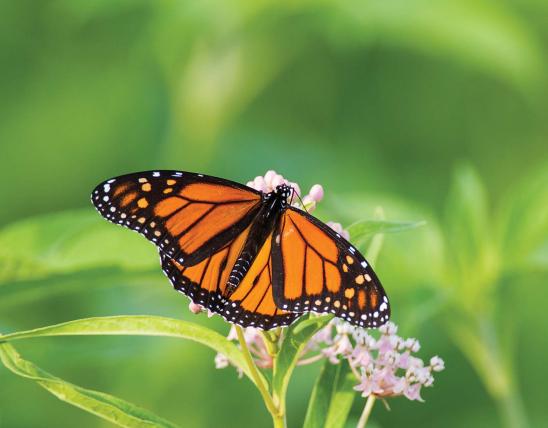
Sphinx and hummingbird moths and large butterflies visit the flowers, and a variety of mammals browse the foliage. Small rodents, such as voles, that burrow underground probably eat the bulbs.
This species is native to prairies and other open habitats in a region extending from the Great Lakes and Upper Mississippi Valley, including Ontario and South Dakota, south to Oklahoma and Georgia. It is listed as endangered in the state of New York and threatened in Tennessee.


