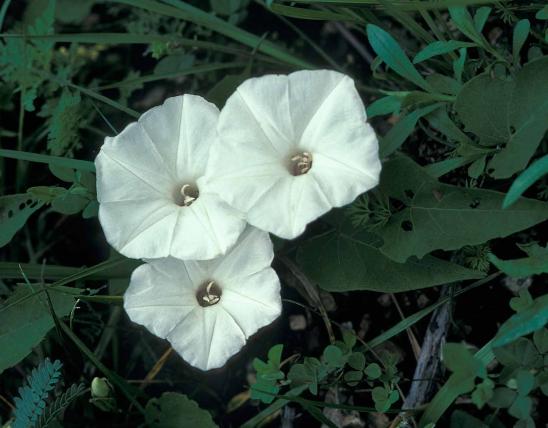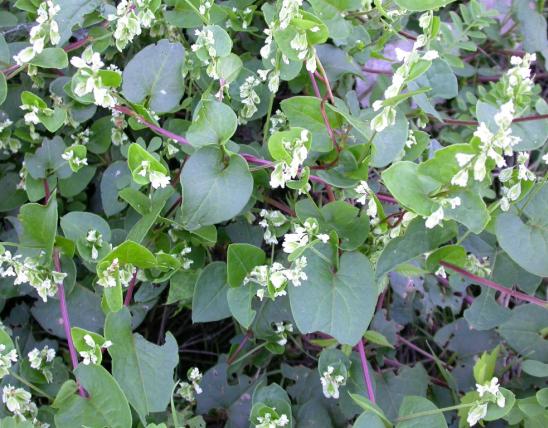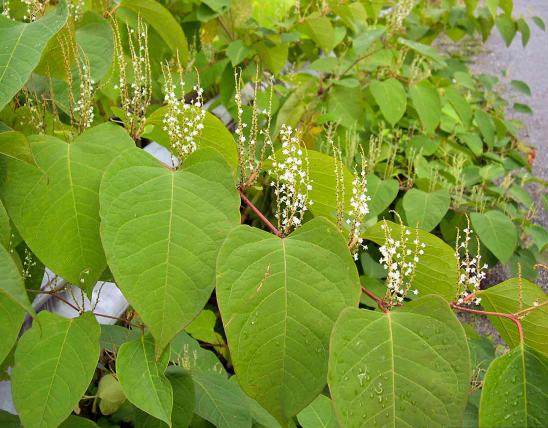









Instantly recognizable as a type of morning glory, hedge bindweed is common in disturbed habitats and can be a serious agricultural weed, but it is not as problematic as its nonnative relative field bindweed.
Hedge bindweed is a creeping, climbing, and twining perennial vine with smooth stems and leaves, spreading by deep roots.
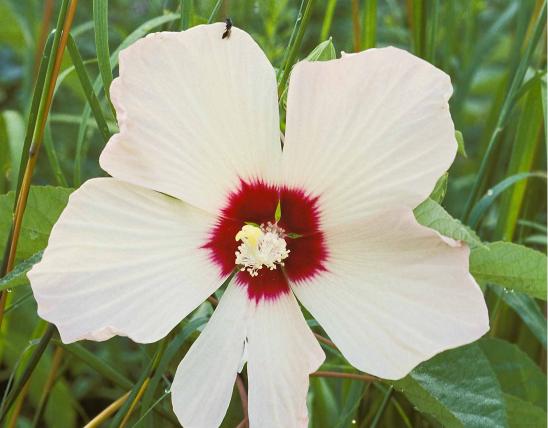
The flowers are on long peduncles from the leaf axils, large, funnel-shaped, to 2½ inches long, white or sometimes pink with a few white stripes on the inside. Each flower is subtended by bracts that usually overlap only toward the base; the bracts are usually sharply pointed. The flowers close by noon on sunny days. The flowers are usually solitary (sometimes in pairs).
Blooms May–September.
The leaves are alternate, arrow-shaped with long leaf stems; the sinus at the base of the leaf blade (where the leaf stem attaches) is U-shaped (not squared-off with the two sides parallel), to 4 inches long.
Similar species: Five species of hedge bindweeds (genus Calystegia) (kal-uh-STEE-jee-uh) have been recorded for Missouri. Botanists have been debating how to divide or group together these plants and their varieties. For more information about MIssouri's other four hedge bindweeds, see Ecosystem Connections.
- Note also that nonnative field bindweed (Convolvulus arvensis), although in a different genus, is quite similar and common statewide. It is among the world's worst agricultural weeds.
Stems can reach lengths of 10 feet.

Scattered statewide, mostly north and west of the Ozarks.
Habitat and Conservation
Occurs in borders of bottomland and moist forests, banks of streams and rivers, margins of ponds, lakes and sloughs, disturbed parts of upland prairies, fallow fields, crop fields, pastures, fencerows, gardens, railroads, roadsides, and open, disturbed areas.
Status
Native Missouri wildflower and nonwoody vine, with a wide global distribution.
Human Connections
This plant and its close relatives in the genus Calystegia can become noxious weeds in crop fields and other disturbed sites, but their smaller root systems make them less significant as weeds than their nonnative relative field bindweed (Convolvulus arvensis), which is a more serious bane to farmers and gardeners.
Ecosystem Connections
The flowers provide nectar for insects.
Several insects, including some beetles and the larvae of plume moths, eat the foliage.
Here are the other four hedge bindweeds known to occur in Missouri:
- Short-stalked false bindweed, or twin-flowered false bindweed (Calystegia silvatica ssp. fraterniflora): scattered nearly statewide, in a variety of lowland and upland, often disturbed habitats. This species is very similar to Calystegia sepium. The bracts at the base of the flowers usually strongly overlap and are rounded to bluntly pointed. The flowers usually occur in pairs (sometimes solitarily). The sinus at the base of the leaf blade is relatively narrow, the two sides parallel and at abrupt right angles to the leaf base (the sinus is not U-shaped). (These characters separate it from C. sepium.)
- Macoun's bindweed (Calystegia macounii): uncommon, widely scattered statewide; stream banks, pastures, fallow fields, and gardens. The stems and leaves are covered with velvety hairs.
- Japanese bindweed (Calystegia pubescens): nonnative, uncommon, scattered, mostly in disturbed habitats in and around urban areas. The flowers are smaller than our other hedge bindweeds (petal tubes only 1–1 ½ inches long); the specimens found growing in Missouri have had doubled petals and were probably escaped from ornamental plantings.
- Low bindweed, dwarf morning glory, or upright false bindweed (Calystegia spithamaea spp. spithamaea): uncommon in the eastern half of the state; openings of woodlands, exposed ledges of bluffs, upland prairies, roadsides. Our only Calystegia whose stems grow erect or ascending, but not twining.