







Field bindweed is a nonnative member of the morning glory family. With its extensive, deep root system, it is extremely difficult to eradicate. It is considered one of the world’s worst agricultural weeds.
Field bindweed is a creeping, climbing, and twining perennial vine with smooth stems and leaves, spreading by a network of deep roots. The somewhat fleshy, branching rhizomes may reach depths of 13 feet or more.
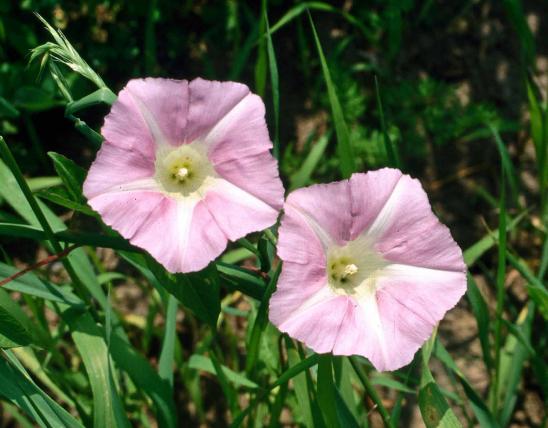
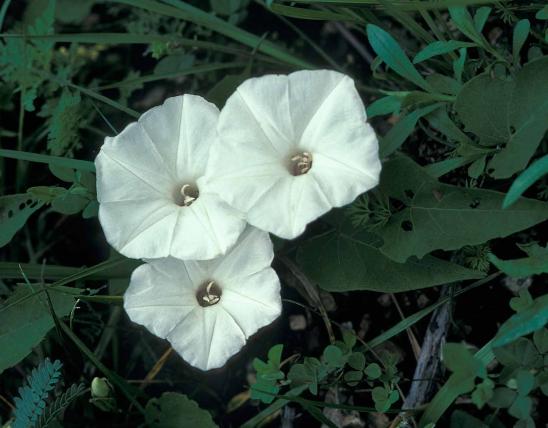
The flowers are white or pink, small, funnel- or bell-shaped, with 2 small, scalelike bracts 1 or more inches below the flowers, which are on stems arising from the bracts. Flowers are single or in loose clusters of 2 or 3, arising on peduncles from the bract point.
Blooms May–September.
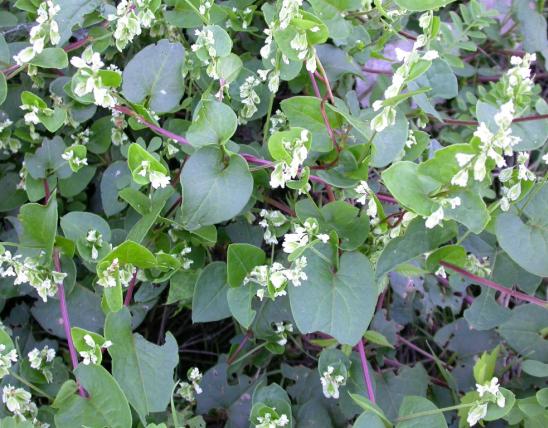
The leaves are alternate, usually with short stalks; the leaf blades ½–2 inches long, the shape variable: oblong, ovate, or triangular, sometimes with a pair of triangular lobes at the base (then appearing arrow-shaped), rounded to sharply pointed at the tip.
Because field bindweed is a noxious agricultural weed, the University of Missouri Agricultural Extension provides additional resources about the species.
Similar species: This is the only species of Convolvulus recorded for Missouri. Globally, there are more than 200 species in this genus.
In Missouri, the most similar species are the hedge bindweeds (genus Calystegia), such as the hedge bindweed C. sepium, and the morning glories (genus Ipomoea), such as wild potato vine (I. pandurata).
Stem length: to 3 feet, occasionally to 6 feet.
Common statewide.
Habitat and Conservation
Occurs on banks of streams and rivers, disturbed portions of upland prairies, and disturbed margins of upland woodlands and glades; also in crop fields, fallow fields, pastures, gardens, fencerows, roadsides, railroads, and open, disturbed areas.
Field bindweed apparently is native to Europe and possibly also Asia and Africa. It is now naturalized worldwide.
Status
Nonnative perennial nonwoody vine. Field bindweed is one of 12 species of plants designated by the state of Missouri as a noxious weed that cause economic harm to the state’s agriculture industry.
Human Connections
Field bindweed grows rapidly and forms dense mats in crop fields and gardens; it climbs up, twines around, and chokes out desirable plants.
Gardeners know that if only a small segment of the roots remain, bindweed can quickly regrow its complex root system and send up new plants several feet from the initial infestation. Additionally, the seeds can remain viable for decades, meaning that a plot of land that has sustained a population of field bindweed will continue to have new plants germinating for a long time.
The genus name, Convolvulus, is from the Latin word meaning “to entwine.” The species name, arvensis, means “of cultivated fields.” It’s a great scientific name for this weedy plant that twists around other plants such as crops or garden ornamentals.
Field bindweed appears to have been introduced to the United States before 1740; at that time, it was sold as a medicinal herb and garden ornamental in New England. Another theory is that it arrived on our shores as a contaminant in crop seed. It spread quickly after that; it reached California by 1850. By the 1880s, people were recognizing it as a severe agricultural weed.
Field bindweed is now considered a noxious weed and is regulated by law in most states, including Missouri. It causes economic harm to the state’s agriculture industry, and it is very difficult to control or eradicate. Landowners are required by law to control designated noxious weeds on their property so that they do not reproduce. The Missouri Department of Agriculture provides assistance to landowners for controlling this and other designated noxious weeds.
Field bindweed has a long history of medicinal use in both Europe and North America, apparently for its laxative properties.
Various parts of the plants, including the roots, have been reported as poisonous to some livestock.
Ecosystem Connections
Fortunately, field bindweed mostly does not invade healthy natural habitats. It is most problematic in disturbed habitats, such as crop fields, vacant lots, roadsides, gardens, and other places where the soil has been dug up. It is also mostly limited to sunny areas.
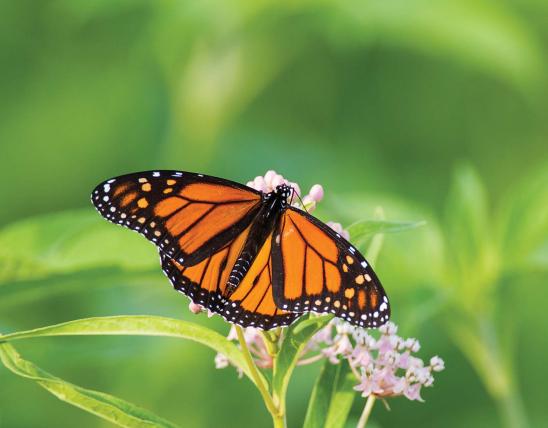
A variety of pollinators visit the flowers.
Wherever nonnative plants such as field bindweed occupy spaces where native plants could live, they reduce Missouri’s natural habitats.