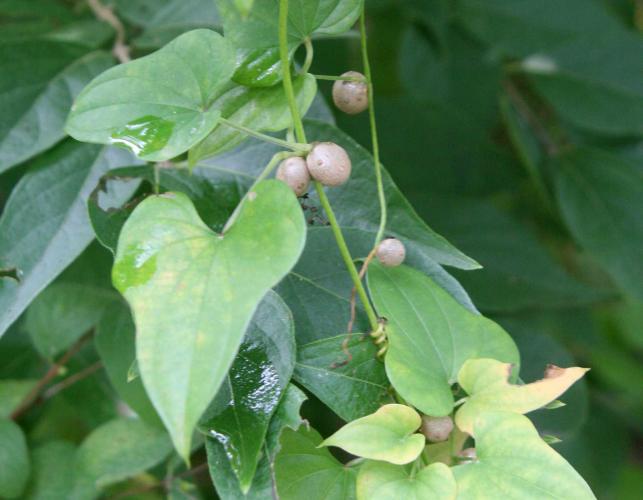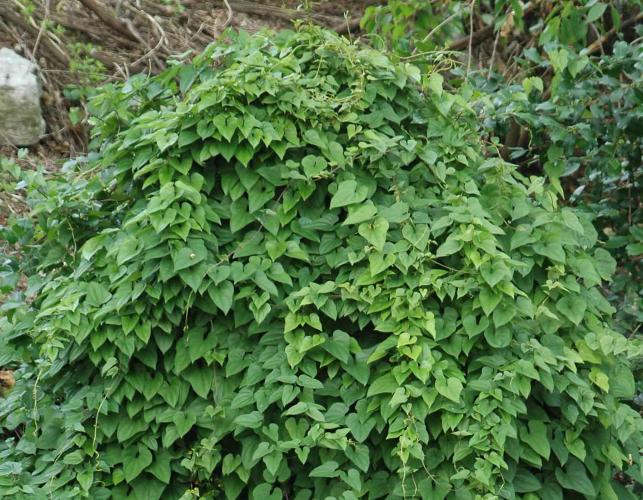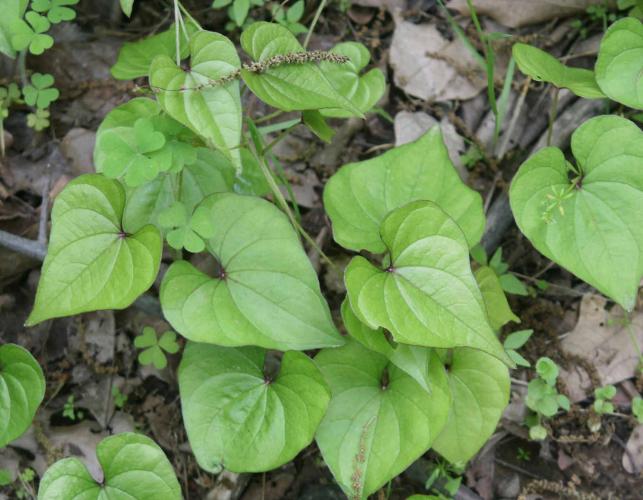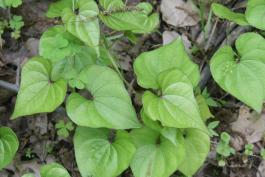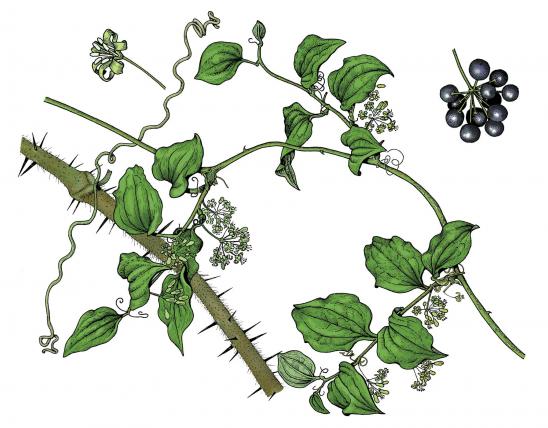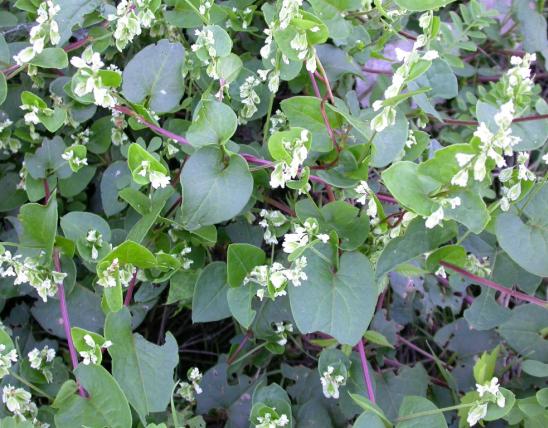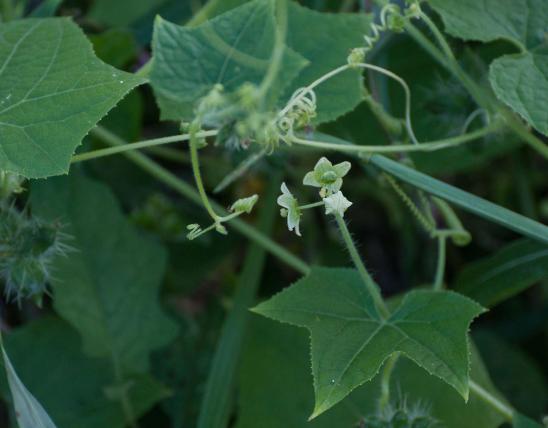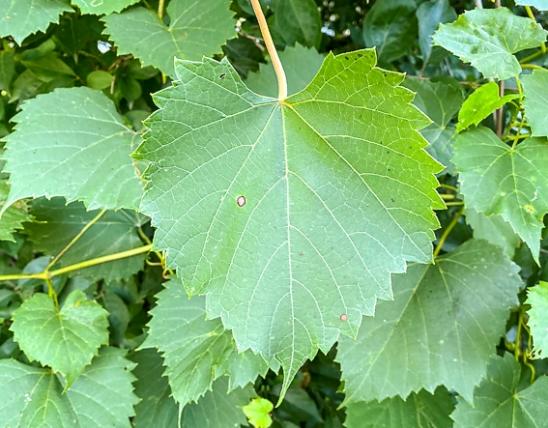














Chinese yam is an invasive, nonnative vine that overtakes nearly everything within reach that stands still long enough. It has heart-shaped leaves and produces tiny, potato-like structures in the leaf axils.
Chinese yam is an aggressive, nonwoody, deciduous perennial vine that can overtake acres of vegetation, similar to kudzu, climbing over shrubs and trees. The rootstock is a stout, spindle-shaped tuber that can grow to be more than 3 feet long and weight 10 pounds. The stems are round, slender, and twining; plants usually die back to the ground and resprout in spring.
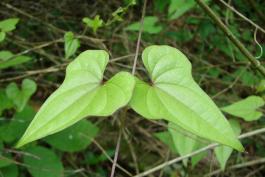
The leaves are usually opposite (sometimes alternate toward branch tips), green, with 7–9 parallel veins, fiddle-shaped or heart-shaped, with a pointed tip and two lobes near the base of the leaf. New growth often has a reddish coloration at the base of the leaves.
The flowers are tiny, white to greenish yellow, with the scent of cinnamon. Male and female flowers are formed on separate plants, and female plants have not been observed in the wild in our country.
Blooms June–August.
- Chinese yam is not known to produce seed in the United States, but it produces bulbils, which resemble tiny Irish potatoes and are not technically fruits, in the leaf axils. The bulbils easily break off and start new plants where they fall.
Stems: to 16 feet long or longer.

Currently in 16 counties in southern Missouri; it is found throughout the eastern and central United States.
Habitat and Conservation
Chinese yam becomes established in moist bottomland forests, along stream banks, drainages and roadsides, along fencerows, and at old homesites.
It can grow in full sun to full shade but prefers partial shade. It is tolerant of most soil conditions, but it is most aggressive in silty loam soils rich in nitrogen, associated with riparian (river and streamside) habitats.
Chinese yam forms small bulbils (resembling miniature potatoes) in the axils of the leaves. New vines quickly sprout from these bulbils, which drop off the vine and are carried to new locations by water or rodents or in topsoil moved for construction purposes.
- Even a small piece of a bulbil will sprout into a new vine, the way a small piece of a potato can create a new plant.
- The bulbils can overwinter and form new vines in spring.
Status
Invasive. Nonnative, aggressive vine. Difficult to control or to eradicate.
Control
Human Connections
Introduced from East Asia in the 1800s for ornamental, food, and medicinal uses. Where Chinese yam is native, it is a food crop. In North America, it is an invasive weed.
Chinese yam escapes from cultivation and aggressively smothers native plants with its vines. Gardeners quickly learn that this vine is very difficult to control. Tiny fragments of the "air potatoes" begin new infestations.
Please do not plant Chinese yam. Instead, select a beautiful native species such as native yellow honeysuckle or Dutchman’s pipe. Native plants serve native pollinators, and and they feed native herbivorous insects, ultimately feeding insectivores such as songbirds.
Botanically, Chinese yam is a "true" yam (it's in genus Dioscorea, in family Dioscoreaceae). The sweet potatoes that Americans often call "yams" (genus Ipomoea) are in a different family (grouped with morning glories in the Convolvulaceae). But look for true yams and their products at international groceries:
- One popular species is D. cayenensis, the white or yellow yam, native to Africa. A traditional preparation is to boil and pound the yams into a paste for a dish called iyan.
- Another one is the purple yam called ube in Filipino cuisine, D. alata. (It's different from the purple-fleshed sweet potato you sometimes find.) Ube is popular in lovely purple, sweet bakery items, like cookies, muffins, and pancakes.
- The subject of this page, Chinese yam, from East Asia, is prepared in Chinese, Korean, and Japanese cuisine.
Ecosystem Connections
These aggressive vines can overtake acres, shading out all other plants, shrubs, and even trees, eventually killing them.
The weight of the vines can break tree limbs, similar to kudzu.
It outcompetes and displaces native plants, reduces plant diversity, and is of little value for wildlife.