


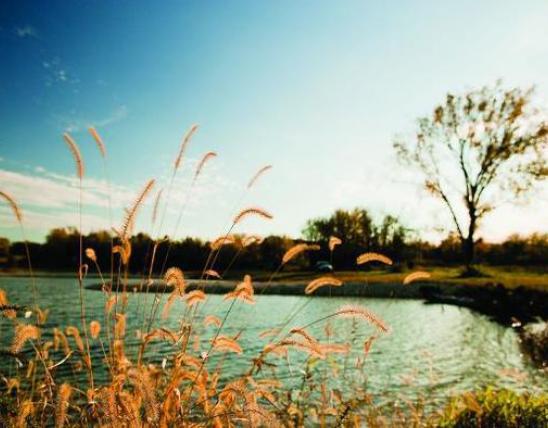
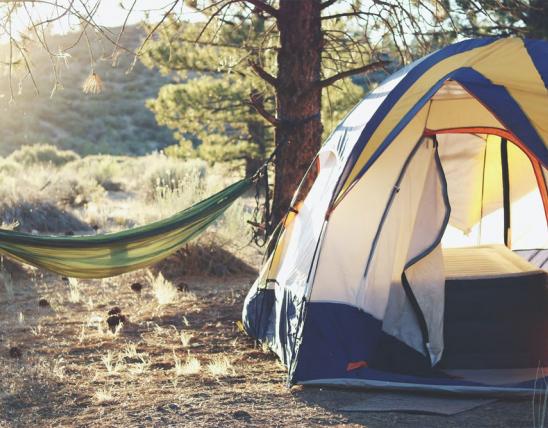





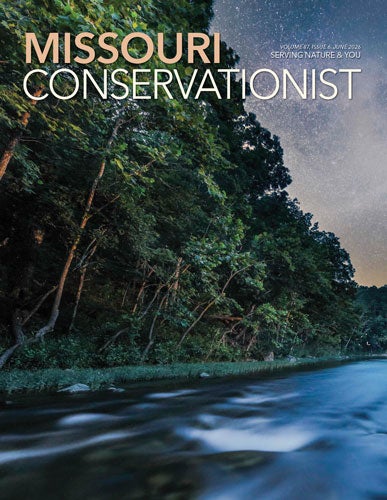

The campfire is dying. Dinner is over, and the dishes are washed. Tents are up, and the pads and bags are laid out. Leaning back in my chair, I look up. A towering wall of gray dolomite rises to my right, bathed in warm evening sunlight. Across the river, car-sized boulders, obviously fallen from the bluff above, rest in crystal-clear, deep-green water. Downstream of the gravel bar, a riffle gurgles a lilting melody — one that will eventually lull me to sleep.
But not right now. Instead, I relax in my chair, listening to a pair of bullfrogs squaring off in a jug-o-rum duel from opposite sides of the river. Occasionally a twanging green frog chimes in. Toads begin to trill. A ruckus suddenly arising from all around — from low, wet spots on the gravel bar and from the warm slough behind me. Dragonflies buzz over the river, darting at insects, their wings glinting in the sun. I’m watching all this and listening.
But I’m also waiting for darkness. This spot on the Jacks Fork River, far from the “light domes” of large cities, has great night sky viewing.
The largest tributary of the Current River, the Jacks Fork flows largely through steeply sloping, forested land, much of it in the Mark Twain National Forest. As part of the Ozark National Scenic Riverways, the valley of the Jacks Fork is protected from development and other intensive land uses. It is my favorite float stream. And tonight’s upcoming event — viewing the starry night sky here in the heart of the Ozarks — is one of the premier outdoor experiences to be had in Missouri.
The sun slips low over a forested ridge. Shadows deepen. Slanting sunlight brings sharp relief to crags on the bluff face. The tops of lofty oaks and hickories are still brightly lit, but under the canopy, in the forest’s dark interior, fireflies begin to flicker. A creeping purple tint gradually overtakes the dome of sky as twilight deepens and stars begin to pop out.
Get Out of the City
There is a marked contrast between the night sky on the Jacks Fork and what I can see from my backyard. In the city, even during the nearly moonless sky, just days before the new moon, only a few handfuls of stars are visible. On the Jacks Fork, thousands are visible.
The difference is artificial light. A dome of man-made light, called skyglow, forms over cities. These blobs of light, clearly visible from space, brightly delineate developed parts of the Earth’s nighttime face.
On the Jacks Fork, artificial light is minimal — coming only from our headlamps, with their subdued red lights, or a satellite or plane passing overhead, or the faint skyglow from Mountain View, a small city about 5 miles to the southwest.
Hello Darkness, My Old Friend
Artificial light at night doesn’t just obscure our view of the stars. Excessive light at night is harmful to many species of plants and animals, especially nocturnal animals, disrupting their feeding, mating, or migrating. Nighttime is important to almost all living things. People need darkness, too. It’s when we rest, recharging our batteries, and when our bodies manufacture chemicals that help with healing and reducing anxiety.
As darkness descends on the Jacks Fork, fireflies begin their erratic spotlighting, a quasi-psychedelic light show on solid blackness. Some move rapidly, skimming just over the river surface — twin reflecting streaks, like blinking fighter jets flying in tandem. Others move more slowly with weaker flashes. Fireflies are an example of nocturnal insects harmed by artificial light at night. Their flashing, meant to attract mates, can’t be seen by other fireflies in areas with too much light. As a result, these fascinating insects are disappearing from many urban yards.
In the distance, a barred owl hoots its plaintive who-cooks-for-you, soon answered by another owl farther downstream. Across the river a screech owl calls softly. What can’t be heard, or seen, are the birds that may be passing high overhead in migration. Most birds migrate at night, navigating by the light of the moon and stars. The Jacks Fork lies in the Mississippi Flyway, a wide swath of land where migrating birds funnel through. On the date of this trip — in June — the BirdCast website indicated about 25 million birds were still migrating, even though the peak of spring migration had passed.
Migrating birds continue to follow their ancestral flyways. Unfortunately, skyglow around big cities in the flyway, like St. Louis and Kansas City, disrupt migration patterns as birds become disoriented and confused, often flying in circles or detours, needlessly expending energy. Many of them crash into brightly lit buildings. An estimated 600 million birds die each year in collisions with buildings. That’s why Lights Out Heartland, a collaborative effort spearheaded by National Audubon Society and DarkSky Missouri, urges people to turn off lights in buildings during migration times.
Not All Darkness is the Same
After midnight, high over the campsite, the Miky Way stretches from horizon to horizon. This rim-to-rim spectacle is a sure sign of good dark sky viewing. Dark sky viewing is best in dry air at high elevations where the atmosphere is thinner. But along the Jacks Fork, even with high humidity, the viewing is still spectacular because the sky is so dark. The darkness of places is measured using the Bortle Scale, from one to nine, with one being the darkest. This site rates a little over two on the scale. There are few places in Missouri with a Bortle rating as low as this stretch of the Jacks Fork.
Tonight’s starry night sky is magnificent, although a bit surreal, with surroundings lit only by the pinprick lights from thousands of stars. The night sky is also inspirational — a poignant reminder that darkness is equally as important to us as day; that the health of people, as well as wildlife and plants, depend on this natural cycle of day and night, to which almost all life is tuned. We can more fully appreciate the pristine dark sky by visiting places like the Jacks Fork. But when we return home, we can also see more clearly how artificial light at night can diminish our outdoor experiences and negatively affect the wildlife we value.
Be a Light Saver
Luckily, many problems caused by artificial light at night are relatively easy to correct. DarkSky Missouri, an organization seeking to protect the night sky, offers five principles for responsible outdoor lighting. Following these principles will preserve the quality of the night sky without compromising safety or security.
The first principle is to make sure the lighting is truly needed, considering the impact it might have on neighbors and wildlife.
Second, lighting should be targeted, shining only where it is needed. Elevated lights should be shielded, shining only downward, not outward or upward into space where the light does no good and is merely a waste of energy. Lights pointing upward or outward can interfere with the migration of birds or disrupt the feeding activities of bats and moths.
Third, use the lowest level of lighting for the job. The human eye is remarkably adept at seeing in dim light. Overly bright lights are not helpful, causing glare and obstructing our view. Contrary to popular notions, brighter lights do not always make us safer.
The fourth principle is that lighting should be controlled, so that it is turned on only when needed. Timers or motion detectors, for example, are great options.
Lastly, warm-colored — or amber — lights are much better for wildlife than short-wavelength light of blue or violet colors. DarkSky International provides lots of information about “dark-sky compliant” lighting fixtures.
The magic of the dark night sky has left me awed and inspired, though sleep tugs at me. What a treasure we have in places like this, where we can see the night sky almost as our ancestors did — undiminished and unmarred. It is a gentle reminder that we should all be careful stewards of our natural world, making sure that our children and grandchildren will be able to enjoy the night sky as we did here on the banks of the Jacks Fork.


Also In This Issue

With longer days, nature reaches its crescendo

The not-so-underground hobby of native seed collecting
And More...
This Issue's Staff
Editor – Angie Daly Morfeld
Associate Editor – Larry Archer
Photography Editor – Ben Nickelson
Staff Writer – Kristie Hilgedick
Staff Writer – Joe Jerek
Staff Writer – Dianne Van Dien
Designer – Marci Porter
Designer – Kate Morrow
Photographer – Noppadol Paothong
Photographer – David Stonner
Circulation – Marcia Hale