












Skunks get a bad rap. Known for their pungent perfume, these cat-sized mammals are often smelled long before they are seen. But there is far more to skunks than meets the eye … or the nose.
Earning Their Stripes
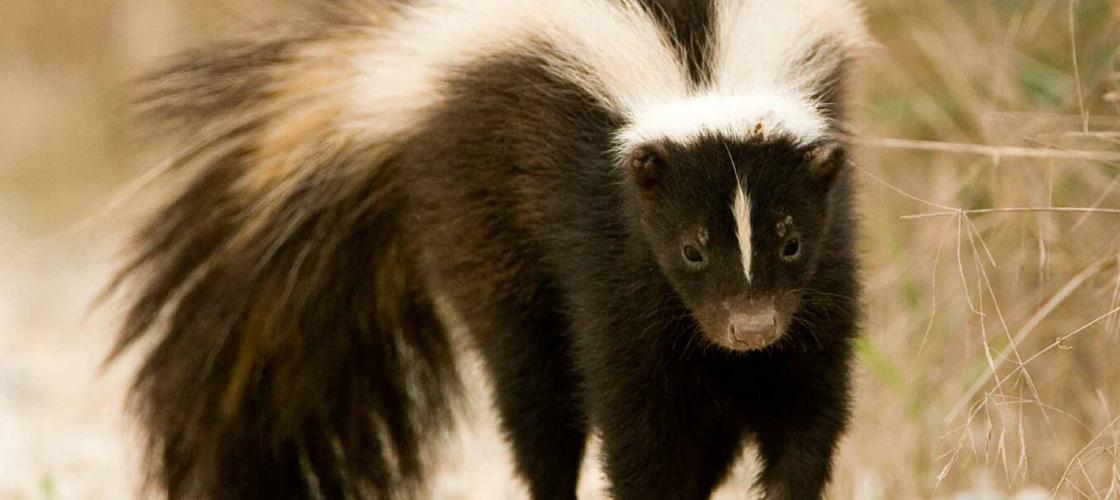
Young skunks are born nearly naked, but hints of the distinctive black and white markings they will possess as adults are already evident.
Their signature stripes, which usually run down their head and divide to become two stripes on each side of the body, are unique to each individual skunk. Some skunks have stripes that are almost nonexistent while others have stripes that cover the entire back.
“You could say skunks are just like us,” said Nate Bowersock, MDC’s black bear/furbearer biologist. “Just like we have our own characteristics and features that make us unique, so do skunks. And that uniqueness shows up in their markings.”
Striped skunks begin breeding in February, and litters, typically of four to six young, soon follow in May or June. As adults, they will grow up to 11½ pounds and reach 20–30 inches.
In late autumn as it gets colder, more time is spent in dens. When it’s near freezing, skunks become drowsy and sleep intermittently, but they do not truly hibernate.
Home Sweet Home
Striped skunks are found statewide in a variety of habitats. They prefer forest borders, brushy field corners, fencerows, and open grassy fields broken up by wooded ravines and rocky outcrops, where permanent water is nearby.
A skunk’s den is usually in the ground. But a skunk can make its home just about anywhere, including in a stump, refuse dump, cave, rock pile, crevice in a cliff, farm building, wood pile, or haystack.
A skunk might even make a home near your home.
“Skunks like to end up in some sort of structure and burrow,” Bowersock said. “So, underneath decks, porches, and sheds are perfect because with little excavation, suddenly they have a fairly solid burrow to hide or make a nest for their young.”
If you find a skunk taking up residence near your residence, Bowersock says don’t panic.
“It’s best to just leave them alone,” Bowersock said. “If you confront them, that’s when you could have issues. If you leave them alone, by summertime, they likely will leave, and you can cover up the space so they will not return.”
Nature’s Pest Control
Striped skunks forage most of the night and are omnivorous, eating both plants and animals.
In spring and summer, insects are their preferred food, so you might consider them nature’s pest control. They dine on some of the insects that bug us when we are trying to enjoy the outdoors. Some of their favorite menu items include bees, wasps, and larvae. They also enjoy hives and honey.
“They will break open logs and get into beehives,” Bowersock said. “So, on a simple level, they are almost like a miniature bear.”
Their pursuit of insects causes them to dig, which in turn breaks up woody debris and turns up the soil.
“They are helping break up materials so they can get at insects,” Bowersock said. “By digging, they are helping with soil cycles and plant growth.”
Skunks are also useful in the removal of mammals that can be considered a nuisance, including moles, shrews, mice, and rats. They also have an appetite for ground squirrels, young rabbits, and chipmunks.
Skunks are part of nature’s clean-up crew, as well. As scavengers, skunks feed on larger mammals as carrion, which in turn keeps the forests clean.
“They also eat fruits throughout the summer and fall, and that helps with seed distribution across the landscape,” Bowersock added.
To Spray or Not to Spray
Skunks have a not-so-secret weapon lurking in glands located in the base of their tail. When provoked, a very pungent spray is secreted through these glands. This is a very effective defense mechanism, as the spray can be aimed and sprayed at will.
However, spraying is not the skunk’s first go-to method of protection.
“It seems to be a running fear that you’re going to get sprayed by a skunk immediately, but that really is not true,” Bowersock said. “Skunks are very non-confrontational and really don’t want anything to do with people. In most cases, skunks will try to just run away.”
Prior to spraying, skunks usually warn intruders by stamping their feet and holding their tail high in the air. If intruders don’t take heed, the next step will be a smelly one.
So, the next time you see a skunk, take a minute to appreciate all it does for the ecosystem — at a respectable distance, of course.
Angie Daly Morfeld is the editor of the Missouri Conservationist. She had a dachshund, named Baxter, who seemed to love to tangle with skunks. He often came home doused in their musky scent. She misses Baxter, but not the skunky smell.
There are steps you can take to deter a skunk from frequenting your front door and other places near your home. Make sure items that attract skunks — like pet food, garbage, and animal feed — is unavailable to them. If you need assistance with a nuisance skunk, visit short.mdc.mo.gov/4Fn.H4
A Skunk of a Different Stripe
Missouri is also home to a lesser-known skunk — the plains spotted skunk. At one time, this species was distributed throughout the state, but today populations are scattered and rare. In fact, it is listed as endangered in Missouri and is considered a species of conservation concern.
“They’ve been up for the federal endangered species listing,” explained Nate Bowersock, MDC’s black bear/furbearer biologist. “But the thing that’s slowing or limiting that is the fact that we just don’t know much about them. It’s something a lot of us furbearer biologists are trying to learn more about.”
The spotted skunk is smaller than its striped cousin. Its overall color is black with white stripes and spots. There is a white spot on the forehead and in front of each ear. Four white stripes along the neck, back, and sides extend from the head to about the middle of the body. Behind these, more white stripes and spots occur. The tail is usually all black, sometimes with a white tip.
Spotted skunks mate in late winter, and young are born from April to July. Like striped skunks, spotted skunks are also born nearly naked but possess the beginnings of the adult’s characteristic black and white markings.
Their habitat is similar to that of their striped cousins, but spotted skunks require extensive cover between their foraging areas and their dens. In the Ozark Highlands, they are found more commonly in woodland habitats with leaf litter and downed logs.
Some believe their decline is potentially due to farming practices that eliminated the brushy cover this species prefers.
“When we had a lot of smaller farms across the state, the fields provided a good source of food for these skunks, including small mammals and insects, and natural fencerow cover,” Bowersock said. “But when we started switching to larger farms, a lot of that cover disappeared.”
These two species of skunks definitely dine at the same places. Also considered omnivores, spotted skunks eat both plant and animals. Like striped skunks, they are considered an asset for both rodent and insect control. They also do their part to clean up the outdoors by feeding on carrion.
Their defense mechanism is also a noxious spray, but like striped skunks, it is not their go-to, as it takes time to replenish that fuel. Instead, they will try to buy time to get away by stamping their feet or doing a handstand, with their hind feet and tail in the air.


Also In This Issue

Improving property for nature and owners in priority geographies

Mysterious and Magnificent Birds of Legend and Myth
And More...
This Issue's Staff
Editor – Angie Daly Morfeld
Associate Editor – Larry Archer
Photography Editor – Ben Nickelson
Staff Writer – Kristie Hilgedick
Staff Writer – Joe Jerek
Staff Writer – Dianne Van Dien
Designer – Marci Porter
Designer – Kate Morrow
Photographer – Noppadol Paothong
Photographer – David Stonner
Circulation – Marcia Hale